Keeping medieval Aberdeen’s streets clean and safe

by Edda Frankot

The medieval magistrates of Aberdeen, like their modern counterparts, were concerned with the accessibility and cleanliness of its roads, with building regulations and with potentially hazardous sites. Unlike the modern city council, however, the medieval government only had a small amount of staff working for it permanently or on an annual basis, such as clerks, sergeants and a bellman. For other tasks adhoc committees or officials were appointed. But there may also have been others doing duties which remain largely invisible in the sources as they have survived, because these duties were not directly relevant to the court, unlike those mentioned above. The only aspects worthy of noting were their appointment and any financial arrangements.

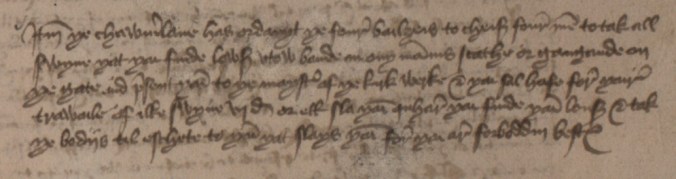
In 1479, for example, the alderman, council and community hired Alexander Coutts to mend the causeways and gutters of the town and to keep all the streets clean so that ‘al men may haf honest and clene passage throuch al the toune’. He would be paid by the people of Aberdeen as follows: all owners of houses with a fireplace (‘fyre house’) would pay him a penny. All other ‘outburgesses’, ‘inburgesses’ (that is to say burgesses living outwith and within the bounds of the town respectively) and ‘indwellers’ (non-burgesses) who had a chamber or a house would also pay a penny, half of them at Martinmass (11 November), the other half at Whitsunday.1

GB0230CA000100001-00006-00599-

GB0230CA000100001-00006-00600-2

ACR, 6, pp. 599-600.

An adhoc committee of 9 or 10 ‘of the best of the town’ was to be appointed by the alderman and baillies in 1449 to go round the streets with the ‘gangand assize’2 to investigate any ‘purprisioun’ or purpresture, that is to say the ‘illegal enclosure or encroachment upon the land or property of another’, often on public or common land.3 Wherever there was any such encroachment, they were to make note of it and charge whoever was responsible to rectify the problem within forty days.4 This exercise resembles a perambulation. The fact that any failure to comply takes place under ‘pain of purprisioune of the king’ also suggests that public property is the focus of the action, which was also the case in perambulations. Different from other known perambulations is the absence of the rest of the population when doing the ambulating and the route followed. This seems to have been a check of encroachments along the streets of Aberdeen’s inner city, rather than along the inner or outer march stones, which were further out.

GB0230CA000100001-00005-00001-00034-

ACR, 5-1, p. 34.

The assize was also to check whether houses were safe. If any were found to be ‘unsufficient’, the owners would be allowed only eight days to repair them. Otherwise the baillies would come and take down the doors and windows and make the place uninhabitable.5 In the case of houses in disrepair, the town magistrates thus took a rather abrupt approach. This may have done wonders in getting those buildings repaired quickly by owners who could afford to get workmen out to do the job. But it would be a disastrous policy for landlords (and/or anyone living in their houses) who could not act so swiftly for whatever reason. There is no further evidence whether such people could receive a deferral if requested.

These three entries show that the town magistrates cared about the cleanliness and safety of Aberdeen’s streets and buildings and organised the maintenance and oversight of it, though based on these three entries it is difficult to say how regular this was. The town government was also concerned about any encroachments on public property and so they organised checks of this. This is a fact already well known from the history of the perambulations, or ‘riding of the marches’, though most of the information we have about this is post-medieval.6 As such, these entries form a useful addition to our knowledge of local government in the later Middle Ages.


  1. ACR, 6, p. 599-600 (13 Sep 1479). 
  2. It is not entirely clear what the gangand assize is. It would make sense if the nine or ten men chosen would make up this assize, but the way it is phrased these men are to go with the assize. 
  3. ‘Purprestur(e n.’, Dictionary of the Scots Language (2004) Scottish Language Dictionaries Ltd. Accessed 2 Mar 2018 <http://www.dsl.ac.uk/entry/dost/purpresture
  4. ACR, 5-1, p. 34 (c. 15 Feb 1449). 
  5. Ibid. 
  6. See for example: The Freedom Lands and Marches of Aberdeen, 1319-1929 (Aberdeen 1929). This includes a map of the inner and outer marches perambulation routes. A recent sample check of the registers from the 1630s-60s has shown that the list of ‘References in Council Registers to Perambulations of the Marches’ (Appendix V, p. 35) is not in any way complete. 

Transcription volumes 1-7 completed!

by Edda Frankot

An important project milestone was reached last month when the last words of volumes 1-7 were transcribed on the afternoon of 18 January. The transcription of the first seven volumes, up to the year 1501, is now complete. Over the past eighteen months or so, the project’s two research assistants, Claire Hawes and William Hepburn, with a small amount of assistance of yours truly, have transcribed 4027 pages – no mean feat!

This does not mean, of course, that the project as a whole is now finished. The checking of the transcription and annotations is still in full flow. Once that is completed a final phase of getting the corpus ready to go online will commence. In the meantime, thanks to generous additional support from Aberdeen City Council to enhance the project, Claire and William have begun the transcription of volume 8. This volume will at least partly be transcribed traditionally, but there are also ongoing investigations into the possibility of having this book machine-transcribed for us by a project called READ. Watch this space for updates on that! Overall our final corpus will in part contain a level of annotation enhanced beyond our original specification.

Now that the transcription of volumes 1-7 is complete, it has been possible to do a word count. This count confirms our suspicions that volume 6 includes a relatively large amount of material, but also brings up some other fascinating facts. The total count as it stands now (this number will most likely change slightly during the final stages of the checking process) is 1,391,217 words. To put this in perspective: Shakespeare’s complete works total 884,421 words. A significant chunk of our nearly 1.4 million corpus (so far) is taken up by volume 6: 539,254 words (39%). By contrast, volume 7, which has 137 pages more than volume 6, contains ‘only’ 332,392 words (24%). On average, then, there are about 547 words on every page of volume 6, but only 296 on those of volume 7. The average across all volumes is about 300 words per page. The scribe of a large part of volume 6 used more of the pages (he only left one of the margins blank, rather than both), he placed his text lines closer together and appears to have written in a smaller hand. The volume with the lowest amount of words per page is volume 2, at only 189. This results from many blank spaces left between court entries, and blank pages.

Above: An illustration of different page word densities and lay-outs: ACR, 6, p. 752 (left) and ACR, 7, p. 508 (right).

LACR Corpus Word Count

It has also been possible to differentiate between words in Latin and in Scots (and those from entries in ‘multiple languages’, that is to say entries with a lot of switches between Latin and Scots, which typically occurs in lists of names). Overall 58% of the corpus is in Latin, 41.1% is in Scots and 0.9% in multiple languages. Two entries are in Dutch. In volumes 1 and 2 (1398-1414) only slightly more than 1% of the words are in Scots. In volume 4 (1433-1447) this rises to nearly 9%. By volume 6 (1468-1486) the division between the two languages is almost exactly 50-50, whereas in volume 7 (1487-1501) more than 68% is in Scots. Much more detailed research into this phenomenon is of course undertaken by our former text enrichment research fellow, Anna Havinga. Anna not only distinguishes between words and entries in Scots and Latin, but she also analyses the development of the language shift by year. But even the very coarse overview given here already throws up some fascinating first indications which future research will hopefully be able to elaborate upon.

The best helmsmen stand ashore?*

(* Literal translation of the Dutch expression ‘De beste stuurlui staan aan wal’, which is used to indicate that it is easy to criticise someone doing a job when one is watching from the sidelines.)

by Edda Frankot

ACR, 5, p. 542 (1465)

5-1 p542

On the thirteenth of March 1465 three merchants appeared before one of the baillies sitting in the tolbooth. They showed an indenture made between merchants of Aberdeen and Johannes Wolffyne, the master of a bus (a type of cargo or fishing vessel) called the Johannes. This indenture, a charter written in duplicate on the same sheet which was usually separated by cutting along a jagged line, concerned a sea journey. The three men who had appeared in court asked that a specific section of the contract be recorded in the burgh’s ‘common book’ by the court clerk and notary public. This request and the entry as a whole are interesting on a number of levels.

First of all it is interesting linguistically: the entry itself is in Latin, but the quoted words from the contract are in Scots. I would have expected the shipping contract, between Aberdeen merchants and what appears to be a foreign skipper on the basis of his unusual last name, also to have been in Latin. Some examples of similar documents which are recorded in the oldest Sasine Register (see the earlier post about this book) are in Latin. Of course, it is possible that the words were translated specifically for this recording, for the benefit of the merchants perhaps, but that does not make it any less interesting.

Secondly, the entry is informative from a maritime historical and legal perspective: the words specify that the skipper should employ a ‘gud sufficiande sterman’, that is to say a helmsman or pilot, to navigate the coasts of Scotland, England, Flanders, Holland and Zeeland. Apparently the skipper was known not to have these skills himself, which suggests that he was either inexperienced on the whole or on this particular route, or that he had a certain reputation for bad steermanship. The fifteenth century is a time when duties aboard ships became increasingly more specialised, with the skipper evolving into a captain, commanding officers like helmsmen below him rather than navigating the ship himself. But the fact that these words were included specifically, and repeated in the register, does indicate a situation that was not entirely normal. The two shipping contracts that are recorded in the oldest Sasine Register do not include a similar stipulation. They do, however, require sufficient sailors, cables, anchors, fire and water, among other things, to be taken on board.1

Finally, the entry is interesting within the context of the development of written records. Despite the existence of a contract in duplicate, the three men thought it necessary to show the document before the court and to have some of its words recorded separately in the burgh’s register. This was most likely done as an extra precaution, should both copies be lost and any problems occur on the journey. Again, this suggests that the merchants were not entirely confident of the shipmaster. In the later fifteenth century, this entry would most likely have ended up in the so-called Sasine Register, which appears to have been a type of protocol book, but a similar book was most likely not yet in existence in the 1460s. Notaries public at this time were often also active as burgh clerks, as evidenced by this entry. As a result, the registers often include a mix of actual court cases and matters of voluntary justice, that is to say matters for which we would today use a notary, like this one.

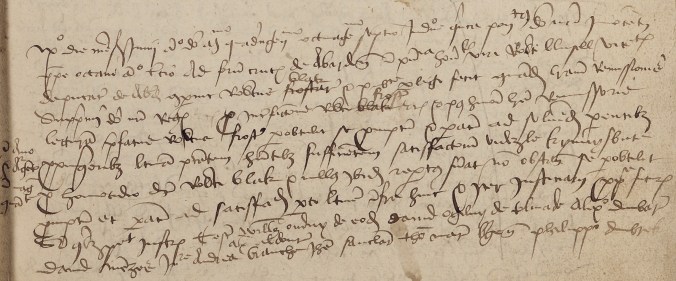
Unfortunately, we do not know whether any problems occurred during the journey to the Low Countries. Johannes Wolffyne does appear elsewhere in the registers, but this is just two days after this entry, when he and his sailors were charged with ‘perturbatio’ (disturbance) against William Menzies and his ‘accomplices’. It appears that the two groups of men had gotten into a fight, as Menzies and his associates were similarly charged. On the 18th of March, all the men were back in court and this time they were all listed (see images below). They were made, by the alderman and council, to ask each other for forgiveness and to take each other by the hand and forgive each other on pain of a fine.2 If Wolffyne did come back to Aberdeen after this, his following visits will have been less eventful as he leaves no further trace in the records here.

Transcription ARO-05-0542-04:

xiijo die mensis Marcij anno Domini et cetera lxiiijto coram Thoma de Camera uno ballivorum huius burgi protribunale sedente in pretorio eiusdem Dauid filius Mathei Willelmus de Kantle et Alexander de Marr’ comparuerunt et demonstraverunt quandam indenturam factam inter mercatores huius burgi et Johannem Wolffyne magistrum cuiusdam busche vulgaliter nuncupate Johannes penes naulacionem dicte navis sue et in eadem indentura fuit expressatum hec verba sequentia and that the saide maystir sal finde in his schip a gud sufficiande sterman for the costis of Scotlande Inglande Flandris Holande and Selande / et hec verba dicti Dauid Wilelmus et Alexander pecierunt scribi in libro communi per me clericum curie et notarium publicum


  1. ACAA, Sasine Register, vol. 1, p. 144 (15 Oct 1489), p. 170 (10 Feb 1489). 
  2. ACR, 5, p. 535 (15 March 1465), p. 536 (18 Mar 1465). 

Aberdeen Burgh Court Roll – Happy 700th ‘Birthday’

Regular readers of this blog will know that the focus of the Law in the Aberdeen Council Registers project are the eight registers that span the period 1398-1511. Yet the earliest record of council business anywhere in Scotland also resides at the Aberdeen City & Aberdeenshire Archives and is known as the Burgh Court Roll. Predating the first surviving Register by some 81 years, it dates from 1317.

ACC-6726PP

17/11/17 City Archivist , Phil Astley (blue shirt) with Lord Provost Barney Crockett and Dr Jackson Armstrong. Courtesy of Aberdeen City Council.

Being great lovers of birthday cake, the project team couldn’t let the roll’s 700th anniversary go by without a suitable celebration for this nationally important document, so on Monday 20th November a public talk was held in the Town and County Hall at the Town House in Aberdeen, with City Archivist, Phil Astley introducing fellow project members Dr Jackson Armstrong who provided an overview of the project and Dr Andrew Simpson who spoke about the context and content of the roll itself.

The Burgh Court Roll is a rather unusual looking item, markedly different to the volumes that we are working on. At around 160cm long and 20cm wide, it comprises five panels of parchment that were stitched together when it was created, including a brieve, a letter issued in the name of Robert the Bruce, which has been sewn to the main roll about half way along its length.

At some point in the nineteenth century, a small tube had been fashioned to accommodate the roll and, apart from those occasions when it was removed from the tube to be consulted, it was kept within the tube until 2006. At that time it underwent significant conservation work to repair a number of holes that had appeared over time and to “relax” and flatten it. We know that in the later sixteenth century there were more of these rolls in existence….”evil to be read”. Why has this particular one survived? The town clerk in 1591, one Mr Thomas Molisone, undertook an inventory of the burgh records and found various old books, leaves, and scrolls in a poor state of decay. He appears to have preserved only the surviving Burgh Court Roll as an exemplar from before the time of the first ‘buik’ dating from 1398.

The 1317 Burgh Court Roll covers a number of cases that came before the burgh’s head and bailie courts between August and October of that year. It has recently been translated from Latin to modern English by Andrew Simpson and Jackson Armstrong.

At the November 20th event, Andrew Simpson concentrated on one of these cases, presenting the narrative through the eyes of a seventeen-year-old Aberdonian woman who features in the first case. The dispute was heard between 1316 and 1317, and the young woman’s name was Ada.

While Ada had been brought up from infancy in Aberdeen, having been born at Martinmas in the year 1299, at some point her family had left the burgh to live in “another part of the kingdom”. But now, following the death of a close relative, Ada returned to her native town, in order to assert her rights of inheritance in a toft (i.e. a piece of land) and a tenement (i.e. a building) in the Gallowgate.

The trouble was that that land was currently held by an influential man, William of Lindsay, Rector of Ayr who had formerly served Robert the Bruce as Chamberlain of Scotland. The Chamberlain was responsible for overseeing the administration of law and order in the burghs, and the collection of customs and taxes due from the burghs to the king. So Ada’s adversary was not only powerful, but also, presumably, well-versed in the laws of the burghs. The case is a complex and fascinating one, shedding light not only on the legal procedures of the time and where these took place, but on how the fall-out from the Wars of Independence had an impact on the lives of individuals living or connected with Aberdeen. William of Lindsay had a claim to the property because he had been granted it by King Robert. But Ada’s claim was through an ancestor who had taken a loan from one Roginald of Buchan, for which they property had been given in security. Roginald had been forfeited by King Robert for his support for the Comyns against the king. King Robert had then granted the property to William of Lindsay. Later, following the victory at Bannockburn, Roginald had sought to return to the king’s peace. A problem thus arose when the king restored to Roginald all his former lands and possessions, including the property in the Gallowgate.

As Dr Simpson showed, ultimately, Ada secured a payment from William of Lindsay in return for transferring the lands to him. Ada declared her wish to do so at three head courts of the burgh. This procedure publicised her intentions, giving her kin ample opportunity to come forward to redeem the lands.

The court held by the bailies then convened in the open air at the site of the property and there Ada gave sasine (formal conveyance of the land) to William by the symbolic measure of presenting him with “hasp and staple” – a “staple” being a metal loop that held in place a “hasp” or catch on which, for example, a door might hang. The bailie received a denarius de uttoll from Ada, and from William a denarius de intoll. The denarius – penny – of intoll was a payment given to the bailie when someone was put into burgh land. Likewise, the penny of uttoll was paid on quitting burgh land.

The story of the seventeen-year-old Ada and her successful attempt to assert her hereditary rights in the Gallowgate somehow captures the imagination. That the Burgh Court Roll can reveal such fascinating glimpses into life in Scotland’s deep past is reason alone to celebrate its 700th year.

See also: https://news.aberdeencity.gov.uk/free-talk-to-mark-700th-birthday-of-nationally-significant-burgh-court-roll/

Written by Phil Astley, with Jackson Armstrong and Andrew Simpson.

LACR at the Scottish Records Association conference 2017

SRA 2

On 10 November 2017 members of the project team presented at the Scottish Records Association conference, held at the National Records of Scotland, New Register House, Edinburgh.

The theme of this year’s conference was ‘Putting on the Writs: Scottish Court and Legal Records’.

The day included four sessions, on Civil and Ecclesiastical Courts, Sheriff and Franchise courts, and a plenary. The third session of the day was on the topic of ‘Burgh Records’, and consisted of two papers:  

Dr Jackson Armstrong and Dr William Hepburn jointly presented an overview of the project ‘Law in the Aberdeen Council Registers (LACR)’.

Dr Edda Frankot presented a paper on ‘The Records of the Medieval Burgh Courts of Aberdeen’.

Further information can be found at the SRA website:

http://www.scottishrecordsassociation.org/conference


Burgh records, literature and language: a report on The International Conference on Medieval and Renaissance Scottish Language and Literature (ICMRSLL), Glasgow, July 2017

By William Hepburn

ICMRSLL 2017 cropped

The ICMRSLL is a long-running conference focussed on Scottish culture in the medieval and early modern period. The centre piece of this iteration, to which delegates repeatedly turned in their discussions, was a plenary debate between Professor Sally Mapstone, representing literary scholarship, and professor Roger Mason, representing historians. Their discussion emphasised that in the scholarship on this period the boundary between their disciplines was blurred. This was underlined by the diversity of the papers given at the conference. Some were particularly relevant to the themes of the LACR project.

For example, in a panel focussing on Dunfermline, Klaus Hoffman and Emily Wingfield came from separate disciplinary directions but together offered a rounded portrait of the Fife burgh’s literate culture. Hoffman, with a background in linguistics and experience working with the town records of Austria and Scotland, offered a paper on the town clerks and scribes of Dunfermline from 1573-1723. His findings were based on a sample of their work extending to 55,000 words. Hoffman was able to identify the hands of town clerks through records of their election, as well as what seem to the hands of their assistants – a role trainee notaries public might occupy as part of their seven years of training. He said these clerks could be understood as a ‘community of practice’ – a network of writers engaged in a joint enterprise and using a shared repertoire. The dates of Hoffman’s study covered the period in which the Scots language became anglicised, and Hoffman’s study revealed Dunfermline to be about 25 years behind central records in terms of anglicisation, which he attributed to the close ties between the local network of Dunfermline clerks. Emily Wingfield’s paper looked at the literary culture of Dunfermline from which the writings of Robert Henryson – thought to have been a notary public – emerged. She argued that there was an extensive literary network centred on Dunfermline, highlighting evidence such as the Miraculae of St Margaret of Scotland, written in Dunfermline in the mid-thirteenth century and surviving in a copy produced in Dunfermline in the reign of James III; the furnishing of Dunfermline Abbey with books by the abbot Richard Bothwell in the mid-fifteenth century; and the connection of the Liber Pluscardensis to a network of notaries.

In another panel looking at Scottish burghs more broadly, Elizabeth Ewan and Rob Falconer offered, respectively, observations on flyting and restorative justice. Ewan said that records of insults in burgh records offer virtually the only evidence of the ordinary speech of ordinary Scots and that in many cases they give us women’s voices. As well as discussing the themes of insults thrown on the streets – such as disease, dishonesty and physical appearance – Ewan explored the relationship between the flyting of the streets and the flying of the literary world, arguing that the former must have influenced the latter, that street flyting could have drawn on literary flyting and that it took formalised and performative qualities. Rob Falconer’s paper argued that criminality was a fundamental part of social relations in burghs. With the metaphor of the body politic in common use, behaviour that damaged this body could be framed as disease or contagion. In this worldview, moral lapses were dangerous if left untreated. Treatment involved ‘curing’ or ‘purging’ the offender. This often took the form of restorative justice, which was about repairing the harm done by the crime and not just punishing the offender. Once this had been done the offender could be accepted back into society, but if the ‘contagion’ represented by such an individual was too severe it had to be purged through, for example, banishment.

My paper was entitled ‘The Common Book: Burgh Registers and Documentary Culture in Fifteenth-Century Aberdeen’. As elsewhere in Scotland, there was a pronounced materiality to the rituals that governed life in medieval Aberdeen, from the transfer of tokens of land ownership to the public shaming of transgressors such as those who had to present the knife with which they had committed an assault to their victims. This materiality was enhanced by the creation of records – objects which preserved the memory of other objects. It made particular sense in towns, where there was usually close proximity between people and property, the sites where business concerning them was transacted and the places where the written records of them were stored. A burgh archive which gathered together many records such could function as a symbol of the burgh community whatever the format in which it preserved documents, but by shrinking thousands of enactments of this relationship into a portable, easily-searchable artefact, it had particular power. The materiality of these artefacts – burgh registers, often called common books by contemporaries – may have increased the value placed in writing itself. Even those who could not read or write could have seen their power as symbols of the burgh community. Perspectives may have been shifted simply by the awareness that the burgh government had the memory of the town stored in physical form, in much the same the way as Brian Stock outlined when he argued that texts did not have to be present for people to think or behave as if they were. 1

My paper pointed towards administrative practices in burghs as one factor contributing towards the increasing use of the written word in late medieval Scotland. The other papers I have highlighted also pointed towards the significance of burghs and their records to Scottish language and literature as, for instance, centres of literary networks or inspiration for poetic flytings. The work of the Law in the Aberdeen Council Registers project will help to make the richest source from burghs in this period more accessible to scholars, offering the potential for new insights on the language and literature of late medieval Scotland amongst many other subjects.


  1. See for instance Brian Stock, The Implications of Literacy: Written Language and Models of Interpretation in the Eleventh and Twelfth Centuries (Princeton: Princeton University Press, 1983). Thanks to Anne Rutten of the University of St Andrews, who presented on the consolidation of Stewart power through texts in the reigns of Robert II and III on the same panel as me at the ICMRSLL in Glasgow, for first directing me to the work of Stock. 

An encounter with the Dubrovnik council registers

by Edda Frankot

The Aberdeen Council Registers are unique survivals within a Scottish context: Aberdeen is the only burgh for which a nearly complete set of such books for the fifteenth century is extant. But within a European context Aberdeen is far from unique: many town archives in Europe have collections of medieval records, some of them much larger and stretching back into the fourteenth or even the thirteenth century. They provide important potential comparative material for the Aberdeen registers. In the context of my PhD research and focussing specifically on cases of maritime law, I had already looked at very similar material from the towns of Kampen (Netherlands), Lübeck (Germany), Danzig/Gdańsk (Poland) and Reval/Tallinn (Estonia). Very recently, I had the privilege to be introduced to another set of urban registers: the Reformationes and the Acta Consiliorum of Dubrovnik in Croatia.

IMG_20170922_121515845

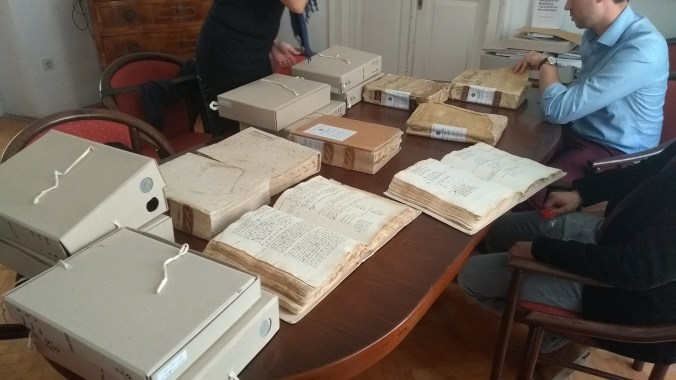
Some of the Reformationes and Acta Consiliorum from Dubrovnik.

I was in Dubrovnik from 20 to 22 September to attend the ‘Mapping Urban Changes’ conference in the context of a proof-of-concept project which I am co-leading with Dr Adelyn Wilson from the School of Law called ‘Spaces of Power in Interregnum Aberdeen’. This sister project of LACR is funded by RIISS under a research development grant. It seeks to visualise the use of the physical space within the burghs of Old and New Aberdeen for the exercise of political, religious, mercantile and administrative power. In addition to presenting this project, I was at the conference to learn about relevant other projects and useful techniques and methodologies. In this respect the conference was very fruitful.

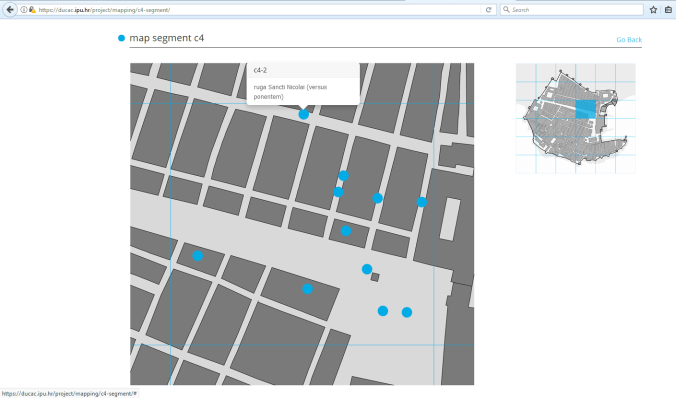
Visiting Dubrovnik also provided the opportunity to learn more about the Du:cac project, which has just been completed. This project, led by Dr Ana Plosnić Ŝkarić of Zagreb University, aimed to transcribe all relevant entries or deliberations from the period 1400-1450 concerning the spaces and buildings within the walls of Dubrovnik and link these to a searchable map. The Du:cac website includes a custom-made map with clickable points, indicating actual buildings, spaces near them (in those cases where a house is said to be near a church, for example), streets and neighbourhoods. These link to relevant transcriptions. The transcriptions will also be published as an e-book.

Dubrovnik map screenshot

A screenshot from the Du:cac website, showing a map segment with clickable points.

The government of Dubrovnik was made up somewhat differently to that of Aberdeen. The city had three councils: the Major Council, the Minor and the Senate. Up until 1415 the deliberations of all three councils were kept in the same book, called Reformationes (these were begun in the late thirteenth century). From 1415, they were divided up into three registers. From the years between 1400 and 1450 there survive three volumes of Reformationes, nine volumes of Acta Consilii Maioris, twelve volumes of Acta Minoris Consilii and eleven volumes of Acta Consilii Rogatorum, comprising a total of 15,944 pages (the Aberdeen Council Registers from 1398-1511 comprise 5239 pages). The volumes are almost completely in Latin, with occasional words in Croat and some entries in Italian, which was used as a lingua franca in the Adriatic region, as Ana Plosnić explained to me. Latin was used in these registers until the end of the Dubrovnik republic in the late eighteenth century.

IMG_20170921_124114721

The Sponza Palace

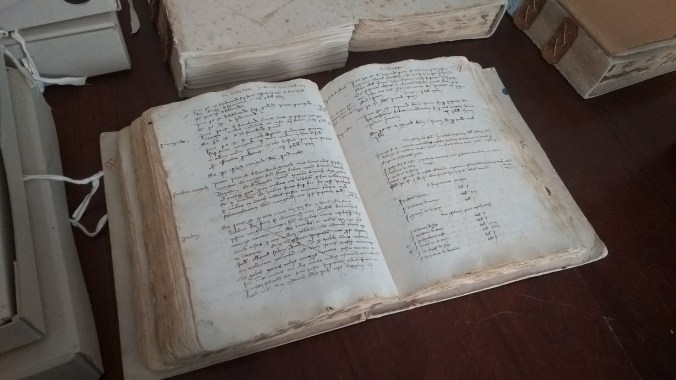
Just before I had to catch a plane back to Aberdeen via Paris and had to leave the beautiful city (and weather) behind, there was an opportunity to visit the archives which are in the Sponza Palace, one of the few buildings which survived the 1667 earthquake in Dubrovnik unscathed. There, Ana Plosnić kindly showed me some of the fourteenth- and fifteenth-century registers. The page layout of these look very similar to those of the Aberdeen books: with marginal headings and clearly recognizable entries. The Acta Consiliorum also include deliberations on elections, which provide interesting comparative material for the entries recently uncovered in Newburgh’s registers by LACR’s William Hepburn (see the post on his visiting scholarship at St Andrews University Library Special Collections). In Dubrovnik votes could be cast not only in favour of candidates, but also against them, and relatives were excluded from voting for a specific person (indicated as ex. or extra).

IMG_20170922_121503583

All in all, this encounter with the Dubrovnik material once again stresses the importance of considering the Aberdeen registers in a European context.

Special section published in Urban History: “Communities, courts and Scottish towns”

This month sees the publication in Urban History (Volume 44 – Issue 3 August 2017) of a special section entitled ‘Communities, courts and Scottish towns’. Co-edited by Andrew Mackillop and Jackson W. Armstrong, it features the following articles:

Jackson W. Armstrong and Andrew Mackillop, ‘Introduction: communities, courts and Scottish towns’. The section editors set the stage for three essays which examine changing features of pre-modern political society between the fifteenth century and the early nineteenth century, and the construction and sometimes contested use of vocabularies of law and authority, privileges and liberties, and ideas of urban ‘community’.

Claire Hawes, ‘The urban community in fifteenth-century Scotland: language, law and political practice’. This article seeks to provoke discussion of the political culture of Scotland’s late medieval towns through an analysis of communitarian language and its use by urban elites. Hawes argues that the Scottish urban community, as elsewhere, could be positioned as a location, a legal construct and a group of people. This provided the burgh council with a variety of political tools which could be employed – consciously or otherwise – in order to legitimize its authority.

Bob Harris, ‘Scots burghs, ‘privilege’ and the Court of Session in the eighteenth century’. This piece explores the propensity of Scottish burghs to resort to legal redress in Scotland’s leading civil court. Harris traces what this can tell us both about urban identity and the constitution of urban community in this period, and he opens up an examination of the role which the law may have played in the re-constitution and re-shaping of urban community.

Andrew Mackillop, ‘Riots and reform: burgh authority, the languages of civic reform and the Aberdeen riot of 1785′. This article explores the understudied riots which occurred in Aberdeen in mid-October 1785. Mackillop charts the climate of politicization that characterized the burgh’s civic life in the immediate aftermath of the American Revolution and before the outbreak of the equivalent process in France.

The special section arises as part of the wider Aberdeen Burgh Records Project in RIISS (https://www.abdn.ac.uk/riiss/about/aberdeen-burgh-records-project-97.php), and we are delighted to see these articles feature in Urban History.

The articles and further information may be found at: https://www.cambridge.org/core/journals/urban-history

Manslaughter in 1480s Aberdeen: notes from another fifteenth-century register

by Edda Frankot

The Aberdeen Council Registers are not the only extant registers from fifteenth-century Aberdeen. Another large volume known as the Sasine Register no. 1 has survived since the late fifteenth century, covering the period from June 1484 to January 1502 and totalling just over a 1000 pages.

Its title, Sasine Register, referring to legal procedures whereby a person received formal possession of lands or property, had many years ago put me off using (or even looking at) the book for my PhD on the practice of maritime law. A recent introduction to the manuscript in the context of another project highlighted what a mistake this was: the register is much more a miscellaneous legal register. The title is a later addition. The fact that few other scholars have used the manuscript (and its companions from the early sixteenth century) suggests that I am not the only one who was put off by its title. Though perhaps the manuscript’s unappealing handwriting and the fact that it is almost wholly in Latin do not help either.

Be that as it may, it turned out that the book contains many entries concerning property, but also rather a lot of other very interesting material. A more thorough analysis is still required, but it may be that in June 1484 the town clerks decided to record some of the town’s court business in a separate register. For example, the ‘sasine register’ includes certain matters which were dealt with by only one or two officials and these no longer appear in the council registers. What is most noticeable when leafing through the ‘sasine register’ is its language. Whereas increasingly more Scots was used in the council registers in the second half of the fifteenth century, very few entries in Scots can be found in this book. It is possible that we will see a sharp drop in the use of Latin in the council registers around June 1484 because some of the business recorded in Latin was transferred to this other register. So far we have completed transcription of volumes 5 and 7 (and there appears to be a marked difference in the use of Latin between the two, as concluded by the LACR project’s own Anna Havinga) but have not yet reached 1484 in volume 6. It may also be that there was an increase in business in both Latin and Scots in the mid 1480s. Though we have yet to research this in detail, it is likely that Latin was used more for cases in which formulaic language could be used, that is to say anything that followed a standard format that had been used for years. Examples of this are sasines, the recovery of burghal tenements, inheritance cases (inquisitions post mortem), admissions of burgesses, nominations of procurators etc. This is not to say that all such cases would have been moved to the ‘sasine register’, as some needed to be conducted at specific courts. The recovery of burghal tenements, for example, had to be conducted at four head courts and would be recorded in the council registers. But certain business that could be administered quickly by a smaller number of officials may well have ended up in the other book.

In addition to such cases, there are copies of shipping contracts between skippers and merchants and many other notarial acts, but also fragments of poems and a recipe for a medicine for ‘stanes’ (gall or kidney stones). There are also, quite unexpectedly, entries from the sheriff court. These sheriff court entries will be among the oldest extant in Scotland. Of course, Aberdeenshire can already boast the oldest extant sheriff court book in Scotland (1503-1511)1, but even William Croft Dickinson, possibly the most knowledgeable on Aberdeen and its courts and the editor of the Fife Sheriff Court Book appears to have been unaware of the existence of fifteenth-century sheriff court cases from Aberdeen.

SR p. 37

The interrogation of Andrew Murray senior

The oldest sheriff court entry in the ‘sasine register’ concerns the interrogation of Andrew Murray senior by John Cheyne before Alexander Irvyne, sheriff depute of Aberdeen, as part of the examination into the spoiling of grass or turf in the parish of Ellon.2 Later entries indicate that more serious crimes were also investigated and tried before the Aberdeen sheriff court, as was to be expected. On the 10th of January 1486 Alexander Irvyne was in court to prosecute the killer of Andrew Kelor, but no one compeared (appeared).3 Proceedings on 9 June 1487 were more successful when the killer was known, though the entry confuses killer and killed as both were called Robert. In this case Robert Blindsele was sitting as deputy sheriff.4 Robert Black appeared in court with a letter of remission (forgiveness of wrongdoing) from the king concerning his killing of Robert Frostar and declared himself prepared to pay Frostar’s parents or nearest heirs compensation for his death, which no one objected to.5

SR p. 79

The case of the two Roberts

Though it appears that some of the sheriff court proceedings were held in the tolbooth, like the vast majority of the burgh courts, others appear to have taken place outside, at the mercat cross (‘Ad forum crucis’ in the second line of the image above). It is unclear whether this was a regular occurrence, but at least two of the courts recorded in the sasine register were held there. It should be noted, though, that both were in June. According to Croft Dickinson the sheriff courts in the head burghs of the shire were normally held in the tolbooth. But before the sixteenth century not all courts were held in the head burghs. Elsewhere in the shire people would gather at well-known landmarks, such as churches, or standing stones.6 Croft Dickinson did note a few examples of burgh courts being held at mercat crosses, but these were quite exceptional.7

All in all, the oldest ‘sasine register’ has proven to be another important treasure held by the Aberdeen archives and in recognition of this the manuscript was recently digitally photographed by the National Records of Scotland. But for now, its investigation lies in the hands of those willing to read through its pages one by one…


  1. ‘Illustrative examples’ of this were published in Records of the Sheriff Court of Aberdeenshire, Volume I. Records prior to 1600, ed. David Littlejohn (Aberdeen 1908). 
  2. ACAA, SR, 1, p. 37, 12 Apr 1485. 
  3. ACAA, SR, 1, p. 46. 
  4. On 30 June yet another deputy presided: John Collison. Both Collison and Blindsele would have been Aberdeen burgesses, whereas Irvyne was also laird of Drum. ACAA, SA, 1, p. 81. 
  5. ACAA, SR, 1, p. 79. 
  6. Fife Sheriff Court Book, ed. William Croft Dickinson (Edinburgh 1928), xviii-xix. 
  7. He notes an example from Haddington in 1391 and from Banff in 1549 and 1551. Early Records of Aberdeen, 1317, 1398-1407, ed. William Croft Dickinson (Edinburgh 1957), cxxiv, n. 7. 

‘brokin folkis’ (1499)

By William Hepburn

'Brokin folkis' blog image

On 22 March 1499, Gilbert Litstar – a dyer – made a statement to the alderman and baillies of Aberdeen about dyed cloth in his possession which belonged to residents of the burgh and people from the country. He said that there were ‘certane brokin folkis’ watching in the night. According to the Dictionary of the Scots Language, ‘brokin’, when applied to people, meant being in an impoverished condition and living lawlessly as a consequence. More specifically, it often referred to ‘those having no proper feudal superior or chief, and living by violence and robbery’. The exact status of the ‘brokin folkis’ mentioned here is unclear but Gilbert Litstar clearly saw them as a great danger. He stated to the alderman and baillies that he and others stood on their feet watching over the goods by night. To avoid damage to the goods he asked Maunys the bellman to pass through the town and summon both dwellers of the town and the country who had goods to collect from Gilbert to come and get them within 24 hours. If they did not, stipulated Gilbert, and the goods were stolen or damaged, it would not be his responsibility.

This entry raises a number of interesting questions. How many clients did Gilbert Litstar have, and who were they? Why did he think that having the handbell rung through the town was a sufficient measure to warn both residents of the town as well as people in the country? Where was Gilbert Litstar keeping the goods, and why were they vulnerable? Who were the ‘brokin folkis’?

Transcription:

ACR, 7, p. 942, 22 March 1499

The saide day comperit Gilbert Litstar befor the aldirman and ballieis and exponit oppinlie and declarit how he hed certane littit clath pertening to induellaris of this burghe and to landmen and part of weddis and gagis Ande thar war certane brokin folkis wachand in the nicht and he and his folkis nychtlie stude one thar feit kepand the said gudis and for the eschevin of skathis he causit maunys bellman to pas throw the haill tone and be his handbell opinlie warnit and chargit ale and sindrie personis bath to burghe and land that hed ony clath or weddis with the sad gilbert to cum furthtwith and rede thar’ said clathis and weddis within xxiiij houris and protestand solemptlie gyf thai come nocht and the said clath or weddis happinnis as god forbad to be stollin or skatht that he be quyt and skathles tharof in tym to cum befor thir witnes sere Jhon Ruthirfurd aldirman Androw Cullan Richard Waus balyeis Johne Mar Patrik Andirsone James Colison Duncan Colison Johne Duncansone Philp Dumbrek.

(Some punctuation added and spelling modernised for readability.)