Plague and Quarantine in Aberdeen, 1499

By William Hepburn

Quarantine blog post image

This entry, from 21 June 1499, is one of several from the Aberdeen Council Registers concerning plague. It gives us clues about the town’s response to the disease. Part of this response was to set up two lines of quarantine around the town. The first was the physical boundary of the town. Aberdeen did not have an encircling city wall, so its physical boundary was made up by the town gates and the back walls of properties. This physical boundary on its own was apparently not enough to enforce a line of quarantine around the town, because people were able to jump or climb over the walls and gates. Further measures were put in place, including the employment of guards to watch the town at night and the offer of a reward to anyone who reported someone climbing or jumping the boundary. 1

The second line of quarantine covered the town’s hinterland. The entry states that no people or goods were allowed into the town from outside of a prescribed area surrounding it unless it could be proven that they were uninfected and came from an uninfected place. The entry appears to define that area as stretching from the river Dee on the southern edge of Aberdeen, out to St Ternan’s (modern-day Banchory) in the west, and from there up through Monymusk to Strathbogie (modern-day Huntly or, more broadly, the area around the river Strathbogie). The area was enclosed to the north by a line apparently set somewhere between there and Old Aberdeen to the north of Aberdeen.

In her 2001 thesis on plague in early modern Aberdeen, Karen Jillings argued that before 1514 the town largely escaped the plague.2 Measures such as the ones described in this entry may have helped to keep the plague out.

Transcription:

ACR, 7, p. 963-4, 21 June 1499

Statuta pro Custodia burgi

The saide day It was statut ordanit ande finalie concludit be the aldirman balyeis consale ande communite of this burghe opinlie warnit be the hande bell and officiaris throw the haill tone that nay manere of persone wittalis nor uthir stuf beyonde and one the southt part of the wattir of dee cum within this burghe without sufficient certificacion that thai ar clene and cumin fra clene placis. Item that nay persone off nay degre bevne Sanct Ternanys Monymusk Srabogy nor northt part wart fra ald Abirdene cum within this burghe and that the said personis cum nocht within the tone withoutin sufficient certificacion that thai ar cumin fra clen placis and that thai ar clene. Item that xxiiij personis circualy requerit and warnit personaly pas ilkan nycht to the waching of the tone and that ilke man pas for him self undir the panys of banysing. And that nane Induellar of this towne pas uteuthe to faris. Ande that nay tymmir cum within the tone. And that nane leip dikis portis nor cum in atour ony uthir place the portis vndir the pane of bannysin the tone and quhay findis ony persone lepand ony port or bak dik and schevis to the aldirman the name of the persone he sal haue v s’ to his revarde and that nay tymmir cum within this burghe.


  1. In a recent blog post Edda Frankot highlighted another reward for preventing infection from entering the town. In 1456-7  a man named Alexander Logy was made a burgess as reward a reward for preventing infected people from entering the town at the Green. 
  2. Karen Jillings, ‘For the safte and preservatioun of the toun’: Plague and the Poor in Early Modern Aberdeen (unpublished doctoral thesis, University of Aberdeen, 2002). 

Heroes, hangmen, minstrels and more: the admission of burgesses in medieval Aberdeen

by Edda Frankot

In the fifteenth century, new burgesses and guild brothers were admitted to the town every year. Lists of these admissions are regularly included in the Aberdeen Council Registers. A particularly good source is the Guild Court Book (ACR, volume 5-2), but lists are also included in the other volumes. The majority of the entries on these lists are for men that were admitted as both burgesses and guild brothers, but others only became burgesses. Most of the men were sons of burgesses. Another group that gained automatic entry, on payment of a fee, were those who married the daughter of a burgess. The entries of these two groups are normally very formulaic and provide little additional information beyond names and a payment.

admission heading 1452

The heading of the list of new burgesses and guild brothers from the time of provost John of Fife (1452-53)

But the entries concerning non-standard admissions can provide a lot of interesting detail on a great variety of subjects. A significant number of people were admitted ‘at instanciam’, at the insistence, of specific individuals or groups of people. Often these are local nobles, higher clergy or royal officials. In 1446-47, for example, John Matheson was admitted at the insistence of John of Mar and the Lords Gordon and Forbes. In the same year John Bullock was made a burgess and guild brother at the request of the bishop of Ross and various burgesses. In 1452 the council decided to only allow admissions of burgesses’ sons and sons-in-law for the coming year. This was either to limit the number of burgesses and guild members, or to restrict the influence of outsiders on the town. But in the admission list that follows we nonetheless find three men that were admitted at the insistence of outsiders: one after a request by the comptroller of the king’s rolls, one by Lord Crichton, the chancellor, and one by the countess of Huntly. So it appears that it was hard for the magistrates to resist such requests.1

5-2 p717 Matheson

The admission of John Matheson

Especially fascinating are the entries that give a specific reason for the admission, or a condition. Occasionally, men were admitted as a reward for services rendered to the town, or at the request of an existing burgess who had done a good deed. In the list of 1444-45 Thomas Rutherfurd was admitted because of his role in ending the discord between Thomas and John Voket. According to the 1456-57 list Alexander Logy was admitted at the request of Patrick Piot because the latter had prevented infirm or infected outsiders from entering the town at the Green. Thomas Johnson was made a burgess and guild brother in 1498-99 because of his labours around the capturing of the killer or killers of Agnes Burges in the night. The threat of an English invasion caused the council to admit Andrew Chapman living in Loirston, in 1454-55, on the condition that he would keep a fire lit all night at the Loirston cairn and during the day would keep a watch for English enemies with two others. Men with useful professions were occasionally admitted for free: in 1451-52 a barber, a Frenchman, in 1454-55 a ‘medicus’, in 1456-57 a ‘mimus’, an actor or mime, and in 1487-88 a ‘carnifex’ were entered. The latter may have been a butcher, but because his admission specifically says ‘racione sue artis’: because of his skill or craft, perhaps we can assume he was an executioner. Apart from the doctor, these men were only admitted as burgesses, not as guild brothers.2

7 p913 Johnson

The admission of Thomas Johnson

The fees that were paid by most of the men to be admitted could also be used for specific purposes indicated in the records. The fee paid by William Maitland, a carpenter admitted as a burgess in 1455-56 was given to Patrick Wrych ‘pro elimosina’: as alms. The year before, part of the fee paid by Alexander Chalmers would go towards the repair of the ‘key’, which is not specified further. Obviously it was clear to everyone at the time which key was meant. In 1455 the council decided that Donald of Fife, who was at that time a captive in England, could put forward a suggestion for a new burgess and guild brother ‘for his relief and ransoming’. Presumably the fee paid by this person would be used towards the payment of the ransom.3

5-2 p785 Chalmers

The admission of Alexander Chalmers

Overall, the lists of admission provide a wealth of details for anyone with the patience to seek out the gems that are hidden within them.


  1. ACR, 5-2, p. 717, p. 716; p. 769; p. 773. 
  2. ACR, 5-2, p. 695; p. 798; ACR, 7, p. 913; ACR, 5-2, 785; ACR, 5-2, pp. 658, 695, 798; ACR, 7, 40. 
  3. ACR, 5-2, p. 784; p. 785; p. 782. 

Forbidden beasts and where to keep them

By William Hepburn

Forbidden Beasts ACR entry for blog post

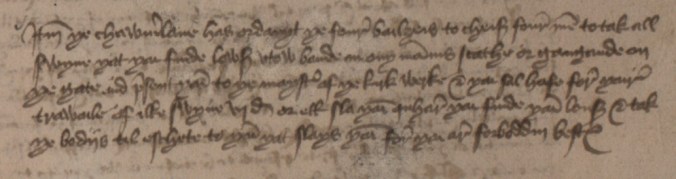
Late medieval towns were distinct from the countryside around them because of their special legal status and their concentration of buildings. But all Scottish medieval towns were small by modern standards and late medieval records frequently remind us how blurred the boundary was between urban and rural life.

Nothing better represents this blurred boundary than the livestock kept in and around towns, which were frequently the subject of urban legislation. Aberdeen, for instance, seems to have had recurring problems with pigs roaming free around the town. These animals were referred to as ‘forboddin bestis’. In June 1465 it was ordained that the baillies would choose four men to capture any pigs causing trouble to people or running loose on the streets. These pig catchers either had to take their porcine prisoners to the master of the ‘kirk werk’ – the official in charge of building work at St Nicholas Kirk, the parish church – for a reward of 6 d. for each pig. Alternatively, they could kill the pigs where they found them and take the carcasses as rewards.

In October 1495 a similar ordinance was issued. It stated that no pigs were to be loose in the town, giving a fifteen-day deadline for pigs to be put in enclosures or removed from the town. For any pigs found loose after this point the owners would have to pay a fine of 8 shillings to the court and the pig would be confiscated from them.

Another royal burgh on the east coast of Scotland – Montrose – issued a flurry of similar legislation in 1459 and 1460.1 It was set down in April 1459 that there would be a fine of 4 d. for each time a pig was found loose and, in October of the same year, that no one was to keep pigs in the town and if they did the pigs would be confiscated. In May 1460 it was also stated that anyone who suffered damage from a loose pig was to bring it before the alderman or bailles and half of the value of it would go to them and the other half to the common use of the town. One entry also lists a fine to be paid for disobeying swine keepers – presumably officials charged with making sure that people kept their pigs under control.

Pigs were not the only livestock to be found in and around towns. A record of a court case from Aberdeen in 1499 shows that Janet Clat and Jock Lammyntone were convicted of breaking down Andrew Gall’s door and taking sheep from his house. In Newburgh, Fife, in 1463 the baillie Thom Rogerson made an accusation that sheep kept by other townspeople were eating crops.2 In Montrose in 1462 keepers of the links were appointed to keep livestock out of the area – sheeps, pigs and oxen – and fines for animals found there were listed. Another entry from 1462 shows that Montrose had a common shepherd.

Animals, then, were a recurring theme of fifteenth-century urban legislation and the damage they might cause to property – and perhaps also to public health – was clearly regarded as far from trivial. These records leave us with the impression that medieval Scottish towns were, in some ways, much like farmyards.

Transcriptions from Aberdeen Council Registers (ACR)

ACR, 5, p. 549, 24 June 1465

Item the chawmerlane has ordanyt the four bailyeis to cheis four men to tak all swyne that thai fande lows utow bande in ony mannis scathe or gangande on the gate and present thaim to the maystir of the kirk werke. And thai sal hafe for thair travaile of ilke swyne vj d’ or ellis sla thaim quhar thai finde thaim lous’ and tak the bodijs til eschete to thaim that slays thaim for thai ar forboddin bestis

ACR, 7, p. 670, 9 October 1495

The saide day it was statut ande ordanit be the consale that nay swyne salbe haldin within the burgh uteuth’ bande ande within fiftene dais to be removit the burgh or in bande. Ande the Joysaris of the saide swyne to pay viij s’ for the amerciament of the court and the saide swyne to be eschet and thaj be comprehendit uteuthe bande the saide fiftene dais beinge runnyn thaj beand fundin in ony mannis skath

ACR, 7, p. 953, 6 May 1499

The samyn day Jonet Clat was convikit be ane suorne assis Alexander Red forspekar for the wranguys away takin of certane scheip out of Androu Gallis hous and for the brekin of his dur for the quhilkis scho was in ane amerciament of the court and to amend as law wil and to forber in tyme to cum. Ande Jok Lammytone was convikit be the saide assis, the saide alexander Rede forspekar, for the wranguis takin of certan schep out of the saide hous and brekin of the sad dur as saide is et cetera

The saide day Jonet Clat and Jok Lammyntone was convikit tbe the saide assis Alexander Rede forspekar for the away takin of Certan Schep fra Androw Gall this day takin in his corne for the quhilkis thai war in ane amerciament of the court et cetera


  1. All Montrose references from Montrose Burgh Court Book 1455-1467, National Records of Scotland, B51/10/1. 
  2. Newburgh Burgh Court Book 1457-1479, University of St Andrews Special Collections, B54/7/1. 

The common minstrels of Aberdeen

by Claire Hawes

minstrels

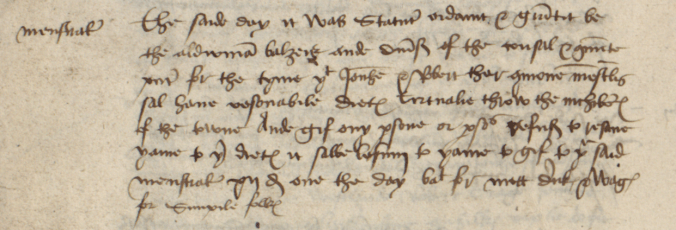
This entry, from volume 7 of the Aberdeen Council Registers, gives a rare insight into the cultural life of the burgh. It is a statute, from 18 January 1493,  which orders that all the burgesses of the town should take turns in hosting John and Robert, the burgh’s minstrels. Any burgess who refused to host would have to pay the minstrels 12 pence, for food, drink and wages. This allowed the cost of the minstrels’ board and lodging to be distributed amongst the burgesses.

The fact that John and Robert were ‘common minstrels’ suggests that they were employed by the town as a whole – the burgh corporation – rather than by individuals, hence the reason that all the burgesses had to contribute to their upkeep. It is likely that their services were required on important occasions such as feast days, meetings of the guild, and perhaps the annual head court, as well as for visits from royal officials, and even the king himself.

In 1507 James IV’s new bride, Margaret Tudor, undertook a ceremonial entry into the city. The event was recorded in verse by William Dunbar, a famous Scottish Renaissance poet. The minstrels are mentioned in the third verse – could it be John and Robert?

Ane fair processioun mett hir at the port,

In a cap of gold and silk full pleasantlie,

Syne at hir entrie with many fair disport

Ressaveit hir on streittis lustilie;

Quhair first the salutatioun honorabilly

Of the sweitt Virgin guidlie mycht be seine,

The sound of menstraillis blawing to the sky:

Be blyth and blisfull, burgh of Aberdein.


Transcription:

The saide day it was statutit, ordanit and grantit be the aldirman, balyeis ande divers of the consal and communite present for the tyme, that Jonhe and Robert – thar commone menstralis – sal have resonabile dietis circualie throw the nichtbouris of the towne. Ande if ony persone or personis refus to resave thame to thar dietis, it sal be lesum to thame to gif to the said menstralis xij d. on the day, batht for mett, drink, and wagis for simpile folkis.

Distinguished visitor and research seminars

This week (3-7 April 2017), the Research Institute of Irish and Scottish Studies (RIISS) was pleased to host Professor Jan Dumolyn (University of Ghent) as a visitor. Professor Dumolyn’s research is concerned with medieval Flanders, and he is the leading historian of medieval Bruges. His time in Aberdeen included meetings with various colleagues on campus, and visits to the University Library’s Special Collections Centre, the Aberdeen City & Aberdeenshire Archives, and the Maritime Museum.

Two seminars were held during the week. On 4 April Dr Claire Hawes of the LACR project presented a paper on ‘Politics and the Public Domain in Fifteenth-Century Scotland’, which led to a discussion of approaches to the study of political culture. Dr Hawes offered a fascinating new perspective on the political history of late medieval and early modern Scotland, suggesting a way forward that moves beyond the well-worn framework of crown-magnate relations. On 6 April Professor Jan Dumolyn spoke on ‘Commercial Connections between Flanders, Scotland and the Hanseatic world: An Interdisciplinary Approach’. Both these seminars prompted comment on a number of points of comparison between Scotland and other European territories in the later middle ages. The latter paper offered a view on the potential for collaboration between historians and archaeologists in the study of trade in bulk commodities, and in particular on how ballast stones can be a means to investigate commercial networks across the North Sea and Baltic Sea. The scope for tracing Scottish migrants in the rich records of Bruges was also touched upon, for example noting the Scottish shore porters of late medieval Bruges, and recalling the fact that the dialect word in that city for fish imported from Scotland was ‘aberdaan’.

Who Killed David Dun?

Who killed David Dun event

‘Who Killed David Dun?’ was an event held at the Aberdeen Town House on 26 February 2017 as part of the Granite Noir festival. Granite Noir was Aberdeen’s first book festival dedicated to crime fiction. When the Law in the Aberdeen Council Registers (LACR) project was asked to take part and create an event for the festival, the first problem that sprang to mind was that the chief subject of crime fiction – murder – was barely evident in the Aberdeen Council Registers which sit at the heart of the project. Murder did not lie within the jurisdiction of the burgh courts recorded in the registers.

What the registers do contain, however, is abundant evidence of disagreements and conflict – often violent – between inhabitants of the medieval town. As we transcribed volume 5 of the Aberdeen Burgh Registers one name seemed to come up with unusual frequency in relation to disturbances of the peace – David Dun. In the office we imagined why David Dun might have fought with other townspeople so often. Though there is nothing to suggest David Dun was murdered, with so many potential enemies he seems like someone who plausibly could have been murdered. I decided to build the LACR contribution to Granite Noir around the fictional murder of David Dun.

David Dun game Shiprow screenshot

As well as placing the LACR event firmly within the theme of the festival, this fictional murder offered a hook on which to hang many insights gleaned from real historical sources. It also provided the driving force for an interactive narrative which would allow the audience to engage directly with the historical sources which form the basis of our work as a research project. The event was designed to function much like interactive books such as the Choose Your Own Adventure or Fighting Fantasy series. The audience was presented with choices and had to decide by majority vote which path the narrative took. Along the way they encountered people, locations and events which were all based on evidence from the Aberdeen Council Registers. They had to look out for clues to help them work out who had killed David Dun. This interactive narrative was built using the open source interactive fiction tool Twine.

Transcription challenge

One challenge in creating the game was to find a way of directly engaging audiences with the historical records. To do so I decided that the character that the audience collectively played would be the town clerk. During the game, the town clerk consulted the Aberdeen Council Registers to cross reference evidence from them with evidence gathered from events and conversations in the narrative. Using the conceit that the town clerk was new and struggled with the writing of previous town clerks, the game included transcription challenges that needed to be passed to ‘unlock’ the relevant evidence from the register. These challenges involved showing actual passages from the registers and asking audiences to try to identify certain words in the fifteenth-century script. Once they had done so they could read translated passages from the registers which offered clues about the identity of the murderer.

In this way, the structure of the game allowed the audience to get a taste of the palaeography and source analysis work carried out by the LACR project – experiences which can normally only be accessed through specialist knowledge and training. It also underlined to the audience that most historical records were not just repositories of information made to be accessed by future generations. Rather, they were actively used in the period in which they were created. For example, records were brought forward as evidence to help resolve medieval court cases. The use of records as evidence to help solve the murder in the game was intended to reflect the active role of written records in medieval Aberdeen.

The event was well-attended and the audience successfully identified the killer of David Dun! Attendees also had the opportunity to inspect one of the original UNESCO-recognised Aberdeen Burgh Registers, which was kindly put on display by Phil Astley (partner of the LACR project and City Archivist for Aberdeen City and Aberdeenshire Archives). In a question session at the end the audience asked insightful questions about the Aberdeen Council Registers and the medieval town. The event was a rewarding experience for me. It made me think about medieval Aberdeen in new ways and revealed some interesting connections between different pieces of evidence from the registers. I would like to thank Lee Randall of Granite Noir and Phil Astley for the opportunity to take part in the festival.

Project Symposium I: Cultures of Law in Urban Northern Europe

By Jackson Armstrong

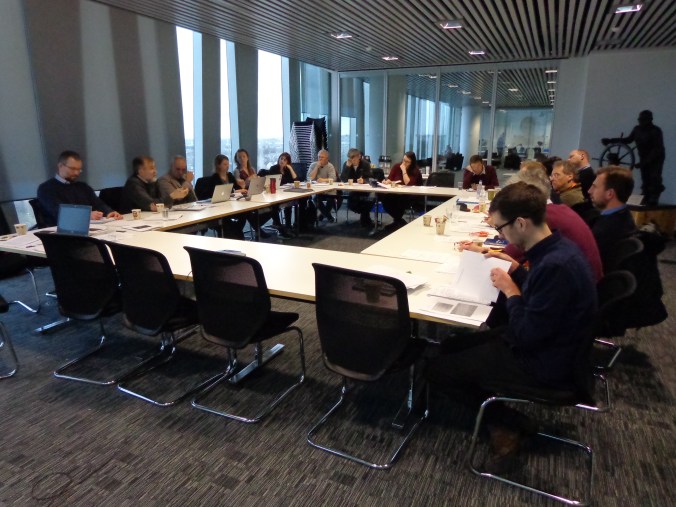
On Friday 24th and Saturday 25th February 2017 our project hosted its first symposium, on the subject of ‘Cultures of Law in Urban Northern Europe’. This was funded by the Research Institute of Irish and Scottish Studies (RIISS) and was held in the Craig Suite at the Sir Duncan C. Rice Library, University of Aberdeen.

symposium-2017-021

After a welcome from Michael P. Brown on behalf of RIISS, and an introduction offered by Jackson Armstrong, the sessions, chaired by Anna Havinga, Adam Wyner, Andrew Mackillop and William Hepburn included the following presentations:

Graeme Small (Durham) and William Hepburn (Aberdeen) – Typology of the written record: materiality and process in the Aberdeen Council Registers

Christian Liddy (Durham) – The publication of law

David Ditchburn (TCD) – Time: Extracts from the Aberdeen Council Registers

Edda Frankot (Aberdeen) – Legal business outside the courts: private and public houses as spaces of law

John Ford (Aberdeen) – The Voyage of the James of Veere: Maritime Law in Aberdeen in the Early Sixteenth Century

Claire Hawes (Aberdeen) – Debt, Morality and the Law in fifteenth-century Aberdeen

Justyna Wubs-Mrozewicz (Amsterdam) – Conflicts about property and inheritances in sixteenth century Danzig

Jelle Haemers (& Chanelle Delameillieure) (Leuven) – Jurisdiction and Marriage in the Fifteenth-Century ‘Registers of the Aldermen’ of Ghent and Leuven

Michael H. Brown (St Andrews) – Burghs and Regalities: Conflicts of Jurisdiction

Jörg Rogge (Mainz) – Pax Urbana – the use of law for the achievement of political goals

Andrew Simpson (Aberdeen) – Texts of the Medieval Scottish Common Law in the Aberdeen Council Registers

Jackson Armstrong (Aberdeen) – ‘Malice’ and motivation for hostility and non-lethal wounding

Joanna Kopaczyk (Edinburgh) – Language as code: language choices and functions in a multilingual legal culture

Anna Havinga (Aberdeen) – Language shift in the Aberdeen Council Registers

Adelyn Wilson (Aberdeen) – Legal education in Aberdeen in the sixteenth and seventeenth centuries

Proceedings on Friday 24th also included a visit to Old Aberdeen House (Aberdeen City and Aberdeenshire Archives) with Phil Astley, and to St Machar Cathedral.

The objective of this first gathering was to present ‘gobbet’ style extracts from primary sources, and to raise questions for development illustrated by those extracts. We look forward to reconvening in 2018 to share draft papers developed from these initial questions and discussions, in collaboration for an edited collection of essays on the subject.

Violence against women in medieval Aberdeen

by Edda Frankot

ACR, 5, p. 296, 25 February 1457

vol-5-296

Item Thomas Raa in amerciamento pro iniusta perturbacione vxoris Johannis Dis’ et emendabit parti lese.

Item dicta vxor in amerciamento pro iniusta perturbacione ipsius Johannis [sic; recte: Thome?] et cetera.

Item Thomas Raa in amerciament1 for unjust disturbance of the wife of John Dis’ and will pay amends to the injured party.

Item the said wife in amerciament for unjust disturbance of the same John et cetera.

ACR, 5, p. 304, 15 Jul 1457

vol-5-304

Eodem die Johannes Glenny adiudicatur in amerciamento pro iniusta perturbacione vxoris Johannis Spront et emendabit parti lese ad visum proborum.

Item Johannes Spront adiudicabatur in amerciamento pro iniusta perturbacione dicti Johannis Glenny et emendabit et cetera.

The same day John Glenny is judged in amerciament for unjust disturbance of the wife of John Spront and will pay amends to the injured party in accordance with the vision of honest [men].

Item John Spront is judged in amerciament for unjust disturbance of the said John Glenny and will pay amends et cetera.

The Council Registers include many reference to perturbatio/perturbio and, in its Scots form, strub(u)lance. This appears to have been used for a broad range of disturbances which only occasionally are narrowed down further to ‘perturbatio burgi’ (disturbance of the burgh), or ‘strublance by word’, but which stops short of including violence which resulted in the drawing of blood. Regularly, two people are convicted, one after the other, for perturbatio against the other. Generally the entries are very short, like the examples above, and include no further details on the context of the disturbance: the time, the place and the reason for the dispute. Nor do we get any sense of the seriousness of the conflict. A nice exception to this is the case of ‘strubulance and skathtinge [harming]’ from 1491 which consisted of ‘castyne of wattir and filtht in his house’.2

Usually the convicted and the victims are men, but not always. In the first example above the wife of John Dis’ is both victim and disturber. I think we can assume that the second entry is supposed to say that she was convicted of perturbatio against Thomas, not against her own husband. There is no indication from the sources which of the two may have initiated the dispute. In the second example, the wife of John Spront is the victim of John Glenny, but John Glenny himself was also convicted for perturbatio against Spront, suggesting he defended his wife against unwanted attention. A point to note is the fact that neither of the women is named. Though some women do appear under their own name in the Aberdeen records, they very regularly just appear as the wife of their husbands. In this case it is unclear whether John Dis or his wife was considered responsible for paying the amends to Thomas Raa, as the entry does not extend that far.

It is likely that many of the cases of perturbatio and strublance took place within the context of public houses, which would mainly have been frequented by men, though as said there is very little specific evidence with regards to this in the Aberdeen sources. My main point of reference are the sources from the Dutch town of Kampen from around the same period, which include a lot more detail in cases of violence. In Kampen, too, the groups of perpetrator and victims were mainly made up of men, and the majority of the violence took place in public houses. A drinking jug was a popular choice for a weapon. Unfortunately, similar details are usually lacking in Aberdeen, but these four short entries perhaps leave more to the imagination…


  1. Amerciament: The condition of being subject to a pecuniary penalty at the discretion of the court or judge. http://www.dsl.ac.uk/entry/dost/amerciament 
  2. ACR, 7, p. 273 (14 Oct 1491). 

A Genoese merchant in medieval Aberdeen – a case from the lost ‘volume three’

by Edda Frankot

The Aberdeen Council Registers form an almost complete set of records: the only extensive period which is not covered by the registers runs from the middle of the year 1414 to the end of 1433. Even although there is only one volume missing in the sequence of volumes that is currently extant, namely volume three, former Aberdeen City Archivist, Judith Cripps, in a 1981 report on the matter argued that there may well have been three books that covered the period from 1414-33.1 By the early nineteenth century only the middle part, dating to 1426-29, had survived. At that time, William Kennedy, author of the Annals of Aberdeen, reported that he had seen this part some years before, but that it had ‘lately been mislaid’.2 A recent discovery by LACR’s own project director, Jackson Armstrong, suggests that fifty years earlier this part had also been the only remaining evidence from the period 1426-29. This discovery was the presence of a manuscript with extracts of the burgh records, including ones from 1426-29, in the Aberdeen University Library. For more on this discovery, see this week’s press release.

The extracts were made by James Man, who intended to write a history of Aberdeen. Most of his notes are short summaries of the contents of the burgh records, with occasional short quotes from the original in Latin. Seeing that volume two of the registers is almost entirely in Latin, whereas only 5-10% of volume four is in Scots, the vast majority of volume three would be expected to have been in Latin too. But it appears that Man also came across at least one entry in Scots. This is the only entry from 1426-29 that he transcribed in full, and its language is clearly different from that of the rest of Man’s notes: it is in Middle Scots and reads much like other entries in Scots from the fifteenth century elsewhere in the registers.

This specific entry is also interesting in that it features one of the only known instances of a southern European merchant active in Aberdeen. Pelegrino Grellus was a merchant from Genoa who, with his brother Lazarino, appears regularly in the royal Exchequer Rolls in the late 1420s and early 1430s, at about the same time as the two brothers appear in the Aberdeen records.3 The entry, dated 1426, concerns a dispute between ‘Pylgrime mirchand of Gene (=Genoa)’ and Jelm (or John?) van Wrey, whose place of origin remains to be identified, and his shipmen. Man may have had some trouble reading the place names in the original, as the first few letters of the word in his copy are difficult to identify. It looks something like ‘Mineth’ and is likely to be a place in the Low Countries. The alderman (provost), bailies and community of Aberdeen determined that Van Wrey, who was shipmaster of a ‘bus’, and his shipmen should calculate their fees (‘and se qwhat is acht thaim of thair fees’), which Pelegrino should then pay to the sailors. In addition, it was determined that the shipmaster should sail to Lazarino in Edinburgh. It appears that another decision had to be made there as to who should pay the shipmen’s fees for that part of the journey: the shipmaster or Lazarino, but it is not entirely clear from the notes whose decision this was to make.4

It may be that Pelegrino was in Aberdeen in relation with the transactions detailed in the Exchequer Roll, that is to say collecting salmon as part of his payment by the king for supplying the court, though there is no mention of a payment to the brothers in the Exchequer Roll for 1426-7.5 A year later, Pelegrino did receive thirty lasts and two barrels of salmon, in addition to another eleven lasts and eleven small barrels. For 1428-9 the two brothers are named together.6. It may also be that Pelegrino and Lazarino were already active in Scottish trade before they started supplying the king.

It is rare to come across southern European merchants active in Scottish trade. Taken as a whole, there were few foreign merchants who resided in Scotland in the later middle ages. There were no communities of merchants residing in any of the Scottish burghs in this period as there were in other towns throughout Europe (such as, for example, the Scots in Bruges and later in Veere), not even in Edinburgh.7 In addition, the majority of merchants who did come to Scotland were either English, Dutch, Flemish or Hanseatic (especially from Stralsund and Danzig). The most notable Aberdeen resident with a presumed southern European connection was William of Spaigne/Spanye, who appears in volumes four and five and may well have appeared in volume three, as his first appearance is on page six of volume four. William of Spaigne was a councillor in the late 1430s and early 1440s and appears finally in 1450. In that same year a Jonet Spaigne is listed in an account. She was perhaps a relation, either a daughter or a sister. Judging by the fact that William was a councillor, he must have been fairly well established in Aberdeen by the late 1430s. Despite his suggestive surname, we do not know whether he came from Spain himself, or descended from a Spaniard. We do know that he owned some property on the Gallowgate in the late 1440s.8

There is also no evidence as to where the Genoese Pelegrino resided, but his brother owned a house in Kirkcudbright in the mid-fifteenth century and served as custumar of that town in 1455 and 1460, so many years after the entry from 1426.9 In 1426 Lazarino appears to have been in Edinburgh, though it is not clear whether he was a permanent resident. Unfortunately, any other potential appearances in volume three are lost forever, like most other Scottish burgh records from that period. But thanks to the efforts of James Man in the 1700s we have at least gained a glimpse into Aberdeen in the 1420s and its links with the outside world.


  1. Report to City of Aberdeen District Council on Missing Register of Council 1414-1434, Judith A. Cripps, City of Aberdeen Archivist, 29 June 1981. 
  2. Letter from the Scottish Record Office (John Imrie) to John Wilson, Town Clerk of Aberdeen, 2 February 1981. 
  3. ER IV, 443, 444, 445, 472, 507, 531, 542, 621. 
  4. AUL, MS 532, p. 13. 
  5. With regards to supplying the court, see ER IV, cxlv 
  6. ER IV, 443; 472, 507. 
  7. David Ditchburn, Scotland and Europe: the Medieval Kingdom and its Contacts with Christendom, c. 1215-1545, volume 1: Religion, Culture and Commerce (East Linton 2000), 204; Edda Frankot, ‘Aberdeen and the east coast of Scotland. Autonomy on the periphery’, in: Wim Blockmans, Mikhail Krom and Justyna Wubs-Mrozewicz, eds, Routledge Handbook of Maritime Trade around Europe, 1300-1600. Commercial Networks and Urban Autonomy (Woodbridge: Routledge, forthcoming 2017), 409-25, at 415. 
  8. ACR 4, pp. 6, 103, 139; ACR 5(1), pp. 25, 26, 116; ACR 5(2), pp. 647, 659, 662, 663, 667, 674, 682, 691, 692. 
  9. Ditchburn, Scotland and Europe, 204.