Urban Freedom in Medieval Aberdeen

by Claire Hawes

When most people think of freedom in late medieval Scotland they picture Mel Gibson with a blue face and a large sword. This, unsurprisingly, was not the whole story, and the Aberdeen registers provide us with a very rich source of information about what freedom meant in Scotland’s towns.
Pont freedom

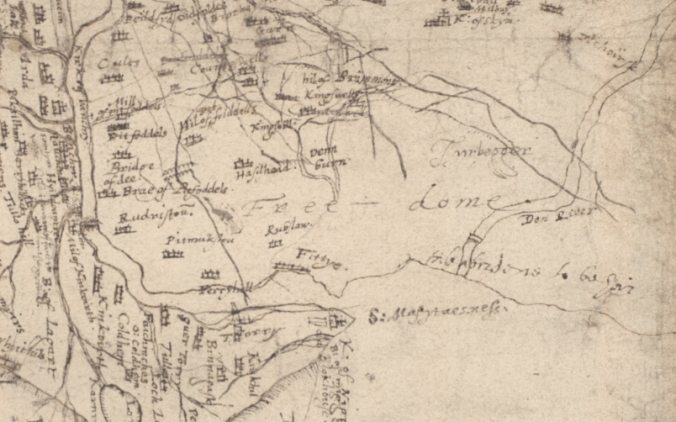
Map of Lower Deeside by Timothy Pont, c. 1590, showing the freedom of Aberdeen. Reproduced with the permission of the National Library of Scotland. http://maps.nls.uk/index.html

In our own political culture freedom is associated with democracy and civil liberties. Within agreed limits we have freedom of speech, freedom of movement and freedom of assembly. We are free to take a great variety of decisions about how we want to live, and we are free to campaign, protest and lobby our representatives if we want to make changes to the way we are governed. In other words, many of our freedoms are positive – they involve the right to do certain things.


In order to understand urban freedom in the Middle Ages we need to think about it rather differently. In the first place not everyone in the town was considered to be free. Only the burgesses – the elite group who ran the town – were ‘freemen’, and they were so called because they took a solemn oath, paid a fee, and were then entered into ‘the freedom of the burgh’.1 So this freedom was closer to a privilege, granted to a select few, than a right held by everyone. A man had to meet certain conditions in order to be admitted to burgess-ship. He had to have property in the town, pay suit at the three annual head courts, and agree to undertake the duties of watch and ward.2 Holding property in this way was known as ‘free burgage’, which meant that the burgess could dispose of the land as he saw fit, rather than being obliged to let his heirs inherit it.3 Those who had not been entered into the freedom were known as ‘unfreemen’, and although they were not obliged to perform the same duties as the burgesses they were also not entitled to any of the same privileges.

except lordis

ACR 5/2, p. 723, 24 October 1452. Entry excluding lords from the fishing (second last line).

What were the burgesses free to do that others could not? In some ways it is easier to think in terms of what they were free from. In the medieval period society was steeply hierarchical. Most common people were obliged to turn over a proportion of their produce to their lord, to sustain his lifestyle and to provide for any payments he owed to the king. Royal burghs, such as Aberdeen, were different. The burgesses were not noblemen, but nevertheless the revenues raised within town – known as the burgh customs – were collected by the Chamberlain and paid directly to the crown.4 While the king could take as close an interest as he wished in the affairs of the town in practice this was not necessarily a frequent occurrence, meaning that the burgh inhabitants were, in a very real sense, free from the exactions that overlords often imposed on other common people. Each burgh also held its own courts, so that a burgess could demand to be tried by his peers, rather than in the court of a lord or even a sheriff or justiciar.5 The burgh administration – the alderman, bailies and council – therefore had authority over almost everything that happened in the town, and this authority was closely guarded.

In November 1446, for example, it was decided that no burgess was allowed to request or purchase any leases for lords within the town, and that anyone who did so would lose his freedom.6 The following month the council granted the freedom to fish in the river to John Vaus, stating that he could give the license ‘to what frende of his that be thocht speidful [suitable] to him, except lordis’.7 Such acts were not indicative of a general animosity between lords and towns in Scotland – indeed lords could establish burghs of their own.8 Instead, the burgesses of Aberdeen were simply keen to ensure that the privileges of the community were not eroded by outside interference from powerful neighbours. Men such as the earl of Huntly or the earl of Mar could play a prominent role in the politics of the town, but they did not hold the same rights over the burgesses as they did over their own tenants, and this distinction was important.
within the fredom

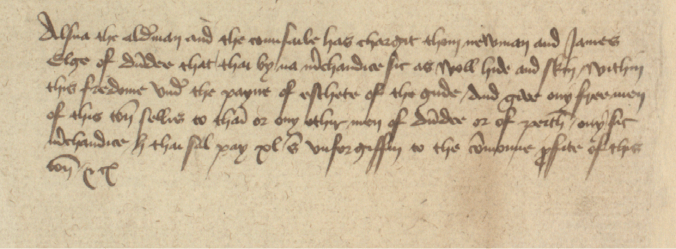
ACR 5/2, p. 702, 13 May 1445. Entry forbidding two men to buy goods within the freedom.

The ‘freedom of the burgh’ was not only a legal concept, it also described a geographical area surrounding the town, in which the burgesses could exercise their trading privileges. Only burgesses were allowed to engage in trade – the freedom was essentially a monopoly of such rights – and burgesses paid an annual rent to their overlord for this privilege. Everyone who lived within the freedom was obliged to bring their wares to the weekly market for the burgesses to buy. The freedom to buy and sell was often accompanied by freedom from the toll levied by the overlord upon people trading there.9 Burgesses did not have to pay this toll, but the unfree did. Prices at the market were set by the council, and trade was strictly regulated. Forestalling (buying goods before the market opened), regrating (selling above the set price) and ‘tapping again’ (re-selling) were all prohibited, and punishable by a hefty fine.10 The frequency with which such charges appear in the records suggests that they were a recurring problem which was difficult to manage successfully. Again we see that urban freedoms took the form of privileges granted over others, which the burgesses were keen to defend.

41

Fifteenth-century seal matrix of the burgh of Aberdeen. Held in Aberdeenshire and Aberdeen City Archives. Photo by Vicky Gray.

This was not always the case. In 1452 the whole town was in debt to Thomas Barnwell, a merchant fishmonger of London.11 The amount must have been significant, because the council nominated three prominent men of the town – John of Fife, John Vaus, Gilbert Menzies – to pay off a quarter of the debt each, with John Blyndseil, Thom Blyndseil and Adam Hill paying the last quarter. They were charged to return the value of the goods paid by the burgesses and ‘freith and bryng hame the commoune seel’.12 It is not clear if Barnwell had actually removed the seal to London as collateral for his debt. If so, this would have been both very unusual and highly significant. The common seal of the town was a physical representation of the community’s authority, and was used to ratify important decisions and legal processes.13 Its removal would imply a debt of great size, although unfortunately the amount is not recorded. In July of the following year the council stated that because it was ‘clerly knawin’ that Andrew Benyng took some of Barnwell’s silver from Adam Benyng, Andrew would need to ‘freith the toune’ of the two barrels of salmon and 12s 6d of silver that remained unpaid, from his own lands and goods.14 This suggests that the council was still collecting money for the repayment of the debt to Barnwell, and that the less scrupulous were taking advantage of the accumulation of silver.

Even this brief glimpse into the Aberdeen Council Registers shows how complex and multifaceted urban freedom was in the fifteenth century. It touched on property ownership, trading rights, legal privileges and the management of debts and other obligations. This makes it one of the most important concepts in medieval Scotland. Even without Mel Gibson.


  1. For example ACR 5/2, p. 773. 
  2.  Elizabeth Ewan, Townlife in Fourteenth-Century Scotland, (Edinburgh, 1990) pp. 92; 55; 103. 
  3. Ibid, p. 105. 
  4.  Ibid, p. 41. The Chamberlain was a royal officer and travelled around the kingdom on ‘ayres’ acting as judge and revenue collector for the towns. 
  5.  Hector MacQueen and William Windram, ‘Laws and Courts in the Burghs’, in Lynch, Spearman and Stell (eds) The Scottish Medieval Town (Edinburgh, 1988), pp. 214-15. 
  6.  ACR 5/2, p. 724. 
  7.  ACR 5/2, p. 727. 
  8.  MacQueen and Windram, ‘Laws and Courts’, p. 212. 
  9.  Ibid, p. 212. 
  10. For example ACR 5/2, p. 750. 
  11. www.nationalarchives.gov.uk, C 241/249/50. 
  12.  ACR 5/2, p. 723. 
  13.  Ewan, Townlife, pp. 51-52. 
  14.  ACR 5/2, p. 731. 

Digital Humanities – What’s the fuss about?

by Anna D. Havinga

“Digital Humanities” (DH) has become a vogue word in academia in the last few decades. DH centres have been set up, DH workshops and summer schools are held regularly all over the world, and the number of DH projects is increasing rapidly. But what is all the fuss about?


What is Digital Humanities?

There are numerous articles that discuss what DH is and is not. It is generally agreed that just posting texts or pictures on the internet or using digital tools for research does not qualify as DH.1 There are, however, few works that give a concise definition of DH. Kirschenbaum quotes a definition from Wikipedia, which he describes as a working definition that “serves as well as any”.2 In my view, the definition for DH on Wikipedia3 has even improved since 2013, when Kirschenbaum’s article was published. I believe it now captures the essence of DH more accurately:

[…] [A] distinctive feature of DH is its cultivation of a two-way relationship between the humanities and the digital: the field both employs technology in the pursuit of humanities research and subjects technology to humanistic questioning and interrogation, often simultaneously. Historically, the digital humanities developed out of humanities computing, and has become associated with other fields, such as humanistic computing, social computing, and media studies. In concrete terms, the digital humanities embraces a variety of topics, from curating online collections of primary sources (primarily textual) to the data mining of large cultural data sets to the development of maker labs. Digital humanities incorporates both digitized (remediated) and born-digital materials [i.e. materials that originate in digital form, ADH] and combines the methodologies from traditional humanities disciplines (such as history, philosophy, linguistics, literature, art, archaeology, music, and cultural studies) and social sciences, with tools provided by computing (such as Hypertext, Hypermedia, data visualisation, information retrieval, data mining, statistics, text mining, digital mapping), and digital publishing. (https://en.wikipedia.org/wiki/Digital_humanities)

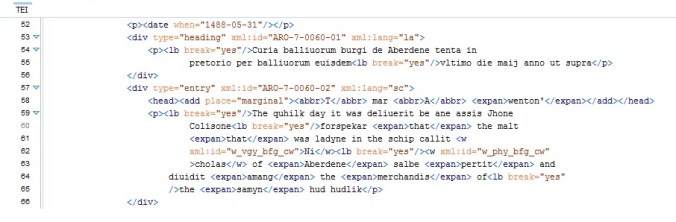
Our Law in Aberdeen Council Registers project can serve as a prime example for a DH project: We create digital transcriptions of the Aberdeen Burgh Records (1397–1511) with the help of computing tools. This means that we type the original handwritten text into a software programme in a format that can be understood by computers. More specifically, we use the oXygen XML editor with the add-on HisTEI to create transcriptions that are compliant with the Text Encoding Initiative (TEI) guidelines (version P5).4 In this way, we produce a machine-readable and machine-searchable text.5 But what benefits does this have? Why do we go through all this effort when the pictures of the Aberdeen Burgh Records are already available online?6


What are the benefits of a digital, transcribed version of a text?

Apart from the obvious benefit of a digital, transcribed version of text being much easier to read than the original handwriting, it allows for information to be added to the text. With the help of so-called ‘tags’, a text can be enriched with all kinds of structural annotations and metadata. Tagging here means adding XML annotations to the text. For example, the textual passages in the Aberdeen Burgh Registers, which are mainly written in Latin or Middle Scots, can be marked up as such, using the ‘xml:lang’ tag. A researcher who is interested in the use of Middle Scots in these registers could then search for and find all Middle Scots sections in the corpus very easily with the help of a text analysis tool such as AntConc or SketchEngine without having to plough through the sections written in Latin. More generally, enriching the text with tags means that a researcher does not have to read through all of the over 5,000 pages of the Aberdeen Council Registers that we will transcribe in order to find what s/he is looking for. A machine-readable and machine-searchable text does not only save time when researching a particular topic but is also generally more flexible than a printed version of text as further tags can be added and unwanted tags can be hidden. Furthermore, a digital text allows us to ask different questions of a text corpus. It is those possible questions plus a variety of other issues that have to be considered before embarking on a DH project.

Blog1_picture

Transcription of volume 7 of the Aberdeen Counil Registers (p. 60), annotated with XML tags


What has to be considered when setting up a DH project?

There are several major questions that have to be considered before starting a DH project of the sort we are carrying out: What is it that you want to get from the material you work on? Who else will be using it? In what way will it be used? Which research questions could be asked? Information on the possible users of the born-digital material is essential in order to decide which information should be marked up in the corpus of text. This is, of course, also a matter of time (and money) since adding information to the original text in form of tags takes time. The balance between time and enrichment has to be determined for each individual DH project. In our project we decided to go through different stages of annotation – starting with basic annotations (e.g. expansions, languages) first and adding further tags later (e.g. names, places etc.). Also, users will be able to add further annotations that may be specific to their research projects. Beyond these considerations, choices about software and hardware, tools, platforms, web development, infrastructure, server environment, interface design etc. have to be made before embarking on the DH project. Anything that is not determined at the beginning of the project may lead to considerable efforts at a later stage of the project.

It is certainly worth going through all this effort. To us it is clear why DH has become such a big thing. It eases research, extends the toolkits of traditional scholarship, and opens up material to a wider audience of users.7 With tags we can enrich the content of texts by adding additional information, which can then change the nature of humanities inquiry. DH projects are by nature about networking and collaboration between different disciplines, which is certainly the way forward in the humanities.


  1. Anne Burdick et al. 2012. Digital_Humanities. Cambridge, MA: MIT Press, p. 122. 
  2. Matthew G. Kirschenbaum. 2013. ‘What Is Digital Humanities and What’s It Doing in English Departments?’ In: Melissa Terras, Julianne Nyhan, Edward Vanhoutte (eds), Defining Digital Humanities. A Reader. Farnham: Ashgate, 195-204, p. 197. 
  3.  https://en.wikipedia.org/wiki/Digital_humanities [accessed 19.07.2016] 
  4.  http://www.tei-c.org/Guidelines/P5/ [accessed 25.07.2016] 
  5. In further blog posts, we will explain in more detail how we do this. 
  6. http://www.scotlandsplaces.gov.uk/digital-volumes/burgh-records/aberdeen-burgh-registers/ [accessed 25.07.2016] 
  7. Anne Burdick et al. 2012, p. 8. 

Memory and proof of age (1507)

ACR, 8, p. 705-6 (21 June 1507)

by Edda Frankot

The Aberdeen Burgh Registers tend only to include brief statements concerning court cases that were dealt with by the burgh courts. From these, it is often difficult to establish the circumstances of a legal matter or of the parties involved in it or to draw any conclusions on the reasoning behind a certain verdict. With regards to cases of verbal or physical abuse, for example, there are often no details on who perpetrator or victim were, what their relationship was, where the abuse had taken place, what the character of it was and who had witnessed it. Of course, these registers were not written for entertainment or to facilitate twenty-first century research, but to keep a record of the decisions of the burgh courts. But one cannot help but be curious to know more.

The character of the Aberdeen records make it all the more interesting, then, when we do come across additional information in a court case, such as depositions of witnesses. It gets even more exciting when the majority of witness statements was made by women, a group generally underrepresented in legal sources. On the 21st of June 1507 fourteen depositions, nine of which were given by women, were recorded in the Aberdeen registers. These depositions concerned the age of a girl, Isabel Buchan, the heir of the late William Buchan, a burgess of Aberdeen.

There are eight entries in total concerning this case between 30 April and 21 June. From these it appears that the matter at hand was whether Isabel Buchan should still be under the tutory of one of the two parties in the case, David Colp. According to Scots law, orphaned minors (that is to say, minors whose fathers had died) were under tutory until they reached puberty. For girls this was at the age of twelve, for boys at fourteen. At that age minors would come into ownership of their property, though they would remain under curatory until they reached majority (for boys) or were married (for girls).

The depositions of the fourteen witnesses that appeared in court on 21 June are interesting in that they provide information on how people remembered important occurrences like births and deaths when communication was still to a large extent oral. There were no registers of births, marriages and deaths until after the Reformation, and few people beyond monasteries and burgh councils would have recorded important events.

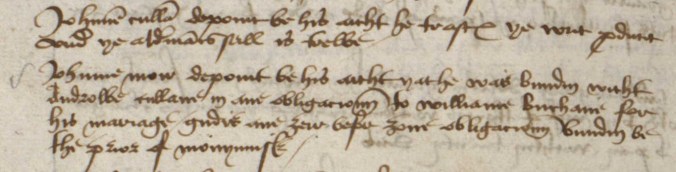
GB0230CA000100001-00008-00705a-

From the statements of the fourteen people deposing in this case it appears that especially the women linked their memories to important feast days and to other memorable life events. Two of the women described their memories of Isabel’s baptism. Bessy Sibbald, Isabel’s godmother, recalled that she ‘hewf hir one monunday before festerinevine and sche dynit that day in Alexander Chameris house’. Alexander Chalmers’ wife, Isabel of Cullen, deposed that she too ‘hwyff Isabell Buchane one monunday before festerinevine’. To ‘hwuf’ means to lift a child from the font as a sponsor during the baptismal ceremony. Based on these memories Bessy thought that Isabel Buchan was at least eleven, as both Andrew Branch, the girl’s godfather, and Alexander Chalmers were still alive when she was baptised. Isabel of Cullen confirmed that her husband died when the girl was one year old, believing she was past her eleventh birthday.

GB0230CA000100001-00008-00705b-

According to Margaret McGlynn, who researched proof of age cases from sixteenth-century England, baptism was the ‘most common single memory of the birth’.1 Mc Glynn noted that the lifting of the child from the font by the godparents after the baptism, the most significant moment in the ritual, stood out in people’s memories of the event. This expression of social relationships, as McGlynn called it, between the godparents and their godchild, was no doubt further enhanced by the subsequent dinner at the house of one of the couples present at the baptism in our case.

Rogier_van_der_Weyden-_Seven_Sacraments_Altarpiece_-_Baptism_detail,_left_wing

From the depositions in the Aberdeen registers, it appears that some documents were also presented in court on the 21st of June, though any details as to what they contained are lacking. However, it appears that the memories of some of the deponents were linked to the drawing up of these documents. John Moir, for example, deposed that he was bound in an obligation with Willam Buchan for his marriage goods a year before ‘yone obligacioun bundin be the prior of Monymusk’. Presumably this meant that Isabel’s parents were married about a year before this obligation was drawn up, and that Isabel herself could not have been born more than about three months before it (though this is not explicitly stated). Two of the women linked their memories of Isabel growing up to another document presented in court, a deed dated on St Catherine’s day (25 November – the year is not mentioned). Elizabeth Mowat stated that she did not know how old Isabel was but that she was not quite four when the deed was drawn up. Andrew Cullen’s wife deposed that Isabel could ‘gang, ett and drink befor the de[e]d’.

GB0230CA000100001-00008-00706a-

GB0230CA000100001-00008-00706b-

In thirteenth- and fourteenth-century England, written evidence was not seen as the most reliable. According to John Bedell in his article on memory and proof of age in that period, both judges and jurors considered written documents as inferior to memories of people who had personal knowledge of a certain event, though they were regularly presented as auxiliary evidence.2 McGlynn noted that in the earlier decades of the sixteenth century very few written documents were used as evidence in proof of age cases in England. People were very aware that written sources could be lost (as well as forged) and that personal memories were more reliable in the long run. This had changed by the late sixteenth century when society as a whole had become more literate.3

That written documents in themselves were not considered sufficient proof in early sixteenth-century Scotland either, is confirmed by the deposition of John Cullen, whose only recorded statement was that he ‘trastis the writ producit under the aldermanis seill’, apparently another document that was present in court. On the whole, though, written documents do appear to have played a more significant role than was usual in England at the same time, but based on one case it is difficult to draw any firm conclusions with regards to Scottish practice in the early sixteenth century.

Relying on the evidence of witnesses and documents, the bailies concluded that Isabel Buchan was eleven years old. Though this is not stated explicitly in the verdict, this meant that she would remain under the tutory of David Colp for a further nine months or so, after which she would be able to enjoy the fruits of her inheritance (though under curatory until she married).

The observations about the functioning of memory in proof of age cases correspond to conclusions made by authors analysing similar sources. Elizabeth van Houts, for example, noted that women, especially mothers and wet nurses, were important as ‘rememberers of birth details’, as this was considered part of the female domain. In such cases women’s testimonies were vital, as is clear from our 1507 case as well.4

Of course, much more can be said about medieval memory in all its facets than it is possible to relate in a short post. Hopefully other proof of age cases like this will crop up as our transcription efforts continue and more research will become possible. But even if not, this case on its own has already provided us with some nicely detailed insights into the workings of memory in medieval society, especially those of women, and as such into the events that most likely mattered most to them.


  1. Margaret McGlynn, ‘Memory, orality and life records: proofs of age in Tudor England’, The Sixteenth Century Journal 40 (2009), 688-9. 
  2. John Bedell, ‘Memory and proof of age in England 1272-1327’, Past & Present 162 (1999), 24. 
  3. McGlynn, ‘Memory, orality and life records’, 686, 696. 
  4. Elisabeth van Houts, ‘Medieval memory in theory and practice: some exploratory thoughts in the guise of a conclusion’, Gesta 48, no. 2 Making Thoughts, Making Pictures, Making Memories: a special issue in honor of Mary J. Carruthers (2009), 188; Idem, ‘Gender and Authority of Oral Witnesses in Europe (800-1300), Transactions of the Royal Historical Society 9 (1999), 220. 

From script to text

by Jackson Armstrong

One of the most cryptic and alluring aspects of the pages of the Aberdeen council registers is the handwriting which appears in them. To most people this script is not remotely decipherable.

Patterns of handwriting change over time. The study of these changes is known as palaeography. An excellent public resource may be found at the Scottish handwriting website.

Even in 1591 the town clerk of Aberdeen reported his bafflement by the handwriting of the fourteenth century. That year the clerk, Master Thomas Mollisone, who was preparing an inventory of extant registers and bailie court books, found no volumes from earlier than 1380. However, he noted that ‘Befoir this, scrowis [scrolls] on parchment ’ written in Latin ‘and for ilk year ane skrow’, survived. In his assessment they were ‘evil to be red, be resoun of the antiquitie of the wreit and the forme of the letter or character … which is not now usit’ and that ‘skairslie gif ony man can reid the samyn’.1

43

The only extant burgh court roll, from 1317, kept at the Aberdeen City and Aberdeenshire Archives.

We think of the contents of the eight register volumes from 1398–1511 as a corpus of text. But what is ‘the text’? The task of our project is to take the handwritten script in the registers and render it as machine readable text. I think it is useful to pause and consider the difference between what we think of as ‘the text’ and the handwritten script. The scripts in these registers use a set of character symbols with standard abbreviations and also special letter forms. It is helpful to think of this as a form of shorthand writing, or even encryption, which it is our job to decipher. A later and more extreme version of such abbreviation, or shorthand, is that which was devised by Thomas Shelton, and used by Samuel Pepys in writing his well-known diary. The ‘text’ of Pepys’s diary entries (what might be described as their meaningful content) is not necessarily the same as the writing on the page. The editors of Pepys’ diaries had the difficult task to extract the ‘text’ from the diarist’s shorthand (for an example, see this image of a page of his diary). Similary, a difference can be noted between the text of our material, and the handwriting which various scribes used to symbolise that meaningful content. It is our interpretation of the handwritten script which produces ‘the text’.

This brings us to the nature of the transcription we produce by rendering the script into text. A diplomatic transcription aims to reproduce everything as it is, for instance giving wt for wt . By contrast, a semi-diplomatic transcription includes the full expansion, in this case expanding wt to ‘with’. It may even be possible to represent the set of symbols used for the original script with high fidelity, producing what is in effect a facsimile. For instance, a form of typeface called ‘record type’ was invented in the late eighteenth century to reproduce medieval abbreviations. That would be a tremendously cumbersome process and it would not help in moving from script to text. In addition, record type and full diplomatic transcription were invented before the benefit of modern photography. Digital images of the original pages now provide a perfect facsimile, and as a result a diplomatic transcription is no longer necessary.

Our task is not to create a facsimile of handwriting, but to represent the text as consistently and accurately as we can. To this end we aim to produce a text which may be displayed either as a semi-diplomatic transcription, or a semi-normalised transcription. The latter allows for fuller intervention by the transcriber, regularising and smoothing out features like variant letter forms, punctuation, capitalisation, and so on. In the former case, the expansion of abbreviations is assisted by the fact that these were standardised to a large degree. Reference works are available to assist transcribers with the identification and expansion of abbreviated forms.

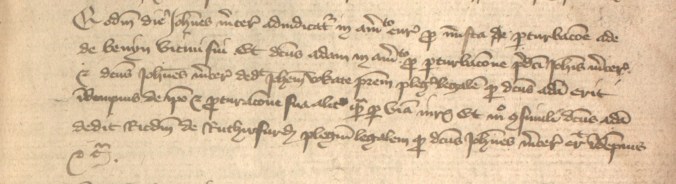
ACR 4, p. 7, entry 2

ACR 4, p. 7, entry 2

semi-diplomatic transcription: Eodem die Johannes mercer’ adiudicatur in amerciamento curie pro iniusta de perturbacione ade de benyn vicini sui. Et dictus adam in amerciamento pro perturbacione predicti Johannis mercer’ et dictus Johannes mercer’ dedit Johannem vokate patrem plegium legalem quod dictus adam erit indempnis de ipso et perturacione sua aliter ipse per viam iuris Et modo consimili dictus adam dedit Ricardum de Ruthirfurd plegium legalem quod Johannes mercer’ erit indempnis et cetera.

semi-normalised transcription: Eodem die Johannes Mercer’ adiudicatur in amerciamento curie pro iniusta de perturbacione Ade de Benyn vicini sui. Et dictus Adam in amerciamento pro perturbacione predicti Johannis Mercer’ et dictus Johannes Mercer’ dedit Johannem Vokate patrem plegium legalem quod dictus Adam erit indempnis de ipso et perturbacione sua aliter ipse per viam juris. Et modo consimili dictus Adam dedit Ricardum de Ruthirfurd plegium legalem quod Johannes Mercer’ erit indempnis et cetera.

In our project we are not doing all this for paper and ink, but electronically, and through Text Encoding Initiative (TEI) annotation. A useful essay on this process is by M J Driscoll, on ‘Electronic Textual Editing: Levels of transcription’.2 Thus the text we produce is not just typed out as ‘flat’ strings of characters and words (as it would be in an edition printed on paper), but it is encoded following TEI standards. This allows the text to be augmented with annotations concerning the structure of the text, features of the transcription and textual meaning. These annotations, for example, enable us to indicate where we have made an expansion by supplying in full the information represented by the abbreviation in the original script.

ARO-4-0007-02a

TEI-annotated transcription of ACR 4, p. 7, entry 2.

However, a pertinent question is whether a silent expansion of a standard abbreviation may still be a consistent and accurate representation of meaningful content when moving from original script to electronic text. Indeed, the choices made by the transcription team as to how to interpret particular characters in the script rely on a process of judgement, partly based on interpretation of context. Cumulatively, those judgements will result in the transcribed text. In all this they follow a process which enables cross-checking to ensure a high degree of inter-transcriber agreement and consistency, both on the transcribed corpus of text, and on the annotations made to augment that corpus.

The process of moving from original script to electronic text is fundamental to our work. It presents its own challenges and choices which take a range of skills to address, and to ensure the final product is robust and reliable.


  1. John Stuart, ed., The Miscellany of the Spalding Club (1841-52), v, p. 9. The use of u/v has been changed to aid readability. 
  2. http://www.tei-c.org/About/Archive_new/ETE/Preview/driscoll.xml 

Black money in Aberdeen (1488)

ACR, 7, p. 57 (14 April 1488)

by William Hepburn

ACR 7 p. 57

1488 was an eventful year in Scotland. King James III faced the second major rebellion of his reign, led by a group of aggrieved noblemen using his teenage son Prince James as a figurehead. After a skirmish at Sauchieburn near Stirling the king was killed in unknown circumstances and his son was crowned as James IV. There is little evidence of these dramatic events in the Aberdeen burgh register entries for that year, which focus on the ongoing affairs of people in and around the town. In amongst this material, however, lies evidence for the widespread impact of one of James III’s most unpopular policies which, in combination with a range of other grievances, provoked some of the king’s subjects into rebelling against him.1

Between 1480 and 1482 James III’s government introduced a form of debased currency known as black money, which was essentially a type of coin with the same face value as existing coins but made from lower-quality metal. According to a contemporary chronicle these coins, along with the war between Scotland and England ‘causyt baitht hungar and derth and mony pure folk deit of hunger’. This crisis led to black money being ‘cryit downe’ in 1482, meaning that it effectively lost its status as legal tender. The outcry against the black money appears to have been a contributing factor to the first major rebellion against James III.2

Scottish_ecclesiastical_penny_96218

A Crux Pellit penny – part of the black money of 1480-82 (Wikimedia Commons)

Elizabeth Gemmill and Nicholas Mayhew discovered many entries about black money in the Aberdeen Burgh Registers from around 1482, when the issue of the currency and its swift denunciation led to a flurry of litigation in the Aberdeen courts. They noted that cases involving black money continued into 1485 but that the issue was ‘essentially short-lived’.3 One entry, however, appears to suggest that its effects were still being felt in Aberdeen as late as 1488.4 It records one of the matters dealt with in a head court held before the baillies of Aberdeen in the tolbooth on 14 April of that year:

‘The samyn day Jhone of Culane Alexander Menyeis ande Jhone Wormet oblist thaim be the fathis of thar bodiis lelely and treulie to content and pay to the men of Danskin for the want of ther silver in tyme of the blak money in lentryne wair ande futvale penny and penny worthis for siclik price as fremmit mene may by it for reddy silver in hand fra merchandis of the toune.’5

Like many of the entries about black money from closer to the time of its demonetisation in 1482, this entry concerns the settling of debts which were complicated by the use of black money in a transaction.6 In this case, ‘men of Danskin’ (Danzig, modern-day Gdansk) were reimbursed by three Scottish merchants (John of Cullen, Alexander Menzies and John Wormet) for a debt incurred ‘in tyme of the black money’. The Scots were to settle the debt by handing over sheepskins (‘lentryne wair’, ‘futvale’) equal to its value.

The only other known issue of black money in James III’s reign was coined in the late 1460s.7 However, it seems that the 1488 entry refers to the 1480-82 coinage rather than this earlier issue.8 The earlier coinage was far less controversial and no trace of it can be found in the historical record for the 1470s, suggesting that it may have fallen out of use by that point.9 Also, the phrase ‘in tyme of the black money’ appears to refer to a well-known episode such as the notorious second issue of the coinage. 10

If the entry does refer to the infamous black money of 1480-82, what is its significance? It would be the latest-known contemporary reference to a legal case concerned with the repercussions of the 1480-82 black money issue in Scotland’s public records, showing that while this issue was largely dealt with in swift fashion, some of the problems it caused were still being resolved as late as six years after the event. Perhaps ‘the men of Danskin’ had returned to Aberdeen for the first time since they were paid in black money and took the opportunity to pursue the issue in the burgh court. Further work on the Aberdeen burgh registers may reveal more echoes of the black money crisis of 1482. It could even uncover evidence which sheds more light on this specific case.

More broadly, it links local, national and international history. Here is a case of a local court dealing with the effects of a reckless royal policy on international merchants. It demonstrates the capacity of these records to reveal detailed evidence about the affairs of Aberdeen as well providing a unique perspective on the impact of royal government and the links between Scotland and the wider world.

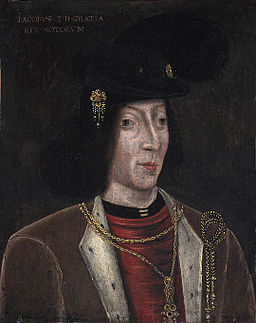
256px-James_III_of_Scotland

Seventeenth-century portrait of James III (Wikimedia Commons)

Lastly, there is a kind of poetic symmetry to this case taking place in 1488. Two months later, James III died at the battle of Sauchieburn on 11 June. After the battle, hoards of treasure belonging to the king were found in Edinburgh and in chests abandoned on the field – treasure which may have been amassed, at least in part, as a result of stowing away coins made of precious metals which he swapped out for the debased black money.11 If the fatal skirmish at Sauchieburn was a lightning strike at the heart of the storm created by James III’s reckless approach to kingship, the case of the black money cleared up by the magistrates of Aberdeen was a raindrop at its outer edge.


  1. Norman Macdougall, James III (Edinburgh: John Donald, 2009), pp.346-51, 359-68. 
  2. Elizabeth Gemmill and Nicholas Mayhew, Changing Values in Medieval Scotland: A Study of Prices, Money, and Weights and Measures (Cambridge: Cambridge University Press, 1995), p. 126; Macdougall, James III, pp. 183, 185. 
  3. Gemmill and Mayhew, Changing Values, p. 127. 
  4. It was also still affecting the Scottish crown’s financial administration, when a case involving payment of black money to the Comptroller was addressed in 1487 – Gemmill and Mayhew, Changing Values, p. 127. 
  5. Minor changes have been made to the text to aid readability 
  6. Gemmill and Mayhew, Changing Values, p. 127. 
  7. Gemmill and Mayhew, Changing Values, p. 125. 
  8. Other debased coins, known as billon placks, were used in James III’s reign but Joan Murray insisted that there are ‘strong reasons against identifying the billon placks as part of the black money’ – Joan E. L. Murray, ‘The Black Money of James III’ in British Archaeological Reports, 45 (1977), pp. 115-130 (p. 119). 
  9. Gemmill and Mayhew, Changing Values, p. 125. 
  10. The same phrase was used in a passage identified by Joan Murray as referring to the 1480-82 black money from a record of a case heard before the lords of council in 1482 – Murray, ‘Black Money’, p. 117. 
  11. Norman Macdougall, James IV (Edinburgh: John Donald, 1989), p. 51; Macdougall, James III, p. 186. 

A Case of Goods Lost at Sea (1485)

ACR, 6, p. 904 (11 February 1485)

by Edda Frankot

vol 6 p. 904 (jettison 1485)The port of Aberdeen in the later fifteenth century was not nearly as busy as it is today. Exactly how many ships docked at the medieval quays in an average year is unknown, but in the first half of the fifteenth century less than ten ships sailed abroad in most years.1 How many more would have had other Scottish ports as their destination is impossible to say, as a thorough port administration is simply not available. Thankfully, the Aberdeen Council Registers do offer a lot of qualitative information on shipping to and from Aberdeen and on the administration of legal cases between the various parties involved in this business. Such cases could be dealt with by different courts: there are instances of legal matters being administered in bailie courts, guild courts and by admirals depute in an admiralty court.2
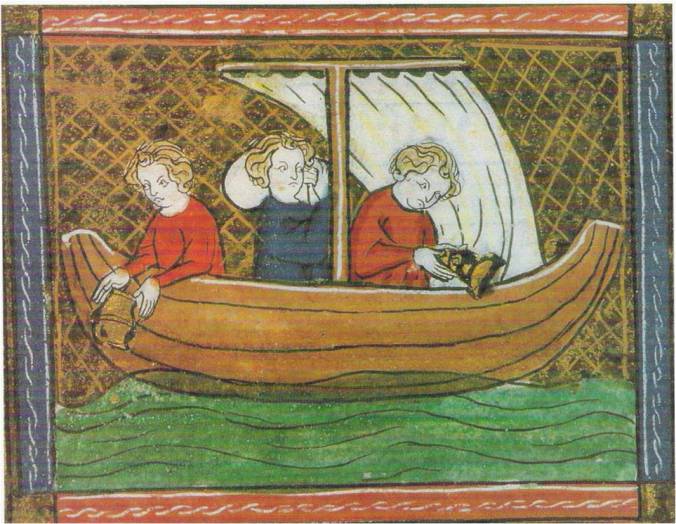
On 11 February 1485, in a court held by the bailies in the tolbooth, an assize (a jury) of twelve sworn men passed judgement in a case concerning the casting of goods from a buss (‘busch’, from the Dutch ‘buis’, originally a herring fishing vessel). The entry in the Aberdeen records is quite short, but offers a few interesting insights into the administration of law in the burgh and into maritime legal practice.

Many cases that were dealt with by the Aberdeen courts were decided by assizes. Sometimes the members are mentioned by name, but often also they are not. In this case twelve names are listed, but assizes in other examples range from between nine and fifteen, and usually an uneven number appears to have been preferred.3 In most cases there are no further indications as to who the members of the assize were and why they were chosen (though it will surely be possible to find out more about individuals when this project is finished and the corpus can be searched for names). An interesting exception is a case from 1449 in which seven members of the assize are identified as ‘mercatorum’, merchants, and the other eight as ‘nautarum’, skippers.4 In the case discussed here, too, three men are identified as members of the maritime community: Peter Andreis is the skipper of the buss in question, Copryng is his ‘stereman’, helmsman, and Michael is the helmsman of a ‘kervel’, a carvel that was most likely anchored in port at the time. As in many other examples, the ships are only identified as ‘the busch’ and ‘the kervel’, suggesting that only a small amount of vessels were docked at the quay at any one time. Sometimes names are mentioned, such as the James of Veere and the shipwreck of the Mary Grace, both with Dutch skippers, in an entry of 6 February 1482 and the Maryknight from Aberdeen in 1461.5

It is likely that the men elected onto the assize were in some way knowledgeable in sea law because they themselves were part of the maritime community. Normally one would only expect men of some authority and standing to be involved, as assizes were often specified to consist of ‘worthy men’ or ‘proborum virorum’, which in maritime cases would mean merchants, shipowners and skippers. But in this case two helmsmen were elected too. What is even more remarkable, though, is that two of the men specified were actually on the ship that was the subject of the lawsuit. What is more, Peter Andreis even passed judgement at his own expense (or rather that of the shipowners which he represented). One would think that this was highly unusual (and irregular), but in another case, between the earl of Orkney and merchants from Aberdeen, the matter was referred to the meeting of the commissioners of all the burghs in Edinburgh. The reason given was ‘… sen the mater langis thaim, thai arre lath to be jugis in their awne cause’.6 In that case too, it appears, the merchants involved would have been asked to judge their own case.

Picture1The assize decided that Walter, a merchant whose goods had been cast overboard, presumably in order to save the ship in an emergency situation, though this is not specifically stated, would be compensated for his losses. The other merchants would ‘lott’ with him. In addition, the skipper would ‘lott’ with the merchants whose goods had been cast with either his ship or his freight. To lot means to contribute a proportionate share to a common payment. This was the usual way in which the sacrifice made at sea to save the whole vessel, its goods and its passengers (in legal terminology: general average) was compensated in most of northern Europe in this period (with some variation). It is also in accordance with the Rôles d’Oléron. These medieval sea laws which originated in France appear to have been valid in Scotland, as several copies of a translation into Scots have survived as part of collections of the main Scottish laws.7

So, this short entry from volume 6 of the Aberdeen Council Registers already provides us with a wealth of information on maritime and legal life in the late medieval burgh: on types of ships frequenting its harbour, on who administered justice in its courts and on how its maritime practice fitted in with that elsewhere in northern Europe. There is so much more yet to explore, not only concerning Aberdeen’s harbour and its maritime community, but also with regard to many other aspects of medieval life, such as the market, the guild, and citizens breaking the law, but also concerning relations with other towns and with local lords such as the earls of Huntly and Mar. Stay tuned for more highlights from the collection!


  1. David Ditchburn, Scotland and Europe. The Medieval Kingdom and its Contacts with Christendom, c. 1214-1560 (East Linton 2000), p. 11, fig. 1.1; David Ditchburn and Marjory Harper, ‘Aberdeen and the outside world’, in: E. Patricia Dennison, David Ditchburn and Michael Lynch, eds, Aberdeen before 1800. A New History (East Linton 2002), p. 379. 
  2. Edda Frankot, ‘Of Laws of Ships and Shipmen’: Medieval Maritime Law and its Practice in Urban Northern Europe (Edinburgh 2012), pp. 56-7. 
  3. Frankot, Medieval Maritime Law, p. 155, notes 51 and 52. 
  4. ACR, 5/1, p. 68 (28 November 1449). 
  5. ACR, 6, p. 720 (6 February 1482); ACR, 5/1, p. 416 (11 April 1461). 
  6. For a more extensive discussion, see Frankot, Medieval Maritime Law, pp. 167-8; ACR, 5/2, p. 692 (16 December 1454). 
  7. Frankot, Medieval Maritime Law, pp. 110-120. The actual articles concerning jettison were, however, corrupted in the known versions of this translation: Ibid., p. 182.