Game Jam Showcases Creative Takes on Medieval Archives

Jam in Archives: a medieval game jam
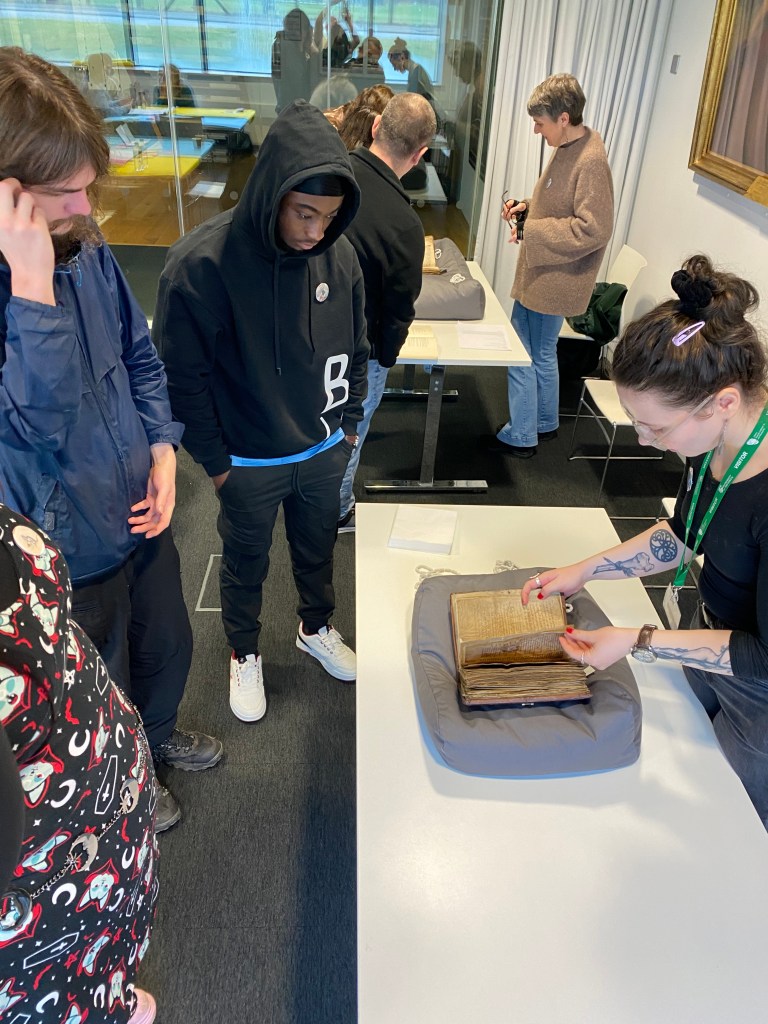
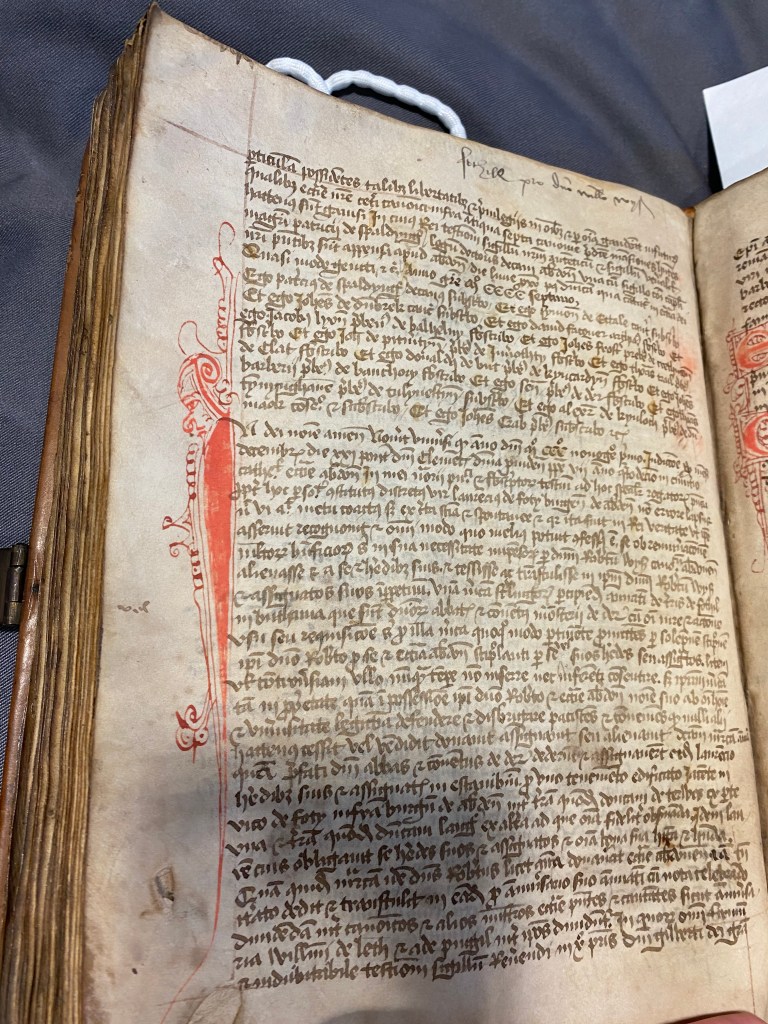
Last week was Jam in Archives: a medieval game jam inspired by manuscripts and books. Participants met on 22 January at the University of Aberdeen. This short, one-day jam focused on three examples of fifteenth-century cartularies, or books of charters, one from Scone Abbey (held by the NLS), one from Glasgow Cathedral, and one from Aberdeen’s St Machar’s Cathedral (both held in Aberdeen’s University Collections). They were introduced by Julia Vallius, a PhD student at Glasgow who has recently completed SGSAH-funded internship with the National Library of Scotland.

Jackson Armstrong introduced the day and William Hepburn gave an introduction to the variety of forms games can take, and to set out the theme and rules. The theme for the day was revealed to be “recording for the future” and the group formed into three teams. The icebreaker included some name badge making with various medieval images .

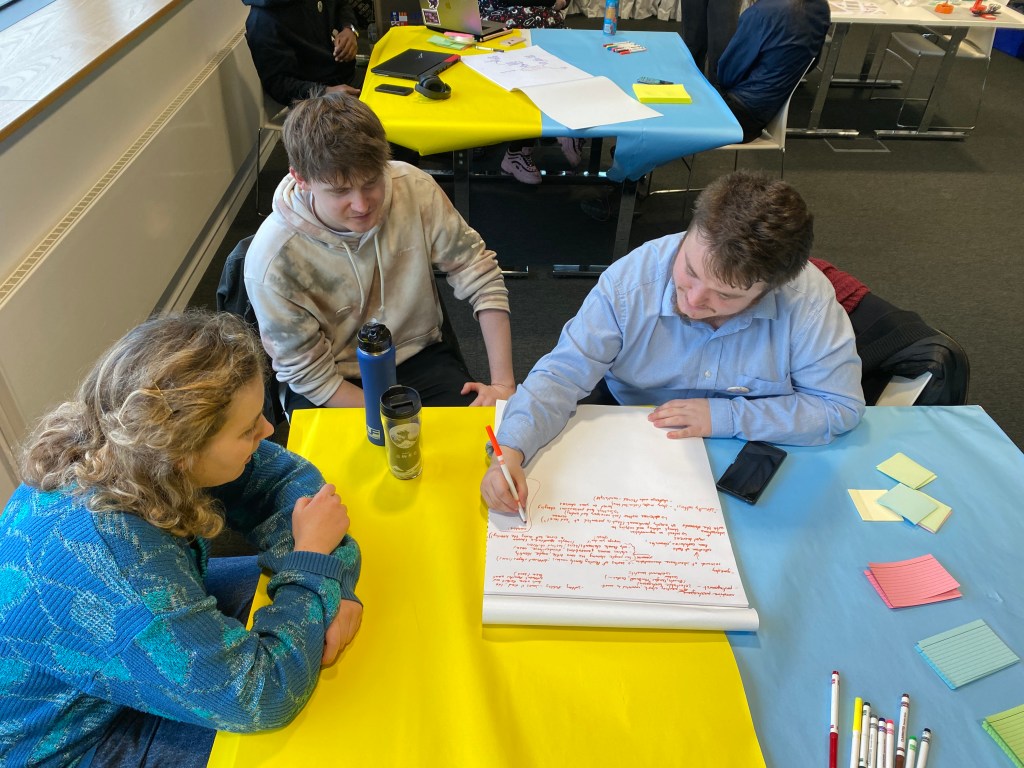
The teams had four hours in total to develop their ideas and demonstration materials for a digital game, and prepare a presentation for our guest judge Jon Ingold of inkle Studios.

The first team devised “Scribes of Succession”, a puzzle game which also invites players to learn about medieval records. After the death of a noble lord, his heir must show their claim to inheritance, and fend off the claims of a rival heir. The gameplay involves a series of tasks including locating a cartulary in a cathedral library, investigating who the scribes were that made copies of charters, and puzzling through their different handwriting, and identifying evidence to prove the heir’s right to succession against the rival.

The second team proposed the game entitled “Make your Claim”. In this game set in Scotland following the untimely death of King James II, the player is a clerk whose challenge is to evaluate the claims to lands of rival families. The clerk must decide who to support and whether evidence can be fabricated or ignored.

The third team created “Ink and Soil”, where the player’s job is to manage a medieval abbey’s lands and resources, and build up written records to protect their lands against neighbouring landowners. All the while pilgrims arrive making curveball demands on these resources.


Jon Ingold awarded an imaginary budget to each game. Scribes of Succession got £250,000, Make your Claim got £4,000, and Ink and Soil got £1,000,000 – as an indication of the scale of budget that might be required to realise each vision.

This Jam in the Archives event was a collaboration between University of Aberdeen, RGU, The National Library of Scotland, supported by the Scottish Graduate School for Arts & Humanities, and Common Profyt Games Ltd. Special thanks to the Univeristy Collections team for their support, and to all our participants for their creativity and enthusiasm!

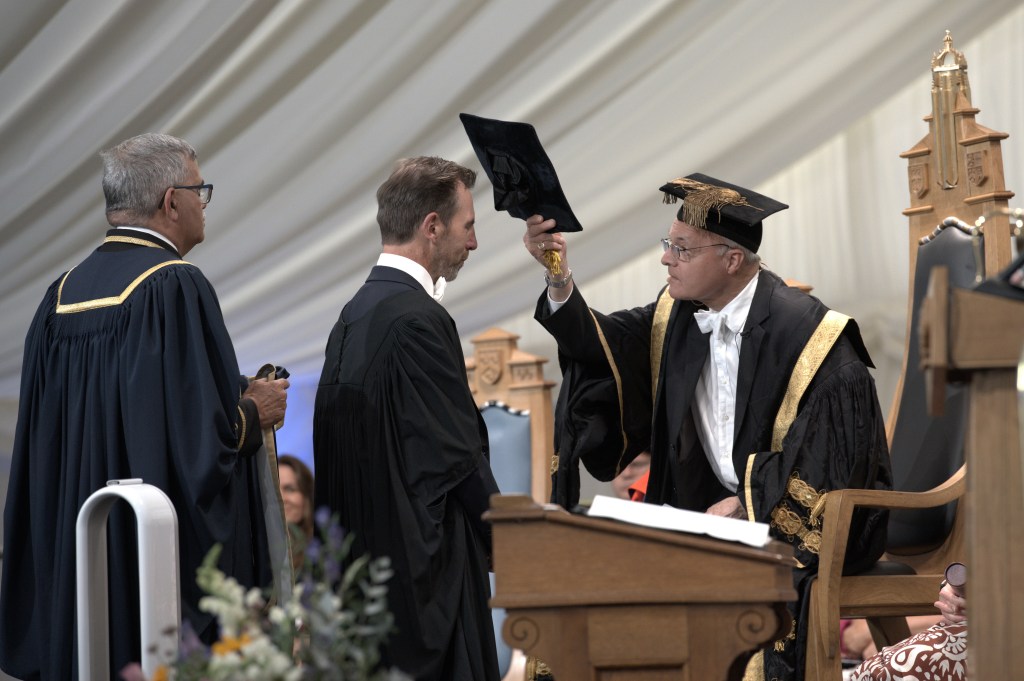
Honorary Degree for City Archivist Phil Astley

On Thursday 27 June Mr Phil Astley received the Honorary Degree of Master of the University.

Professor Jackson Armstrong gave the laureation address at the evening degree ceremony. He highlighted Phil Astley’s career-long dedication to archives and records management, and noted in particular his leadership in securing UNESCO UK Memory of the World recognition for the earliest council registers, and his instrumental efforts in establishing and fulfilling the thriving collaboration between City & University in the Aberdeen Burgh Records Project.

Jackson Armstrong also noted that Phil’s leadership of the City & Shire Archives has substantially contributed to Aberdeen’s civic cultural offering, including by example lunchtime talks at the Maritime Museum and Cowdray Hall, annual festivals such as Granite Noir, and numerous exhibitions at the Aberdeen Art Gallery and other venues.

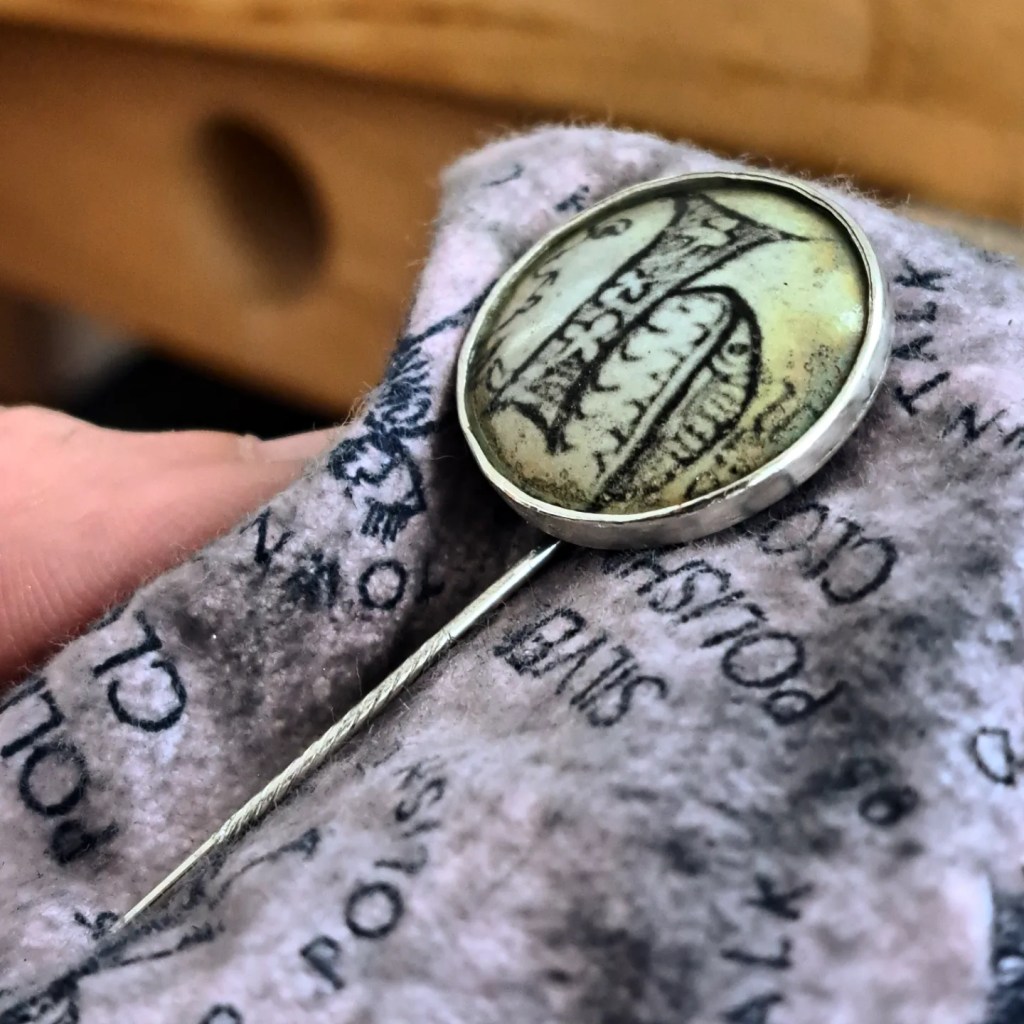
To mark the occasion with a gift for Phil, Jackson commissioned artist Stephanie Graham to make an enamel and silver lapel pin, using an image of the famous ‘fishman’ from the Aberdeen Council Registers. A beautiful result!

Congratulations Phil!

See the University news item here: https://www.abdn.ac.uk/news/23283/

Whitefriars of Aberdeen: A Working List of Witnesses to Carmelite Charters

Aberdeen History alum Julia Vallius has created a Working List to identify information about people who were witnesses or affixed their wax seals to many of the charters of the Aberdeen Carmelite friars from 1338 to 1431.

Detail from MARISCHAL/1/6/1/3/15 in University of Aberdeen Museums and Special Collections, licenced under CC By 4.0.

What is it? The Working List tabulates information about the surviving Aberdeen Carmelite charters, listed chronologically. For instance, it records that in 1399 for a charter by which William Crab donated land to the Carmelites, the witnesses included the provost, Adam de Benyn, and twelve other named men. It also records that the seals of William Crab, and of two bailies of the burgh (Simon de Benyn and William Blyndcele) were attached to the charter. This work helps to identify activities of burgh officials and other prominent figures, including in the period from c.1414–c.1433 when there is a gap in the main council register series.

The charters listed here are from the Marischal College Archives, part of the University of Aberdeen’s Special Collections. The Marischal collection in part contains the charters of the Carmelites, or Whitefriars, first established in Aberdeen in 1273.

Two sample transcriptions of charters are included, one in the Middle Scots vernacular, which records a grant in 1421 by Elizabeth Gordon of Gordon, who was the mother of the first earl of Huntly. She made her own gift and also confirmed “ye gift of my lady my eldmoder [grandmother] dam margret of keth ye qwilk my eldmoder has gifin to my said bretheris [the friars] of before tyme gone“.

The charters concerned have some playful illuminations, including that of a cockerel, shown above, and the head of a crowned king in a charter of David II, and intertwined fish, shown below.

Detail from MARISCHAL/1/1/1/4/4 in University of Aberdeen Museums and Special Collections, licenced under CC By 4.0.

Where is it? The Working List is available under a Creative Commons licence on the OSF (Open Science Framework), at https://osf.io/rdsfg/. Its long title is Working List of Witnesses and Authentication of Carmelite Charters, Aberdeen: Held in the Marischal College Archives (University of Aberdeen Museums and Special Collections), version 1.0, https://doi.org/10.17605/osf.io/rdsfg

Detail from MARISCHAL/1/1/1/4/4 in University of Aberdeen Museums and Special Collections,
licenced under CC By 4.0.

Where does it come from? The Working List began as the appendix created by Julia Vallius for her Senior Honours Dissertation entitled ‘Textual identities and urban communities: Understanding the role of charters and burgh records in the formation and creation of community identities, using the Aberdeen Carmelites charters as a case study’ (April 2020), supervised by Jackson Armstrong. Julia’s dissertation won the Kathleen Edwards Prize in Medieval History. Julia is currently undertaking a PhD in Medieval History at the University of Glasgow.

Julia and Jackson have worked over time to compile a first version of the Working List of Witnesses. Future versions can update, extend and augment this resource. Julia and Jackson are grateful for the support of the Museums and Special Collections throughout this project. 

Working List DOI link [ https://doi.org/10.17605/osf.io/rdsfg ]

Burgh Court Roll of 1317 Digitised & Online

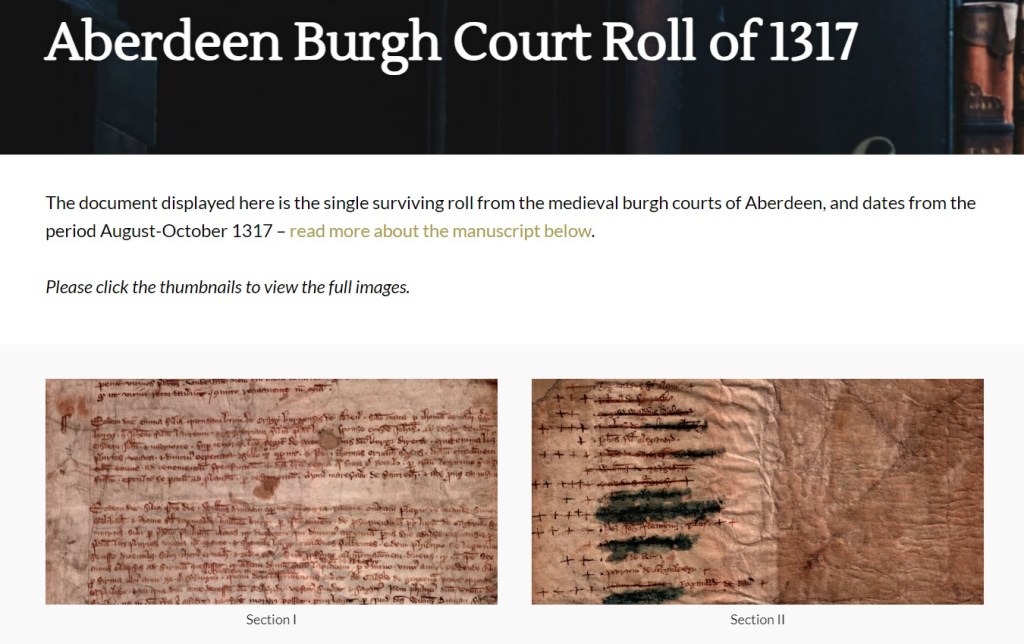
Earlier this year the Stair Society published a digital facsimile of the Aberdeen Burgh Court Roll of 1317. These images are available via the Stair Society’s digitised manuscripts page and are reproduced by kind permission of Aberdeen Archives, Gallery and Museums.

This is the single surviving roll from the medieval burgh courts of Aberdeen, and dates from the period August-October 1317. The roll thus predates the later council register volumes, which survive from 1398 onwards. The burgh court roll is on parchment and it represents a unique survival from the courts of a Scottish burgh dating from the early fourteenth century.

A translation of the roll into English, and a discussion of its contents is available in Andrew R. C. Simpson and Jackson W. Armstrong, ‘The Roll of the Burgh Courts of Aberdeen, August-October 1317’, in Miscellany Eight, ed. by A. M. Godfrey, Stair Society 67, (Edinburgh, 2020), 57-93 (see The Roll of the Burgh Courts of Aberdeen, August–October 1317 (stairsociety.org)).

For further discussion of the roll and its context, see Andrew R. C. Simpson, ‘Urban Legal Procedure in Fourteenth Century Scotland: A fresh look at the 1317 court roll of Aberdeen’, in Comparative Perspectives in Scottish and Norwegian Legal History, Trade and Seafaring, ed. by Andrew Simpson and Jørn Øyrehagen Sunde (Edinburgh, 2023), 181–208.

And for a recent overview of this new book see this post by Andrew Simpson on the Edinburgh Private Law Blog.

A link to the burgh court roll at the Stair Society is now featured within aberdeenregisters.org, with a dedicated page and linked in the main menu.

Volunteers build list of provosts, bailies and sergeands in the ARO

Aberdeen History grads Callum Judge (2020) and Sophia Nicol (2020) have created a working list of civic leaders in the burgh recorded in the Aberdeen Registers Online: 1398-1511.

Sophia and Callum built the list over the summer months of 2020, supervised by Jackson Armstrong. The list was made primarily by identifying elections of provosts, bailies and sergeands which occurred annually at the Michaelmas Head Court, or ‘curia capitalis’, held around 29 September, usually in early October.

Some 756 names of officers who served in the civic administration have been included – many individual people holding office on more than one occasion.

‘electus fuit in officium aldermanni’

The provost, or alderman, was the lead representative of the burgh. The provost was the administrative predecessor of today’s Lord Provost. The bailies had a range of duties, principally relating to justice and land. They presided over their own court, and oversaw the administration of land transactions. The sergeands (sometimes called bedels) were responsible for carrying out the execution of justice in the burgh courts, for instance in issuing summonses and collecting certain penalties. The electorate who chose these officials consisted of the burgesses of the town.

An exhaustive, final tally of all mentions of these officers in the ARO was not the intention in compiling this list. It is a working list – a first version which can be augmented and updated over time. There is not always an election recorded for each year in the ARO, and of course records for 1414-1433 have been missing for more than two centuries. Future work could include capturing additional references to these categories of officers in the corpus, and creating new lists of numerous other figures, such as deans of guild, council members, liners, ale tasters, meat apprisers, and more.

The list may be found here: Working list of provosts, bailies and sergeands in the Aberdeen Registers Online: 1398-1511. It is freely available to all as the first of a set of auxiliary resources to accompany the ARO.