Congratulations to Team Lima who were finalists at the Inform Prize 2025! Third-year Computing Science students in 2024-25 at Aberdeen took on a project to develop the successor platform for Search Aberdeen Registers (sar.abdn.ac.uk). The team included: Haziel Osunde, Rebekah Leslie, Fariha Ibnat, Holly Sinclair, Caitlin Thaeler, Andreas Maita, and Piotr Smialek.
The work of Team Lima has been fundamental to exploring what the future will look like for Search Aberdeen Registers, working towards key criteria for functionality, accessibility, maintenance, and durability.
Since 2014 the Inform Prize has grown into rewarding showcase of some amazing student group projects, developing digital solutions to real life problems. Find out more: https://www.intelligentplant.com/inform-prize
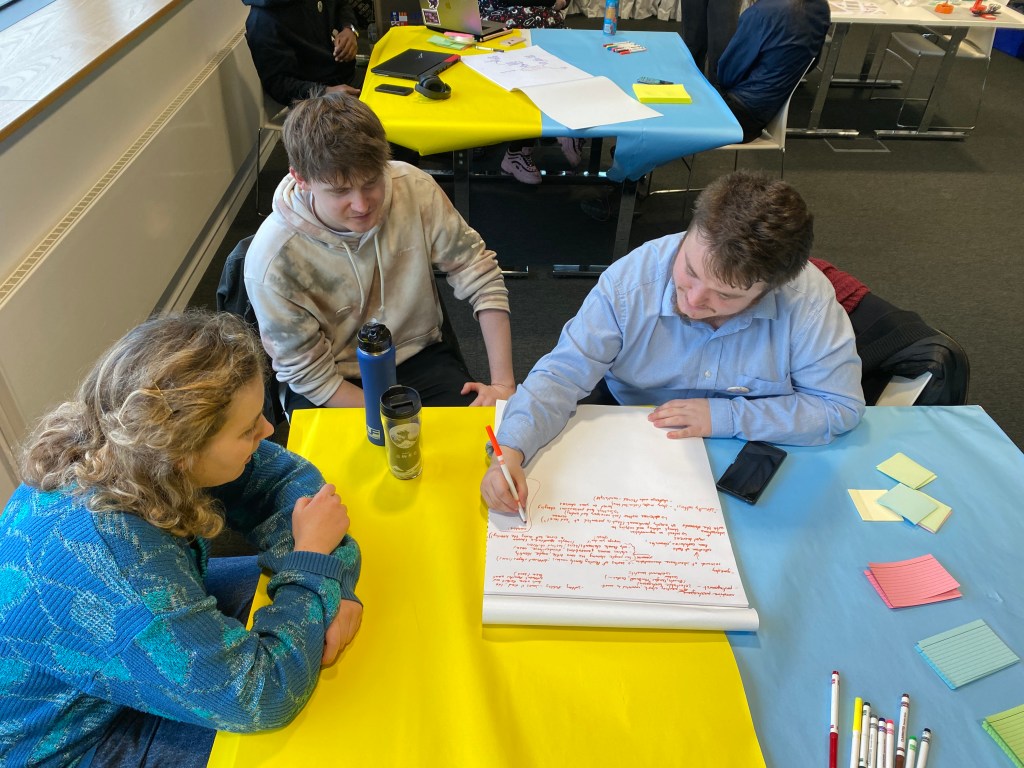
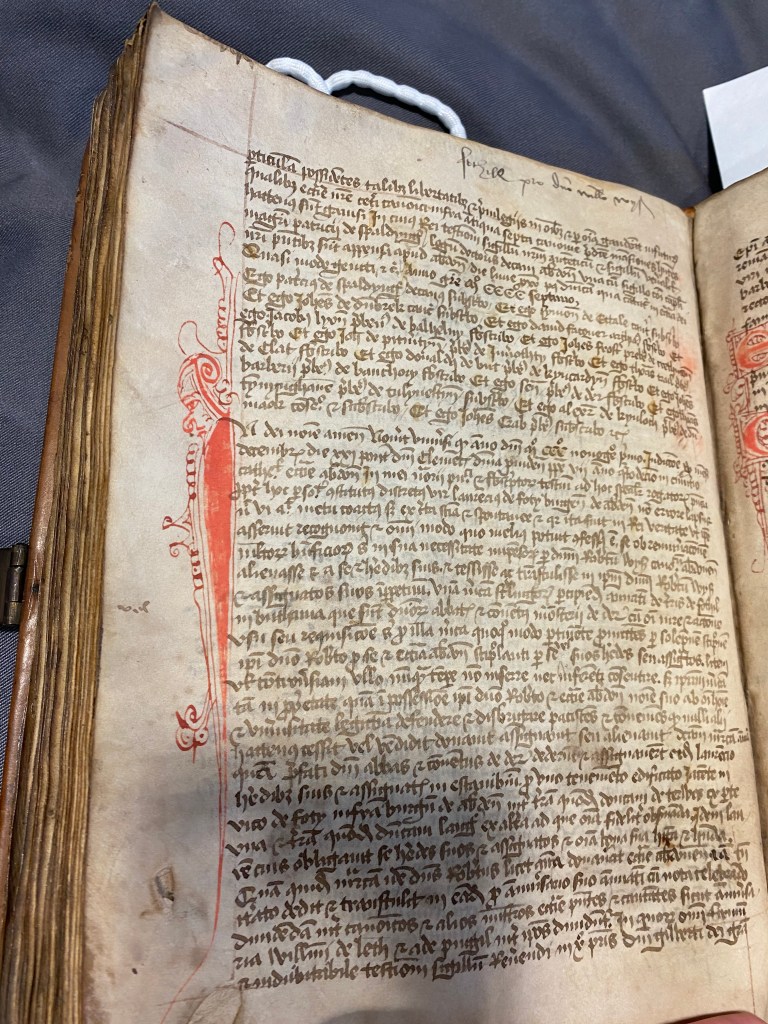
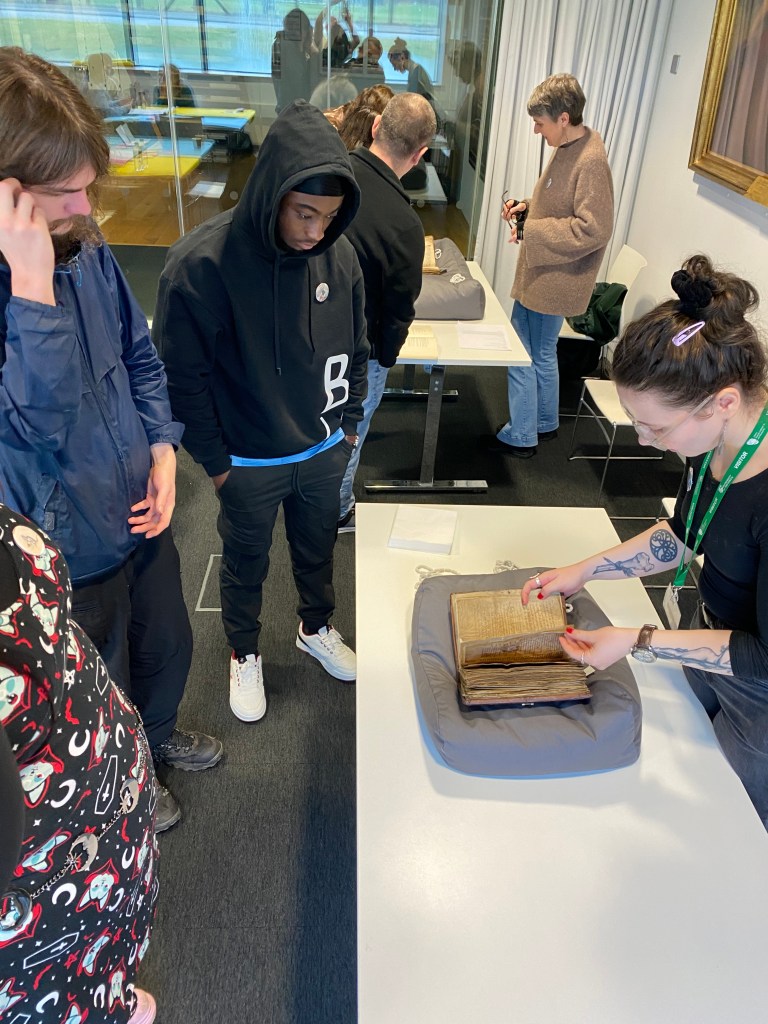
Last week was Jam in Archives: a medieval game jam inspired by manuscripts and books. Participants met on 22 January at the University of Aberdeen. This short, one-day jam focused on three examples of fifteenth-century cartularies, or books of charters, one from Scone Abbey (held by the NLS), one from Glasgow Cathedral, and one from Aberdeen’s St Machar’s Cathedral (both held in Aberdeen’s University Collections). They were introduced by Julia Vallius, a PhD student at Glasgow who has recently completed SGSAH-funded internship with the National Library of Scotland.
Jackson Armstrong introduced the day and William Hepburn gave an introduction to the variety of forms games can take, and to set out the theme and rules. The theme for the day was revealed to be “recording for the future” and the group formed into three teams. The icebreaker included some name badge making with various medieval images .
The teams had four hours in total to develop their ideas and demonstration materials for a digital game, and prepare a presentation for our guest judge Jon Ingold of inkle Studios.
The first team devised “Scribes of Succession”, a puzzle game which also invites players to learn about medieval records. After the death of a noble lord, his heir must show their claim to inheritance, and fend off the claims of a rival heir. The gameplay involves a series of tasks including locating a cartulary in a cathedral library, investigating who the scribes were that made copies of charters, and puzzling through their different handwriting, and identifying evidence to prove the heir’s right to succession against the rival.
The second team proposed the game entitled “Make your Claim”. In this game set in Scotland following the untimely death of King James II, the player is a clerk whose challenge is to evaluate the claims to lands of rival families. The clerk must decide who to support and whether evidence can be fabricated or ignored.
The third team created “Ink and Soil”, where the player’s job is to manage a medieval abbey’s lands and resources, and build up written records to protect their lands against neighbouring landowners. All the while pilgrims arrive making curveball demands on these resources.
Jon Ingold awarded an imaginary budget to each game. Scribes of Succession got £250,000, Make your Claim got £4,000, and Ink and Soil got £1,000,000 – as an indication of the scale of budget that might be required to realise each vision.
This Jam in the Archives event was a collaboration between University of Aberdeen, RGU, The National Library of Scotland, supported by the Scottish Graduate School for Arts & Humanities, and Common Profyt Games Ltd. Special thanks to the Univeristy Collections team for their support, and to all our participants for their creativity and enthusiasm!
Hetty Haxworth and Kit Martin’s medieval art sessions returned this term in person to an Aberdeenshire school. They were joined by Jovi Fawcett and Jackson Armstrong who brought medieval bones and decoding ancient handwriting to the mix of activities.
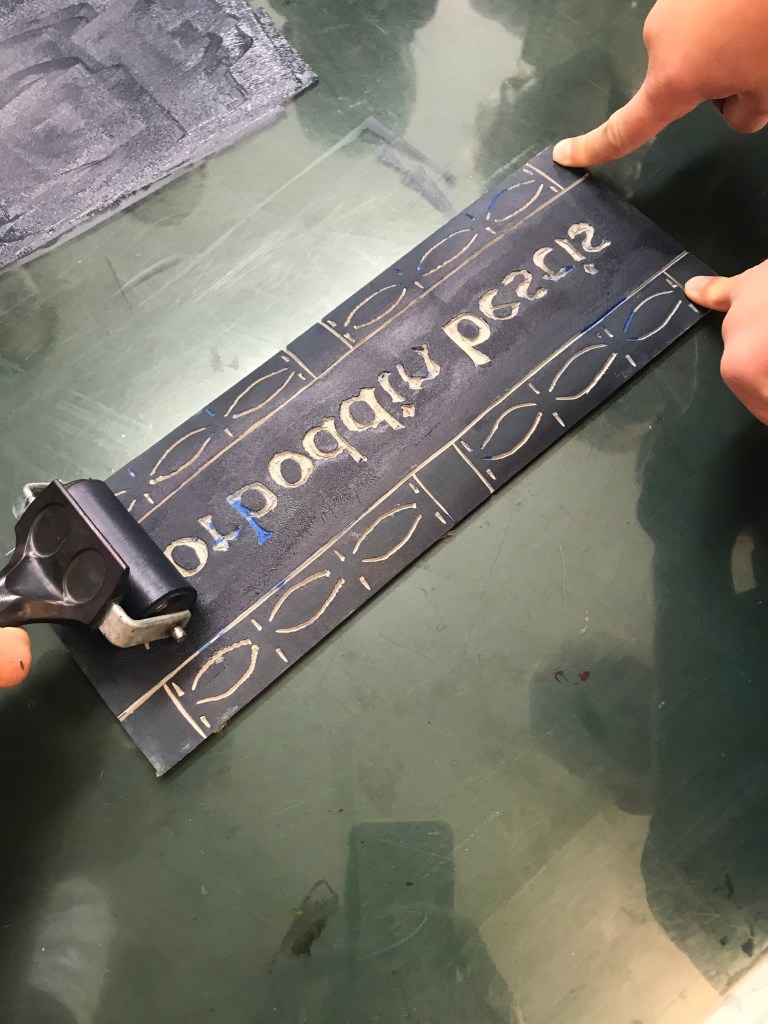
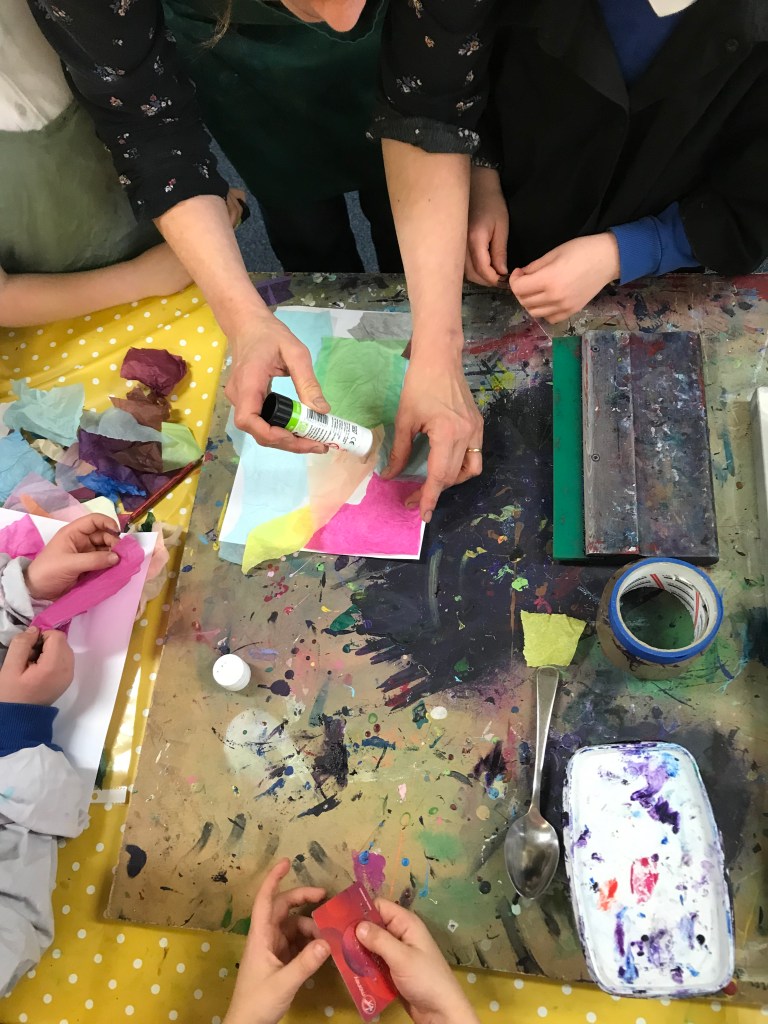
A few years ago artists Hetty Haxworth and Kit Martin worked with the Aberdeen Burgh Records Project to create workshops for primary schools using block printing, monoprinting, collage, design and drawing, all inspired by the content of the Aberdeen Registers Online. Now in person and without any pandemic restrictions (which had meant the original sessions had to be done by instructional video), Hetty, Kit, Jovi and Jackson visited Fettercairn Primary in Aberdeenshire on 31 October and 1 November, and worked with all years from nursery to Primary 7.
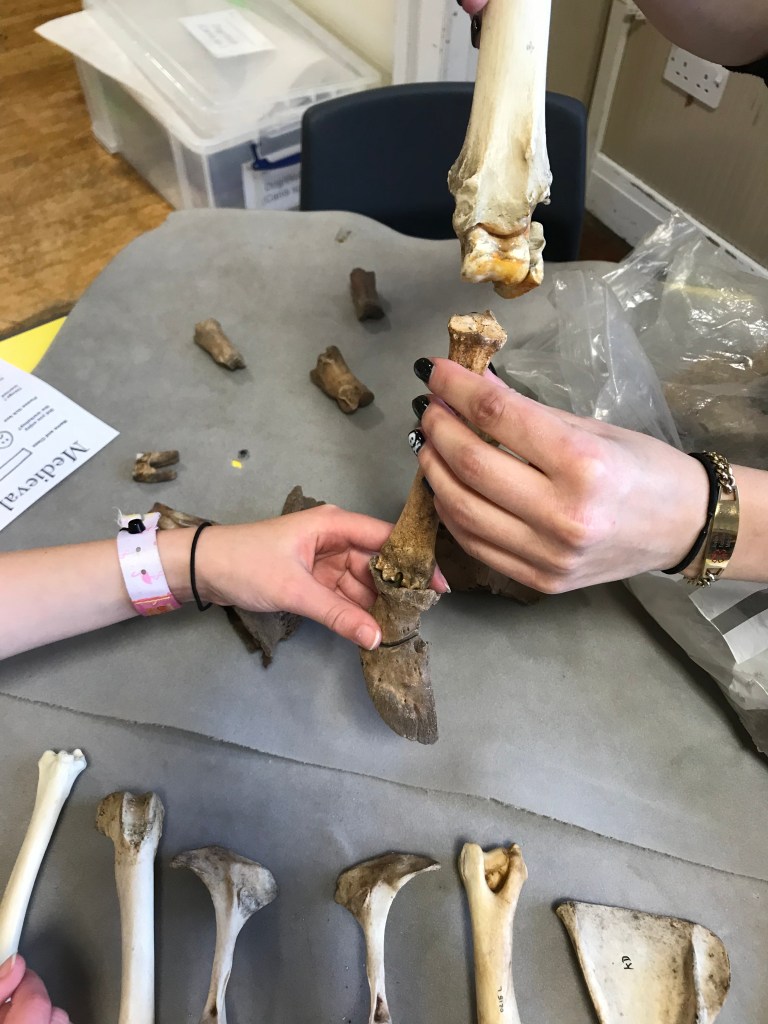
The class groups focused on themes of animals, fish and seafaring in medieval Aberdeen. The Middle Scots phrases ‘rede and suet’ (for salmon) and ‘forboddin bestis’ (for unruly escaped pigs) formed the focus of the artworks that the pupils made in stages by using different printing techniques. PhD student Jovi Fawcett brought examples of medieval and modern bones of sheep and pigs to the school, for the groups to handle. Jackson challenged the pupils to test their palaeography skills and decode examples of letters and words in the ARO.
The result was an exciting mixture of art, archaeology, & historical language. The pupils experienced hands-on practice with print making and drawing. They handled archaeological teaching bones and explored different types of bones articulations, and they encountered Middle Scots words, phrases and medieval handwriting. Feedback from pupils and teachers was positive, and the artworks created by the groups are on display in the school.
Aberdeen History alum Julia Vallius has created a Working List to identify information about people who were witnesses or affixed their wax seals to many of the charters of the Aberdeen Carmelite friars from 1338 to 1431.
Detail from MARISCHAL/1/6/1/3/15 in University of Aberdeen Museums and Special Collections, licenced under CC By 4.0.
What is it? The Working List tabulates information about the surviving Aberdeen Carmelite charters, listed chronologically. For instance, it records that in 1399 for a charter by which William Crab donated land to the Carmelites, the witnesses included the provost, Adam de Benyn, and twelve other named men. It also records that the seals of William Crab, and of two bailies of the burgh (Simon de Benyn and William Blyndcele) were attached to the charter. This work helps to identify activities of burgh officials and other prominent figures, including in the period from c.1414–c.1433 when there is a gap in the main council register series.
The charters listed here are from the Marischal College Archives, part of the University of Aberdeen’s Special Collections. The Marischal collection in part contains the charters of the Carmelites, or Whitefriars, first established in Aberdeen in 1273.
Two sample transcriptions of charters are included, one in the Middle Scots vernacular, which records a grant in 1421 by Elizabeth Gordon of Gordon, who was the mother of the first earl of Huntly. She made her own gift and also confirmed “ye gift of my lady my eldmoder [grandmother] dam margret of keth ye qwilk my eldmoder has gifin to my said bretheris [the friars] of before tyme gone“.
The charters concerned have some playful illuminations, including that of a cockerel, shown above, and the head of a crowned king in a charter of David II, and intertwined fish, shown below.
Detail from MARISCHAL/1/1/1/4/4 in University of Aberdeen Museums and Special Collections, licenced under CC By 4.0.
Where is it? The Working List is available under a Creative Commons licence on the OSF (Open Science Framework), at https://osf.io/rdsfg/. Its long title is Working List of Witnesses and Authentication of Carmelite Charters, Aberdeen: Held in the Marischal College Archives (University of Aberdeen Museums and Special Collections), version 1.0, https://doi.org/10.17605/osf.io/rdsfg
Detail from MARISCHAL/1/1/1/4/4 in University of Aberdeen Museums and Special Collections, licenced under CC By 4.0.
Where does it come from? The Working List began as the appendix created by Julia Vallius for her Senior Honours Dissertation entitled ‘Textual identities and urban communities: Understanding the role of charters and burgh records in the formation and creation of community identities, using the Aberdeen Carmelites charters as a case study’ (April 2020), supervised by Jackson Armstrong. Julia’s dissertation won the Kathleen Edwards Prize in Medieval History. Julia is currently undertaking a PhD in Medieval History at the University of Glasgow.
Julia and Jackson have worked over time to compile a first version of the Working List of Witnesses. Future versions can update, extend and augment this resource. Julia and Jackson are grateful for the support of the Museums and Special Collections throughout this project.
There are a few highlights to note as 2022 draws to a close.
After our excursion to Germany with the FLAG team in October, we returned home to learn that Strange Sickness had received some wonderful recognition.
Strange Sickness was nominated for a BAFTA Scotland Award in the game category, and longlisted in the creativity category at the Scottish Games Awards. The latter was part of the first ever Scottish Games Week, held at the end of October, which was a busy set of activities bringing the games industry together across Scotland.
The BAFTA Scotland Awards ceremony in Glasgow in November was only the second time that the whole Strange Sickness team of William, Katherine, Alana and Jackson had been together in person. It was a dazzling night – no less than two Doctor Whos were there – and it was a great honour to be recognised in this way.
On 29 December, William featured in a radio interview for The World, about the Strange Sickness project.
The World, based in Boston, Massachusetts, is US public radio’s longest-running daily global news programme. Check out the interview in the broadcast online here.
And finally, something seasonal from the Burgh Records…
On this day (31 December) in 1481, several alewives were convicted for selling ale at a higher price than the burgh statutes allowed. Presumably demand was high during the festive period of yule! The day was, of course, not reckoned to be the end of the year under the old calendar, although the date did fall within the yuletide period. These cases were heard in the bailie court which met this day (it was a Monday). The next day of business was the yule head court, held on Monday 7 January. See this blog post about holidays in the ARO.
Of these women only two were identified by their given names: Joneta (spouse of William Rate), and Agnes Baxtar. Another woman, called the spouse of William Moyses and the widow of John Cathkyn, was named. One man – Nicholas Baxtar – was also convicted for selling ale against the common ordinance on behalf of his wife (possibly Agnes who was listed separately) and the wives of Duncan Smyth and John Sincler.
No punishments were specified, suggesting that these measures were a matter of course, the convictions being more of a slap on the wrist than anything more severe. Brewing was a craft dominated by women, and here is a little snapshot of the way in which the courts were used, even during a holiday period, to regulate those who supplied this refreshment to the people of the burgh.
September sees a number of events linked to the Burgh Records Project & the Strange Sickness game.
On Saturday 17th September, 15:45-16:15, at the Sir Duncan Rice Library, William & Jackson will contribute to the Uni-Versal History & Heritage Festival with a short talk on Strange Sickness. More details may be found here www.abdn.ac.uk/events/17704/
On Wednesday 21st September, 12:30-13:15, at the Aberdeen Maritime Museum, William & Jackson will present a Lunchtime talk on the making of Strange Sickness. More details may be found here: www.aberdeencity.gov.uk/AAGM talk
And on Friday 30th September, 19:00-22:00, at the Aberdeen Art Gallery, as part of Gallery Late: Medieval Mayhem, William & Jackson will have a showcase of Strange Sickness and be on hand to chat about the game and answer questions! More details at this link: www.aberdeencity.gov.uk/AAGM medieval
Rumour has it they may have medieval-themed costumes in the works for some of these sessions…
Come along and learn about exploring history through games!
Musician and researcher D. James Ross has published a short paper about his investigations into the nebulous but fascinating Gray family in Aberdeen in the later fifteenth and early sixteenth centuries.
A member of the family was Robert Kervour (Carver), Scotland’s most outstanding Renaissance composer. He is also the man who, as heir to the chaplain Andrew Gray who died in 1504, was to be given possession of Gray’s still for aquavite and rosewater (see the blog post and news item from 2019).
The book examines the practice of banishment for what it reveals about morally acceptable behaviour in late medieval urban society. Punishment was used by authorities in Kampen to address sexual offences, but also for other matters, including the non-payment of fines. The book considers the legal context of the practice, and banishment as a punitive and coercive measure. It also discusses the redemption of exiles, either because their punishment was completed, or because they arranged for the payment of outstanding fines.
Edda said: “The study is something that evolved over a long period of time, while I was engaged on other projects, so much of the book I worked on in my spare time. I think it provides a multi-layered insight into late medieval urban society and legal culture, utilising not only a wide range of written sources, but also contemporary drawings from fifteenth-century Kampen.”
There are eight days remaining in the Strange Sickness Kickstarter campaign . But what does ‘strange sickness’ mean, and why have we chosen it as the title for the game? In this blog post I’ll dive into some of the sources from Aberdeen in which the evocative term is used.
In her recent book, Karen Jillings noted the association of the term with syphilis in the early sixteenth century, called at the time the Great Pox.[1] For instance, an entry from the Aberdeen council registers in 1507 refers to ‘the strange sickness of Naples’. The disease of Naples was another widely-used term for syphilis.[2]
Earlier entries suggest the term ‘strange sickness’ had broader applicability. Certainly, one use of the term from 1497 seems to refer to a venereal disease, coming as it does on the same day as an entry outlining cruel punishments imposed on ‘licht’ (‘immoral’) women, probably referring to sex workers, stipulating that unless they refrained from ‘vicis and Syne of venere’ (‘vices and the sin of sexual indulgence’) they would be burned on the cheek with a hot iron key and banished from the town (click on links in footnotes to see orginal records and transcriptions).[3]
However, an entry from 1498 suggests the term was used more generally, at least at this stage. It records an ordinance of the town for the inhabitants to close the gates at the back of their properties and build up their back walls in order to keep the town safe from ‘the pestilence and ale vthir Strang Seknes’ (‘the pestilence and all other strange sickness’).[4] This refers to the layout of the town, with the backs of individual properties effectively making up the physical boundary of the town, as can still be seen in Gordon of Rothiemay’s map from 1661.[5]
The phrasing here suggests pestilence (i.e. plague) was regarded as ‘strange sickness’ along with other types of disease. That plague was included as a type of strange sickness is further suggested by two entries from 1500. A statute issued on 15 August 1500 stated that people coming off a ship recently arrived from Danzig (today Gdansk) should be quarantined ‘for the sawite and weilfar of the town’ fra ale sthrange seknes’ (‘for the safety and welfare of the town from all strange sickness’).[6] Another statute, from six days later (21 August 1500), imposed further measures related to the ship from Danzig ‘for the escheving of the plage of pestilence and safte of this tone’ (‘for the eschewing of the plague of pestilence and safety of this town’).[7] Two entries from 1506 clearly include plague under the umbrella of ‘strange sickness’.[8]
If ‘strange sickness’ was a general term, encompassing plague, syphilis and possibly other diseases, what does it tell us about their shared characteristics? ‘Sickness’ is clear enough, but strange is a little more ambiguous. In Older Scots ‘strange’ as an adjective could mean, much as does in modern English, unusual or unfamiliar. It could also mean exceptional and, more specifically, alien or foreign.[9]
Certainly, in the late 1490s, syphilis was an unfamiliar disease, and Karen Jillings has argued that Aberdeen was ‘the first government body in the British Isles to tackle the Great Pox.’[10] Aberdonians may have been well aware of plague at this time, at least in theory, but it too is likely to have been unfamiliar in terms of personal experience for most, with no evidence that the disease had struck in the town for many generations.[11] Both diseases could also have been regarded as ‘strange’ in the sense of foreign or alien, with the Aberdeen records referring to France as the source of syphilis and the fears of plague sparked by the arrival of a ship from Danzig. They both too could have been regarded as exceptional in their severity.
The usage ‘strange sickness’ in late-medieval Aberdeen may capture all of these meanings, and it speaks to the role of uncertainty in the human experience of disease and infection. Even after months of blanket media coverage, growing scientific evidence and widespread testing, our experience of Covid-19 often remains shrouded in uncertainty, even setting aside the proliferation of conspiracy theories and disinformation. Symptoms overlap with other conditions, making it hard without a test to know if you have it (and even tests can be inaccurate). When a case is confirmed, working out exactly how it was transmitted comes with even greater uncertainty. All of this has contributed to a strangely intangible sense of threat throughout much of 2020, although for many of those who have caught the virus, and their family, friends and carers, the threat has sadly become all too tangible.
When rumours swirled of the plague and the Great Pox in late-medieval Scotland – diseases which were far more deadly than even Covid-19 – fear and uncertainty must have been widespread. The term ‘strange sickness’ resonates with this atmosphere, which we intend to evoke, and allow players to navigate, in the game.
[1] Karen Jillings, An Urban History of the Plague: Socio-Economic, Political and Medical Impacts in a Scottish Community, 1500-1650 (Abingdon: Routledge, 2018), p. 79.
[2] Jillings, An Urban History of the Plague, p. 77.
We are very pleased to announce the publication of Aberdeen Registers Online: 1398-1511 (ARO), the digital transcription of the first eight volumes of the Aberdeen Council Registers.
From the new ARO website housed within the Research Institute of Irish and Scottish Studies, the complete resource is available for download as a set of XML files. The website also links to a prototype search platform which allows searching and browsing within the ARO, and display of corresponding images from the registers.









 aberdeen registers