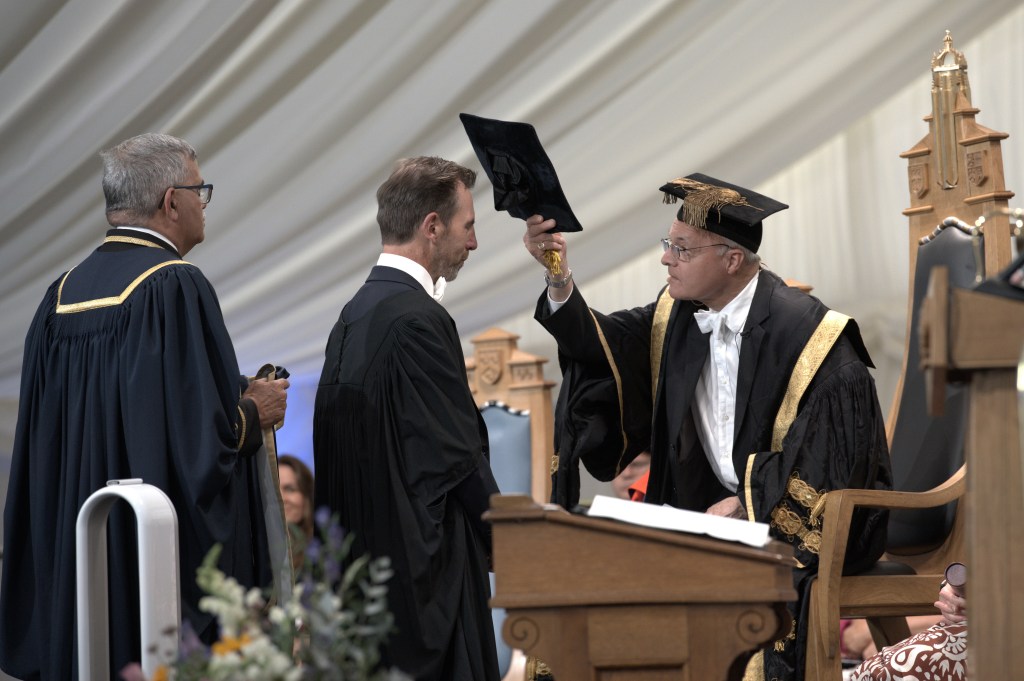
On Thursday 27 June Mr Phil Astley received the Honorary Degree of Master of the University.
Professor Jackson Armstrong gave the laureation address at the evening degree ceremony. He highlighted Phil Astley’s career-long dedication to archives and records management, and noted in particular his leadership in securing UNESCO UK Memory of the World recognition for the earliest council registers, and his instrumental efforts in establishing and fulfilling the thriving collaboration between City & University in the Aberdeen Burgh Records Project.
Jackson Armstrong also noted that Phil’s leadership of the City & Shire Archives has substantially contributed to Aberdeen’s civic cultural offering, including by example lunchtime talks at the Maritime Museum and Cowdray Hall, annual festivals such as Granite Noir, and numerous exhibitions at the Aberdeen Art Gallery and other venues.
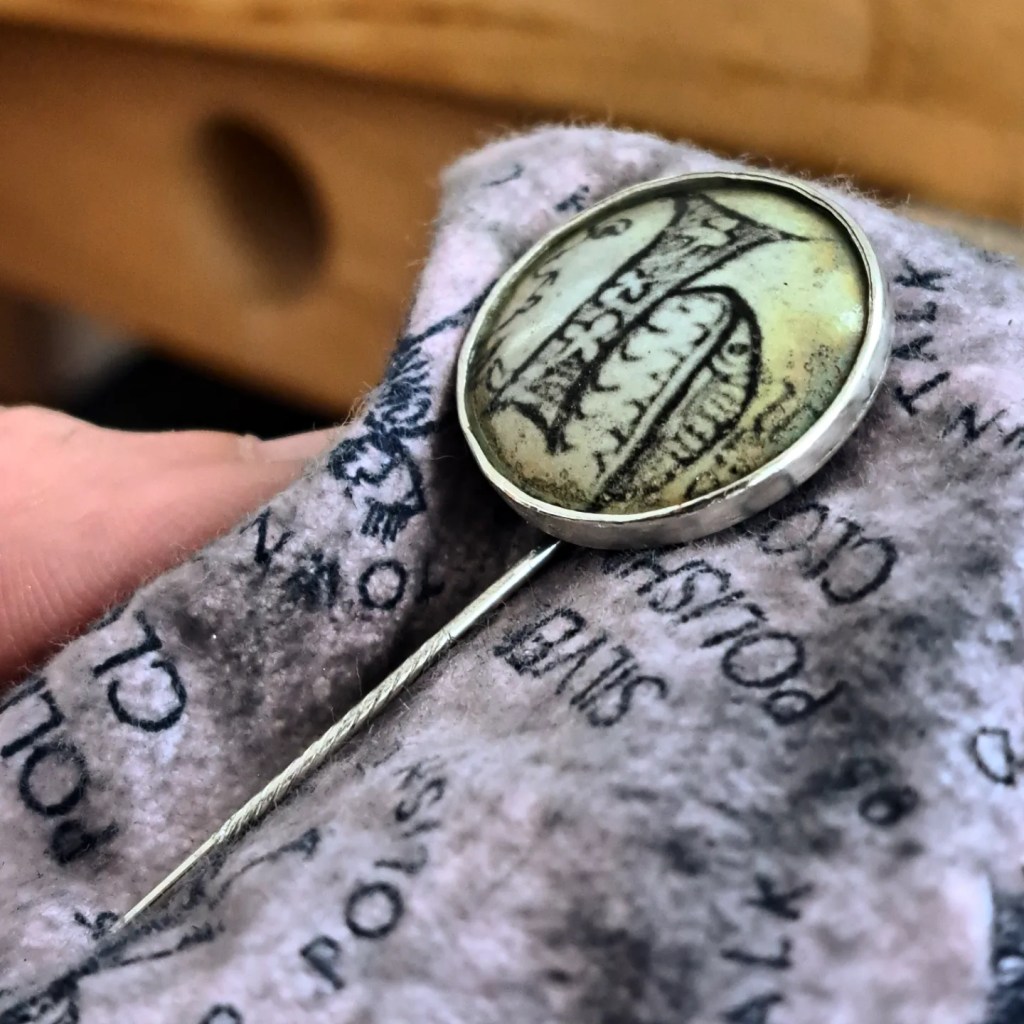
To mark the occasion with a gift for Phil, Jackson commissioned artist Stephanie Graham to make an enamel and silver lapel pin, using an image of the famous ‘fishman’ from the Aberdeen Council Registers. A beautiful result!
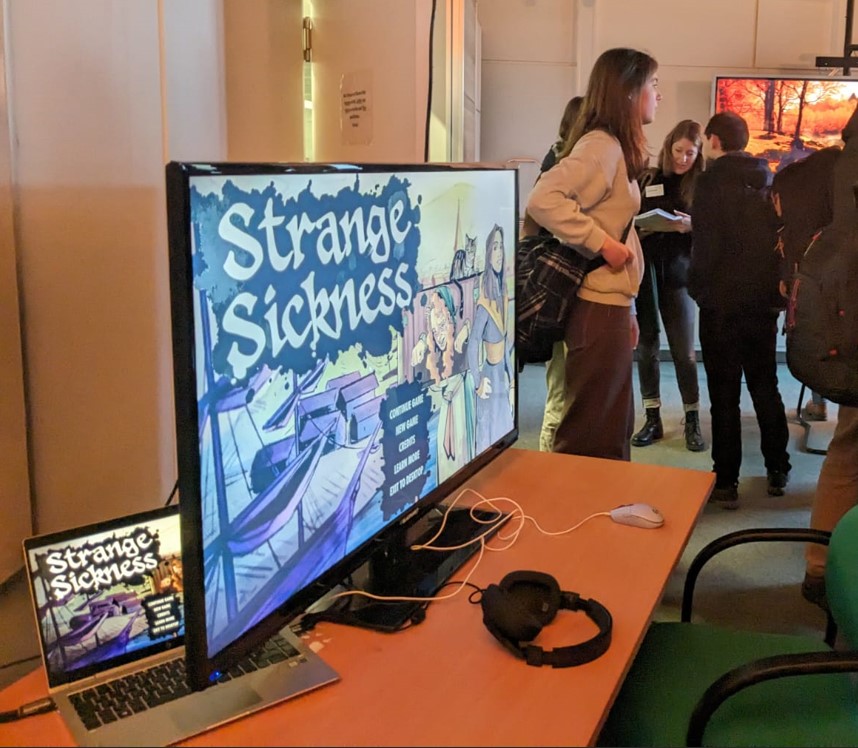
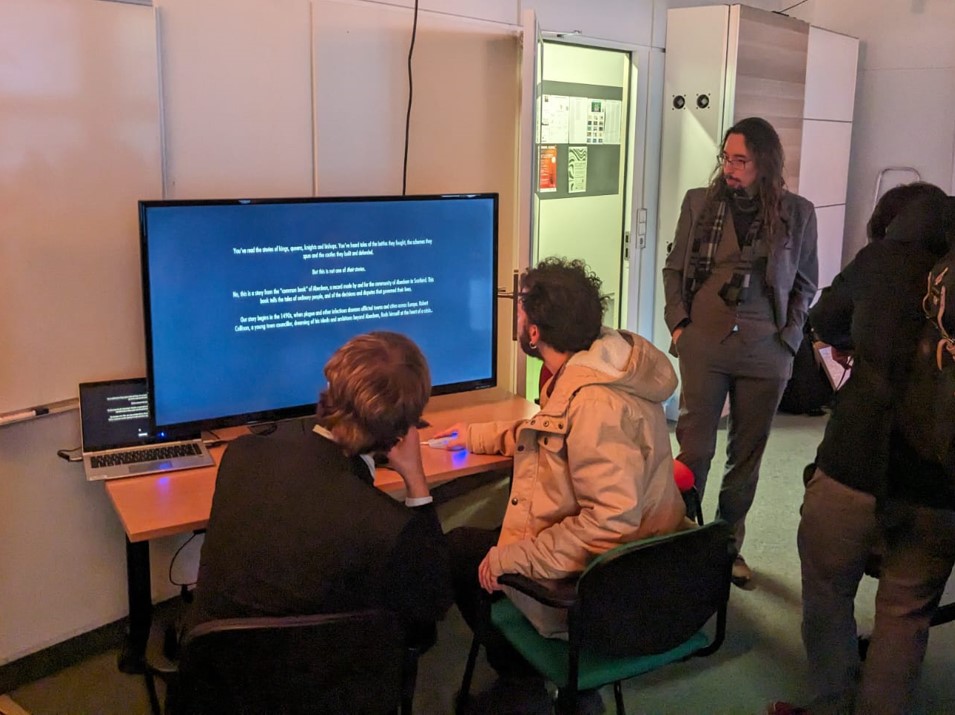
They spoke on ‘Historical primary sources in video games’, exploring ideas about how games can expose historical practice and drawing on their game making experience in Strange Sickness. They were there in true hybrid fashion – William in person while Jackson joined online. The workshop was expertly organised and hosted by Dr Eduardo Luersen and Dr James Wilson : they’re in the photo playing Strange Sickness at the evening session in the GameLab.
The workshop included fascinating papers and discussions including on the topics of historical knowledge, expertise and practice in game-making, on how code and mechanics can make historical arguments, and on the reception of and access to historical ideas through games. The first evening also included a roundtable with the historian and narrative director at Ubisoft, on the process of making of Assassin’s Creed Mirage (2023). Thanks to Eduardo and James for hosting a very stimulating event!
On 14 March Jackson Armstrong gave a paper entitled “All thingis covntit”: Government and Accounting in Fifteenth-Century Burghs.
This was for a joint meeting of the Scottish History Seminar and Medieval History Research Seminar at the University of Edinburgh, coordinated by Dr Alasdair Raffe and Dr Emily Ward.
The presentation explored different types of accounts created in medieval burghs, and what those involved in governing towns thought they were doing when they drew them up and subjected them to audit. The paper represents work underway arising from the FLAG project, and there was a rich discussion afterwards about the nature of account-keeping in medieval and early modern Scotland. It was a valuable opportunity to examine these topics, and also for Jackson to catch up with colleagues and some former students!
On 21 February Jackson Armstrong and William Hepburn gave a talk on ‘Historical Archives & Video Game Development’ in Edinburgh.
This was for the History, Time & Temporality in Music, Sound & Media research cluster, at the Reid School of Music, Edinburgh College of Art. The cluster is running a series this semester on games, coordinated by Dr James Cook.
The presentation explored the approach to history adopted in Strange Sickness, the idea of ‘creative translation’ of historical sources, the different ways a game can be historical, and the lessons learned in making this game. There was a stimulating discussion with the audience questions, in person and online, around the textual, visual and aural layers of games.
William Hepburn reflecting on visual representations of lost spaces
Aberdeen History alum Julia Vallius has created a Working List to identify information about people who were witnesses or affixed their wax seals to many of the charters of the Aberdeen Carmelite friars from 1338 to 1431.
Detail from MARISCHAL/1/6/1/3/15 in University of Aberdeen Museums and Special Collections, licenced under CC By 4.0.
What is it? The Working List tabulates information about the surviving Aberdeen Carmelite charters, listed chronologically. For instance, it records that in 1399 for a charter by which William Crab donated land to the Carmelites, the witnesses included the provost, Adam de Benyn, and twelve other named men. It also records that the seals of William Crab, and of two bailies of the burgh (Simon de Benyn and William Blyndcele) were attached to the charter. This work helps to identify activities of burgh officials and other prominent figures, including in the period from c.1414–c.1433 when there is a gap in the main council register series.
The charters listed here are from the Marischal College Archives, part of the University of Aberdeen’s Special Collections. The Marischal collection in part contains the charters of the Carmelites, or Whitefriars, first established in Aberdeen in 1273.
Two sample transcriptions of charters are included, one in the Middle Scots vernacular, which records a grant in 1421 by Elizabeth Gordon of Gordon, who was the mother of the first earl of Huntly. She made her own gift and also confirmed “ye gift of my lady my eldmoder [grandmother] dam margret of keth ye qwilk my eldmoder has gifin to my said bretheris [the friars] of before tyme gone“.
The charters concerned have some playful illuminations, including that of a cockerel, shown above, and the head of a crowned king in a charter of David II, and intertwined fish, shown below.
Detail from MARISCHAL/1/1/1/4/4 in University of Aberdeen Museums and Special Collections, licenced under CC By 4.0.
Where is it? The Working List is available under a Creative Commons licence on the OSF (Open Science Framework), at https://osf.io/rdsfg/. Its long title is Working List of Witnesses and Authentication of Carmelite Charters, Aberdeen: Held in the Marischal College Archives (University of Aberdeen Museums and Special Collections), version 1.0, https://doi.org/10.17605/osf.io/rdsfg
Detail from MARISCHAL/1/1/1/4/4 in University of Aberdeen Museums and Special Collections, licenced under CC By 4.0.
Where does it come from? The Working List began as the appendix created by Julia Vallius for her Senior Honours Dissertation entitled ‘Textual identities and urban communities: Understanding the role of charters and burgh records in the formation and creation of community identities, using the Aberdeen Carmelites charters as a case study’ (April 2020), supervised by Jackson Armstrong. Julia’s dissertation won the Kathleen Edwards Prize in Medieval History. Julia is currently undertaking a PhD in Medieval History at the University of Glasgow.
Julia and Jackson have worked over time to compile a first version of the Working List of Witnesses. Future versions can update, extend and augment this resource. Julia and Jackson are grateful for the support of the Museums and Special Collections throughout this project.
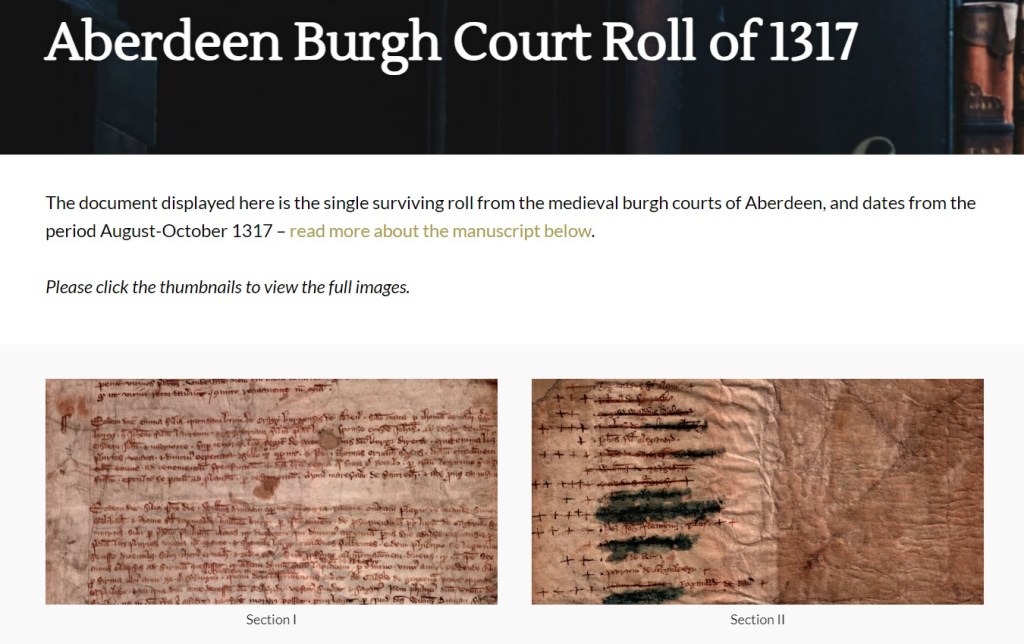
Earlier this year the Stair Society published a digital facsimile of the Aberdeen Burgh Court Roll of 1317. These images are available via the Stair Society’s digitised manuscripts page and are reproduced by kind permission of Aberdeen Archives, Gallery and Museums.
This is the single surviving roll from the medieval burgh courts of Aberdeen, and dates from the period August-October 1317. The roll thus predates the later council register volumes, which survive from 1398 onwards. The burgh court roll is on parchment and it represents a unique survival from the courts of a Scottish burgh dating from the early fourteenth century.
A translation of the roll into English, and a discussion of its contents is available in Andrew R. C. Simpson and Jackson W. Armstrong, ‘The Roll of the Burgh Courts of Aberdeen, August-October 1317’, in Miscellany Eight, ed. by A. M. Godfrey, Stair Society 67, (Edinburgh, 2020), 57-93 (see The Roll of the Burgh Courts of Aberdeen, August–October 1317 (stairsociety.org)).
For further discussion of the roll and its context, see Andrew R. C. Simpson, ‘Urban Legal Procedure in Fourteenth Century Scotland: A fresh look at the 1317 court roll of Aberdeen’, in Comparative Perspectives in Scottish and Norwegian Legal History, Trade and Seafaring, ed. by Andrew Simpson and Jørn Øyrehagen Sunde (Edinburgh, 2023), 181–208.
And for a recent overview of this new book see this post by Andrew Simpson on the Edinburgh Private Law Blog.
A link to the burgh court roll at the Stair Society is now featured within aberdeenregisters.org, with a dedicated page and linked in the main menu.
Accounts kept by Provost Andrew Alanson show details of how the burgh’s funds were managed, including expenditures on cultural activities, roadworks and hospitality.
Aberdeen Accounts 1470–1, held in Beinecke Library, Yale: Osborn Collection, Gordon of Gordonstoun Papers, box II, folder 41.
Dr Jackson Armstrong consulted the original papers in the Beinecke Rare Book and Manuscript Library, Yale, after chasing a reference to the accounts made by Roderick Lyall in a publication from 1989. Lyall had first identified the papers in the early 1980s. With assistance of archivist Diane Ducharme of the Beinecke, Jackson located the accounts within the Gordon of Gordonstoun Papers, part of the Osborn Collection, gifted to the Library in the 1960s.
Beinecke Rare Book and Manuscript Library, Yale University, New Haven, Connecticut
The new publication includes a document transcription of the text (almost entirely in Middle Scots), and explores the creation and preservation of the accounts, as well as what they reveal about the process of accounting and auditing in medieval Scotland. The fact that they survive at all seems to be linked to a dispute which arose over who, among the town’s elite, was selected to audit the accounts.
We are fortunate to know a great deal about Andrew Alanson – a provost and man of law – given he has been the subject of another recent study by Prof. Andrew Simpson.
The income received by the provost came primarily from rents of lands (including the ‘freedom lands’), local mills, and salmon fishings on the Dee and Don.
Expenditures ranged widely, but included the provost’s costs to attend parliament; payment to the men that made the scaffolding for the Candlemas play (on 2 February) (16 pence); payment to an unnamed author for the writing of a play (1 merk), which could have been the Candlemas play or perhaps the Corpus Christi play held in June (& for the characters in the annual Candlemas play see ARO-5-0661-04); costs of the town minstrels’ gowns (40 shillings); the upkeep of roads and causeways and bridges (including the Bow Brig over the Denburn); and the maintenance of the tolbooth (including repairs to the town clock, or ‘knok’ in Scots), of the quayside, and of St Nicholas Kirk.
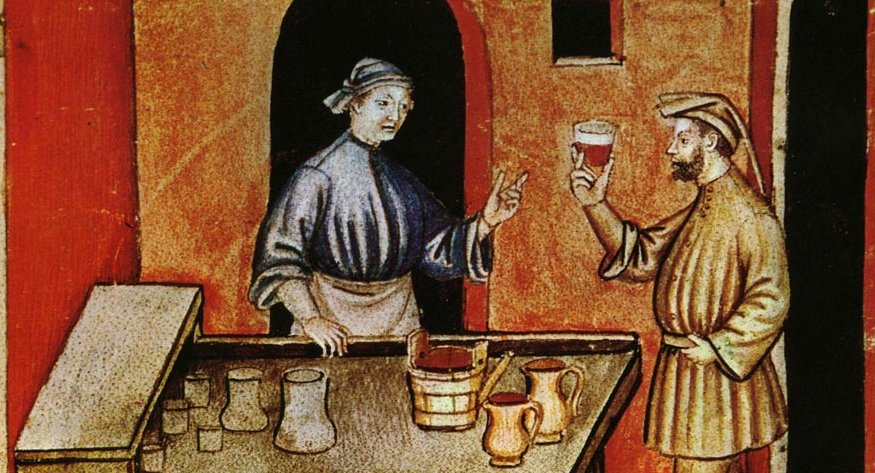
One of most significant expenses was for hospitality. This included the costs of wine purchased for a meeting of the burgh council in a local tavern on one occasion, but more often gifts of wine to visiting noblemen.
The magnates who were ‘wined and dined’ by the provost included the earl of Huntly (George Gordon, the second earl), the bishop of Aberdeen (Thomas Spens), Lord Erskine (Thomas, second Lord Erskine), Lord Forbes (William, third Lord Forbes), the ‘Lord of Erroll’ (William Hay, third earl of Erroll), and the ‘Lord of Crawford’ (David Lindsay, fifth earl of Crawford). Red wine and sweet Malmsey wine were the favoured refreshments.
On 29 November Dr William Hepburn gave a paper to the Aberdeen History seminar.
While it is well known that the Aberdeen Council Registers document the social and economic life of the burgh especially through the lens of legal activities, William Hepburn’s paper argued that these records of everyday administration also represent an expression of the town’s political culture. They capture the ideals and practices that were reinforced time and again by the governing elite over many decades.
Writers such as William Dunbar addressed themes of the moral and religious context of late medieval government
Demonstrating some of the language analysis undertaken in the FLAG project (AHRC-DFG, 2020-2023), he argued that what emerges is a political culture underpinned by the notion of balanced and fair accounting, stemming from the burgh’s foundational transaction and the myriad transactions which remained its raison d’etre, especially for those at the heart of government: the burgesses themselves. The idea of the burgh as an upholder of fair and balanced transactions expressed through a language of order, and of community, in fact served to justify an oligarchic and near-hereditary regime.
This paper closed by indicating some new directions for expanding research questions to address other Scottish burghs records.
MSc students at Aberdeen have developed a new search platform, experimenting with different search functions and displays
Team Delta members with Jackson Armstrong
“Team Delta”, one of the student groups tasked to carry out a client-focused project as part of the MSc Information Technology course, worked with the Aberdeen Burgh Records Project and the Aberdeen City Archives in winter-spring 2023. The group members were Samuel Lawal, Zixiang Tang, Shahbaaz Hussain, Emmanuel Boamah, Yan Zhang, and Layek Ahmad.
The challenge for the team was to develop a search platform based in an application other than Ruby on Rails, and to develop search facilities that would assist researchers with identifying occurrences of personal names, and with identifying numbers of entries of courts of different types. Team Delta built the new search tool in Python and Django.
The new platform is called ‘Enhanced Search 1.0 for ARO’, and it is linked from here.
During the second semester, the team met regularly with Jackson Armstrong who represented the Aberdeen Burgh Records Project as the client. The challenge to create a way to search for courts proved to be the most successful element of the exercise: the courts heading division in the ARO XML corpus is searched specifically for particular strings of text, and the new tool then counts up entries following each heading which is returned in the result, as in the example below. This is a useful way for researchers to quantify how ‘busy’ different types of courts were, with the number of entries representing the cases heard after each heading in the registers.
The challenge to search for names, or groups of names (such as those in the ‘Working List of Provosts, Bailies and Sergeands’) proved more difficult, and the resulting name search facility functions as a keyword search across the whole ARO corpus. This is powerful but non-specific. For both new search facilities, ‘Enhanced Search 1.0 for ARO’ includes a graph feature which displays results visually, as number of occurrences by year. The example below shows occurrences for the search term ‘james’:
‘Enhanced Search 1.0 for ARO’ is available via ARO Resources and Publications linked from the ARO website. It is hosted for the time being on pythonanywhere.com.
One highlight of the project was Team Delta’s visit to the Charter Room at the Aberdeen City Archives to see the original council register volumes, to meet with City Archivist Phil Astley, and to demonstrate the new search tool.
The new trail blazed by Team Delta with ‘Enhanced Search 1.0’ is a great pathway for future development of new versions and features of the tool, and new ways for the ARO to be searched and presented.
The Aberdeen Burgh Records Project thanks all of Team Delta, and Bruce Scharlau who coordinated the MSc IT project course.
The Conference at Riddle’s Court – interior images via @CILIPScotland
On 11 May William & Jackson spoke at the Scottish Council on Archives‘ Why Archives & Records Matter Conference. This was a really insightful day, with presentations from a wide mix of fields (including healthcare, public services, and tourism, to name a few) working with archives and records.
It was striking that so many of the talks and discussions concentrated on the themes of trust, transparency, accountability, and evidence – all very much live topics in 2023 – and all crucial to healthy & vibrant democratic societies. Congratulations to the SCA in bringing together a showcase of how important and impactful archives and records are to all aspects society, economy, & culture.
Jackson & William spoke about about using archives in video game development, through the burgh records project and the making of Strange Sickness.
The event was held in beautiful Riddle’s Court, Edinburgh, a 16th-century merchant’s tenement restored by the Scottish Historic Buildings Trust.