LACR – The view from the Archive

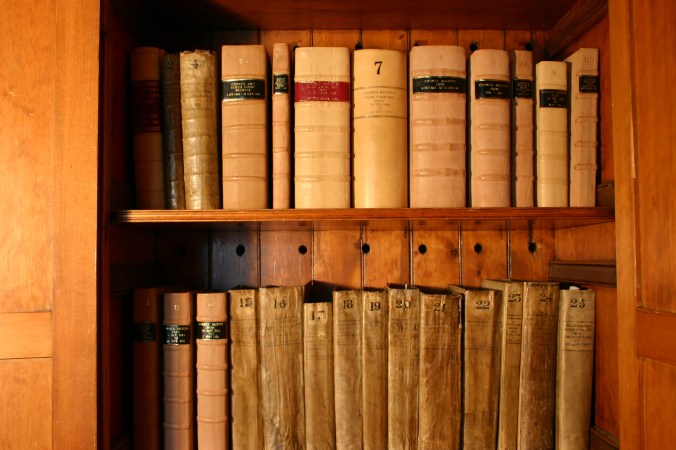
The records that are at the heart of the ‘Law in the Aberdeen Council Registers’ (LACR) project are kept in the beautiful Charter Room on the third floor of Aberdeen’s Town House where they are cared for by the staff of Aberdeen City & Aberdeenshire Archives. Of course the Archive service, formed in 1980, is the latest in a long line of guardians who have ensured the survival of the city’s unique UNESCO-recognised Burgh Registers.

21/11/11 Aberdeen Archives

A question that is frequently asked by visitors is: why does Aberdeen have such a remarkable collection of late-medieval records whereas only fragments remain for other Scottish towns during this period? This is probably the result of three things: the geographical location of Aberdeen which meant that it, and its records, escaped the worst excesses of the Reformation, a culture of good record keeping within the burgh and a healthy dose of good luck. In particular, their survival is testament to the fact that successive town clerks, the predecessors to the current Archive team, saw the records as having important evidential value and were therefore worth preserving. That evidential value persists and is the focus of the current project.

One of the primary functions of the Archive service is to make the records in its care as widely available as possible. A major hurdle to realising this aim for the medieval Burgh Registers is that the language and handwriting of the original text makes them well-nigh impenetrable to all but the expert palaeographer. Aberdeen City & Aberdeenshire Archives sees the current LACR project as the essential foundation for making the fascinating information contained within the records available to those who are not experts. If you follow this blog regularly, you will already have read some riveting stories of life within medieval Aberdeen. Such vignettes are captivating and can help tell the story of the city to tourists, school pupils and locals with a fascination in how their town has developed.

53

The task of opening up the records to this wider audience is too large for the Archive service to achieve on its own and we are immensely proud to be in partnership with the University on the LACR project. The partnership is already having significant knock-on benefits with the Archive participating in many associated public engagement activities. In September Phil Astley, City Archivist, presented a paper about the project at the annual Archive and Records Association Conference in London while November will see the Archive hosting a meeting of the UK National Commission for UNESCO at the Town House. Major regional cultural events taking place in 2017 in Aberdeen and the North East of Scotland such as Spectra, Look Again and the Granite Noir writing festival will all have input from the Archives. All this follows the much higher profile that the service has achieved through the recognition of its records by UNESCO UK and the positive publicity surrounding the LACR project. We are confident there will be many more exciting opportunities to come.

LACR on tour – EAUH conference in Helsinki

by Edda Frankot

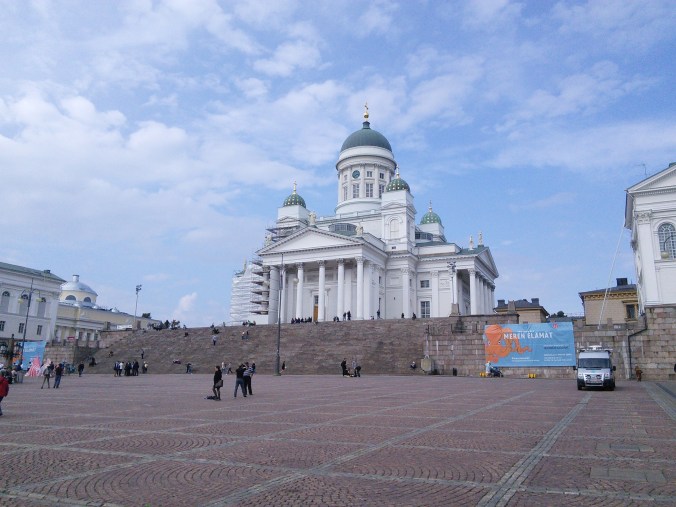
The first outing of the Law in the Aberdeen Council Registers (LACR) project at an academic gathering took place at the bi-annual conference of the European Association for Urban History (EAUH) which, this year, met in the beautiful capital city of Finland, Helsinki, from 24 to 27 August. The conference was held in the grand central building of the city’s university, which shares a space along Helsinki’s Senate Square with the beautiful Lutheran Cathedral. As we learned at the conference, the buildings around the square were all built as part of a great overhaul of Helsinki’s city centre in the 1820s and 1830s by German architect Carl Ludvig Engel, on orders from the Russian tsar, to a state befitting its new role as capital of the autonomous Finnish province of the Russian Empire (from 1809 to 1917). A statue of Tsar Alexander II (assassinated 1881), popular among Helsinki’s citizens, has been given pride of place at the centre of the square. At the end of August the city appeared very lively, partly due to a cultural festival in the city centre.

img_20160825_124021

Lutheran Cathedral

img_20160825_162244

Statue of Tsar Alexander II in front of the former Senate building

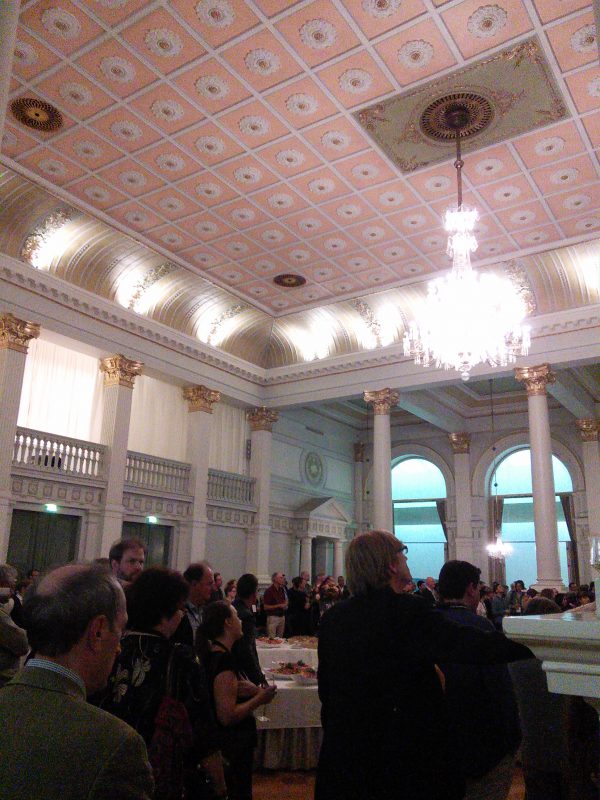
Approximately 750 attendees gathered for a wide array of papers relating to urban history from all regions of the world and from ancient times until the present. The conference started in the early evening of the 24th with a general welcome, a pair of keynote lectures, by Riita Nikula and Maarten Prak, and a lovely musical intermezzo by a small male choir. The remainder of the conference consisted mainly of various long parallel sessions which were split into two, with some shorter sessions included as well. The longer sessions allowed for a wider than usual range of aspects concerning a subject to be elaborated upon. Most of the speakers uploaded a full version of their paper before the conference, but at the conference itself only shorter versions of these, of about 10 minutes each, were presented. This generally allowed for more time for discussion, though one session I attended actually included eleven speakers (!). Because the presentations were brief, this ended up not being too much of a strain on the senses, though the discussion did have to be cut rather short. The conference also included a most welcoming reception in a beautiful room at city hall, at which we could also enjoy the hilarious Bonk exhibition.1

img_20160825_173356

Conference reception at Helsinki City Hall

There were some excellent papers. I particularly enjoyed a presentation on residential segregation in nineteenth-century New York City by Gergely Baics, who is a very engaging speaker. The keynote by Maarten Prak, urging urban historians to focus their research more deliberately on a specific agenda to aid the success of funding applications and increase impact, was also enlightening. Prak suggested three main topics of research as part of this agenda: immigration, creativity and citizenship. Of these three citizenship, especially what Prak called practical citizenship, including political, economic and military participation (in, for example, city councils, guilds and civic militias), is most relevant to our project.

The paper which I presented, entitled ‘Opening the Registers: Digital Humanities and the Aberdeen Burgh Records’, focussed specifically on the Digital Humanities side of the LACR project and the question how archives and urban historians can best work together in the age of digital transformation.

In the case of LACR the objectives of the City Archives and urban historians, as well as scholars from law, computing and socio-linguistics, at the University of Aberdeen come together naturally. Our focus upon the UNESCO-recognised Aberdeen Council Registers, the only source of its kind from urban Scotland which covers (almost) the whole of the fifteenth century, is very straightforward and logical. But in other cases the choice of which archival sources to digitise may not be so clear-cut. There is, therefore, a real danger that certain sources will be quietly forgotten when they remain available only in an analogue form while others, which are considered more important for various reasons, are made widely accessible through digitisation. Resources for digitisation are limited, and choices need to be made, but archivists and historians need to cooperate to ensure best practice.2

Other papers in the session also focussed on digital archives relevant for urban history, both medieval and modern. Of particular relevance to LACR was the paper on the Du:cac (Dubrovnik: Civitas et Acta Consiliorum) project.3 This is producing transcriptions of a similar source to ours from medieval Dubrovnik, Croatia. That project is concerned with geographical locations, which are then linked to the relevant spot on a map of the city which was produced specifically for this project (see screenshot below). The result will be a useful resource for the study of historical urban development. From the perspective of our project, it is an inspiring example of what can in principle be done with material like that for Aberdeen. Once we have produced the digital transcription, the possibilities of what might be done next are wide-ranging indeed!

screenshot-ducac

Screenshot from the du:cac website, showing a segment of the town plan with dots which link to relevant transcriptions of each location (http://ducac.ipu.hr/project/mapping/e6-segment)

Another paper in the session was presented by two archivists from the Copenhagen archives who spoke about their efforts to digitise some important (modern) resources for social history by making use of crowdsourcing, whereby volunteers transcribe or index documents. Crowdsourcing presents a specific set of challenges, but has been used successfully in a number of projects.4 Very interesting was also the presentation on the iron and steel archives of Middlesbrough. As the steelworks there have recently closed, the remaining archives and sites related to the works have become an important focal point of public engagement with the city’s heritage. This is a nice example of how history, archives and heritage can inspire civic public engagement. We hope that our project can set the foundations for similar opportunities for Aberdeen, while at the same time providing abundant material for historians, lawyers and linguists to study.


  1. https://en-gb.facebook.com/BonkExpo2012/ 
  2. With regards to this see also Gerben Zaagsma, ‘On Digital History’, BMGN – Low Countries Historical Review 128 Digital History (2013), 3-29; Charles Jeurgens, ‘The Scent of the Digital Archive: Dilemmas with Archive Digitisation’, BMGN – Low Countries Historical Review 128 Digital History (2013), 30-54. 
  3. Available at http://ducac.ipu.hr/project/. Accessed 16 September 2016. 
  4. For example: the Suda On Line project, available at: http://www.stoa.org/sol/history.shtml; and Itinera Nova for which 29,500 acts of the Louvain aldermen’s bench have so far been transcribed by over 50 volunteers: ‘ State of affairs’, available at: http://www.itineranova.be/in/state-of-affairs. Both accessed 16 September 2016. 

Memory and proof of age (1507)

ACR, 8, p. 705-6 (21 June 1507)

by Edda Frankot

The Aberdeen Burgh Registers tend only to include brief statements concerning court cases that were dealt with by the burgh courts. From these, it is often difficult to establish the circumstances of a legal matter or of the parties involved in it or to draw any conclusions on the reasoning behind a certain verdict. With regards to cases of verbal or physical abuse, for example, there are often no details on who perpetrator or victim were, what their relationship was, where the abuse had taken place, what the character of it was and who had witnessed it. Of course, these registers were not written for entertainment or to facilitate twenty-first century research, but to keep a record of the decisions of the burgh courts. But one cannot help but be curious to know more.

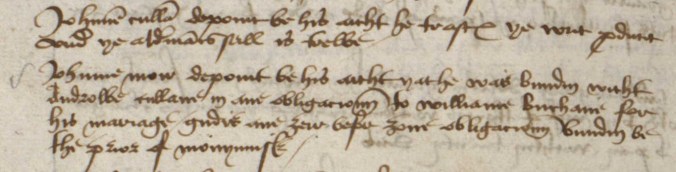
The character of the Aberdeen records make it all the more interesting, then, when we do come across additional information in a court case, such as depositions of witnesses. It gets even more exciting when the majority of witness statements was made by women, a group generally underrepresented in legal sources. On the 21st of June 1507 fourteen depositions, nine of which were given by women, were recorded in the Aberdeen registers. These depositions concerned the age of a girl, Isabel Buchan, the heir of the late William Buchan, a burgess of Aberdeen.

There are eight entries in total concerning this case between 30 April and 21 June. From these it appears that the matter at hand was whether Isabel Buchan should still be under the tutory of one of the two parties in the case, David Colp. According to Scots law, orphaned minors (that is to say, minors whose fathers had died) were under tutory until they reached puberty. For girls this was at the age of twelve, for boys at fourteen. At that age minors would come into ownership of their property, though they would remain under curatory until they reached majority (for boys) or were married (for girls).

The depositions of the fourteen witnesses that appeared in court on 21 June are interesting in that they provide information on how people remembered important occurrences like births and deaths when communication was still to a large extent oral. There were no registers of births, marriages and deaths until after the Reformation, and few people beyond monasteries and burgh councils would have recorded important events.

GB0230CA000100001-00008-00705a-

From the statements of the fourteen people deposing in this case it appears that especially the women linked their memories to important feast days and to other memorable life events. Two of the women described their memories of Isabel’s baptism. Bessy Sibbald, Isabel’s godmother, recalled that she ‘hewf hir one monunday before festerinevine and sche dynit that day in Alexander Chameris house’. Alexander Chalmers’ wife, Isabel of Cullen, deposed that she too ‘hwyff Isabell Buchane one monunday before festerinevine’. To ‘hwuf’ means to lift a child from the font as a sponsor during the baptismal ceremony. Based on these memories Bessy thought that Isabel Buchan was at least eleven, as both Andrew Branch, the girl’s godfather, and Alexander Chalmers were still alive when she was baptised. Isabel of Cullen confirmed that her husband died when the girl was one year old, believing she was past her eleventh birthday.

GB0230CA000100001-00008-00705b-

According to Margaret McGlynn, who researched proof of age cases from sixteenth-century England, baptism was the ‘most common single memory of the birth’.1 Mc Glynn noted that the lifting of the child from the font by the godparents after the baptism, the most significant moment in the ritual, stood out in people’s memories of the event. This expression of social relationships, as McGlynn called it, between the godparents and their godchild, was no doubt further enhanced by the subsequent dinner at the house of one of the couples present at the baptism in our case.

Rogier_van_der_Weyden-_Seven_Sacraments_Altarpiece_-_Baptism_detail,_left_wing

From the depositions in the Aberdeen registers, it appears that some documents were also presented in court on the 21st of June, though any details as to what they contained are lacking. However, it appears that the memories of some of the deponents were linked to the drawing up of these documents. John Moir, for example, deposed that he was bound in an obligation with Willam Buchan for his marriage goods a year before ‘yone obligacioun bundin be the prior of Monymusk’. Presumably this meant that Isabel’s parents were married about a year before this obligation was drawn up, and that Isabel herself could not have been born more than about three months before it (though this is not explicitly stated). Two of the women linked their memories of Isabel growing up to another document presented in court, a deed dated on St Catherine’s day (25 November – the year is not mentioned). Elizabeth Mowat stated that she did not know how old Isabel was but that she was not quite four when the deed was drawn up. Andrew Cullen’s wife deposed that Isabel could ‘gang, ett and drink befor the de[e]d’.

GB0230CA000100001-00008-00706a-

GB0230CA000100001-00008-00706b-

In thirteenth- and fourteenth-century England, written evidence was not seen as the most reliable. According to John Bedell in his article on memory and proof of age in that period, both judges and jurors considered written documents as inferior to memories of people who had personal knowledge of a certain event, though they were regularly presented as auxiliary evidence.2 McGlynn noted that in the earlier decades of the sixteenth century very few written documents were used as evidence in proof of age cases in England. People were very aware that written sources could be lost (as well as forged) and that personal memories were more reliable in the long run. This had changed by the late sixteenth century when society as a whole had become more literate.3

That written documents in themselves were not considered sufficient proof in early sixteenth-century Scotland either, is confirmed by the deposition of John Cullen, whose only recorded statement was that he ‘trastis the writ producit under the aldermanis seill’, apparently another document that was present in court. On the whole, though, written documents do appear to have played a more significant role than was usual in England at the same time, but based on one case it is difficult to draw any firm conclusions with regards to Scottish practice in the early sixteenth century.

Relying on the evidence of witnesses and documents, the bailies concluded that Isabel Buchan was eleven years old. Though this is not stated explicitly in the verdict, this meant that she would remain under the tutory of David Colp for a further nine months or so, after which she would be able to enjoy the fruits of her inheritance (though under curatory until she married).

The observations about the functioning of memory in proof of age cases correspond to conclusions made by authors analysing similar sources. Elizabeth van Houts, for example, noted that women, especially mothers and wet nurses, were important as ‘rememberers of birth details’, as this was considered part of the female domain. In such cases women’s testimonies were vital, as is clear from our 1507 case as well.4

Of course, much more can be said about medieval memory in all its facets than it is possible to relate in a short post. Hopefully other proof of age cases like this will crop up as our transcription efforts continue and more research will become possible. But even if not, this case on its own has already provided us with some nicely detailed insights into the workings of memory in medieval society, especially those of women, and as such into the events that most likely mattered most to them.


  1. Margaret McGlynn, ‘Memory, orality and life records: proofs of age in Tudor England’, The Sixteenth Century Journal 40 (2009), 688-9. 
  2. John Bedell, ‘Memory and proof of age in England 1272-1327’, Past & Present 162 (1999), 24. 
  3. McGlynn, ‘Memory, orality and life records’, 686, 696. 
  4. Elisabeth van Houts, ‘Medieval memory in theory and practice: some exploratory thoughts in the guise of a conclusion’, Gesta 48, no. 2 Making Thoughts, Making Pictures, Making Memories: a special issue in honor of Mary J. Carruthers (2009), 188; Idem, ‘Gender and Authority of Oral Witnesses in Europe (800-1300), Transactions of the Royal Historical Society 9 (1999), 220. 

From script to text

by Jackson Armstrong

One of the most cryptic and alluring aspects of the pages of the Aberdeen council registers is the handwriting which appears in them. To most people this script is not remotely decipherable.

Patterns of handwriting change over time. The study of these changes is known as palaeography. An excellent public resource may be found at the Scottish handwriting website.

Even in 1591 the town clerk of Aberdeen reported his bafflement by the handwriting of the fourteenth century. That year the clerk, Master Thomas Mollisone, who was preparing an inventory of extant registers and bailie court books, found no volumes from earlier than 1380. However, he noted that ‘Befoir this, scrowis [scrolls] on parchment ’ written in Latin ‘and for ilk year ane skrow’, survived. In his assessment they were ‘evil to be red, be resoun of the antiquitie of the wreit and the forme of the letter or character … which is not now usit’ and that ‘skairslie gif ony man can reid the samyn’.1

43

The only extant burgh court roll, from 1317, kept at the Aberdeen City and Aberdeenshire Archives.

We think of the contents of the eight register volumes from 1398–1511 as a corpus of text. But what is ‘the text’? The task of our project is to take the handwritten script in the registers and render it as machine readable text. I think it is useful to pause and consider the difference between what we think of as ‘the text’ and the handwritten script. The scripts in these registers use a set of character symbols with standard abbreviations and also special letter forms. It is helpful to think of this as a form of shorthand writing, or even encryption, which it is our job to decipher. A later and more extreme version of such abbreviation, or shorthand, is that which was devised by Thomas Shelton, and used by Samuel Pepys in writing his well-known diary. The ‘text’ of Pepys’s diary entries (what might be described as their meaningful content) is not necessarily the same as the writing on the page. The editors of Pepys’ diaries had the difficult task to extract the ‘text’ from the diarist’s shorthand (for an example, see this image of a page of his diary). Similary, a difference can be noted between the text of our material, and the handwriting which various scribes used to symbolise that meaningful content. It is our interpretation of the handwritten script which produces ‘the text’.

This brings us to the nature of the transcription we produce by rendering the script into text. A diplomatic transcription aims to reproduce everything as it is, for instance giving wt for wt . By contrast, a semi-diplomatic transcription includes the full expansion, in this case expanding wt to ‘with’. It may even be possible to represent the set of symbols used for the original script with high fidelity, producing what is in effect a facsimile. For instance, a form of typeface called ‘record type’ was invented in the late eighteenth century to reproduce medieval abbreviations. That would be a tremendously cumbersome process and it would not help in moving from script to text. In addition, record type and full diplomatic transcription were invented before the benefit of modern photography. Digital images of the original pages now provide a perfect facsimile, and as a result a diplomatic transcription is no longer necessary.

Our task is not to create a facsimile of handwriting, but to represent the text as consistently and accurately as we can. To this end we aim to produce a text which may be displayed either as a semi-diplomatic transcription, or a semi-normalised transcription. The latter allows for fuller intervention by the transcriber, regularising and smoothing out features like variant letter forms, punctuation, capitalisation, and so on. In the former case, the expansion of abbreviations is assisted by the fact that these were standardised to a large degree. Reference works are available to assist transcribers with the identification and expansion of abbreviated forms.

ACR 4, p. 7, entry 2

ACR 4, p. 7, entry 2

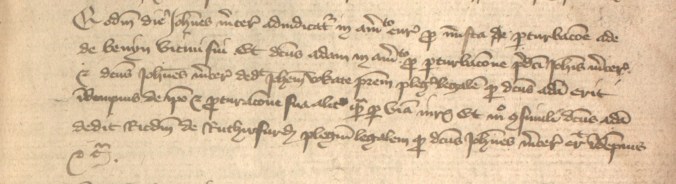
semi-diplomatic transcription: Eodem die Johannes mercer’ adiudicatur in amerciamento curie pro iniusta de perturbacione ade de benyn vicini sui. Et dictus adam in amerciamento pro perturbacione predicti Johannis mercer’ et dictus Johannes mercer’ dedit Johannem vokate patrem plegium legalem quod dictus adam erit indempnis de ipso et perturacione sua aliter ipse per viam iuris Et modo consimili dictus adam dedit Ricardum de Ruthirfurd plegium legalem quod Johannes mercer’ erit indempnis et cetera.

semi-normalised transcription: Eodem die Johannes Mercer’ adiudicatur in amerciamento curie pro iniusta de perturbacione Ade de Benyn vicini sui. Et dictus Adam in amerciamento pro perturbacione predicti Johannis Mercer’ et dictus Johannes Mercer’ dedit Johannem Vokate patrem plegium legalem quod dictus Adam erit indempnis de ipso et perturbacione sua aliter ipse per viam juris. Et modo consimili dictus Adam dedit Ricardum de Ruthirfurd plegium legalem quod Johannes Mercer’ erit indempnis et cetera.

In our project we are not doing all this for paper and ink, but electronically, and through Text Encoding Initiative (TEI) annotation. A useful essay on this process is by M J Driscoll, on ‘Electronic Textual Editing: Levels of transcription’.2 Thus the text we produce is not just typed out as ‘flat’ strings of characters and words (as it would be in an edition printed on paper), but it is encoded following TEI standards. This allows the text to be augmented with annotations concerning the structure of the text, features of the transcription and textual meaning. These annotations, for example, enable us to indicate where we have made an expansion by supplying in full the information represented by the abbreviation in the original script.

ARO-4-0007-02a

TEI-annotated transcription of ACR 4, p. 7, entry 2.

However, a pertinent question is whether a silent expansion of a standard abbreviation may still be a consistent and accurate representation of meaningful content when moving from original script to electronic text. Indeed, the choices made by the transcription team as to how to interpret particular characters in the script rely on a process of judgement, partly based on interpretation of context. Cumulatively, those judgements will result in the transcribed text. In all this they follow a process which enables cross-checking to ensure a high degree of inter-transcriber agreement and consistency, both on the transcribed corpus of text, and on the annotations made to augment that corpus.

The process of moving from original script to electronic text is fundamental to our work. It presents its own challenges and choices which take a range of skills to address, and to ensure the final product is robust and reliable.


  1. John Stuart, ed., The Miscellany of the Spalding Club (1841-52), v, p. 9. The use of u/v has been changed to aid readability. 
  2. http://www.tei-c.org/About/Archive_new/ETE/Preview/driscoll.xml 

A Case of Goods Lost at Sea (1485)

ACR, 6, p. 904 (11 February 1485)

by Edda Frankot

vol 6 p. 904 (jettison 1485)The port of Aberdeen in the later fifteenth century was not nearly as busy as it is today. Exactly how many ships docked at the medieval quays in an average year is unknown, but in the first half of the fifteenth century less than ten ships sailed abroad in most years.1 How many more would have had other Scottish ports as their destination is impossible to say, as a thorough port administration is simply not available. Thankfully, the Aberdeen Council Registers do offer a lot of qualitative information on shipping to and from Aberdeen and on the administration of legal cases between the various parties involved in this business. Such cases could be dealt with by different courts: there are instances of legal matters being administered in bailie courts, guild courts and by admirals depute in an admiralty court.2
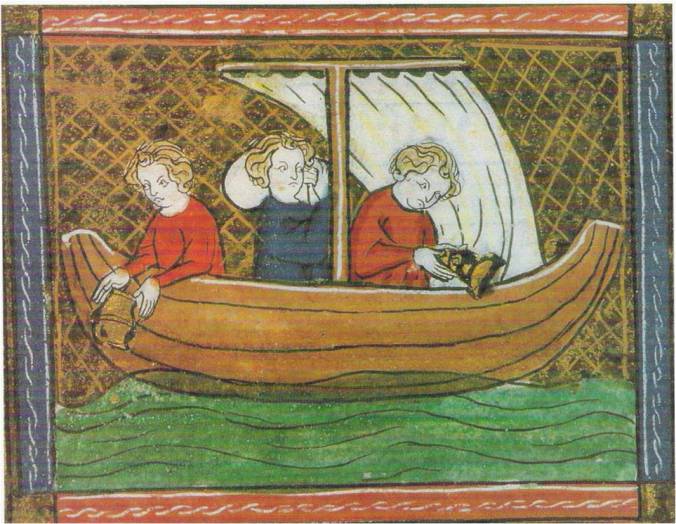
On 11 February 1485, in a court held by the bailies in the tolbooth, an assize (a jury) of twelve sworn men passed judgement in a case concerning the casting of goods from a buss (‘busch’, from the Dutch ‘buis’, originally a herring fishing vessel). The entry in the Aberdeen records is quite short, but offers a few interesting insights into the administration of law in the burgh and into maritime legal practice.

Many cases that were dealt with by the Aberdeen courts were decided by assizes. Sometimes the members are mentioned by name, but often also they are not. In this case twelve names are listed, but assizes in other examples range from between nine and fifteen, and usually an uneven number appears to have been preferred.3 In most cases there are no further indications as to who the members of the assize were and why they were chosen (though it will surely be possible to find out more about individuals when this project is finished and the corpus can be searched for names). An interesting exception is a case from 1449 in which seven members of the assize are identified as ‘mercatorum’, merchants, and the other eight as ‘nautarum’, skippers.4 In the case discussed here, too, three men are identified as members of the maritime community: Peter Andreis is the skipper of the buss in question, Copryng is his ‘stereman’, helmsman, and Michael is the helmsman of a ‘kervel’, a carvel that was most likely anchored in port at the time. As in many other examples, the ships are only identified as ‘the busch’ and ‘the kervel’, suggesting that only a small amount of vessels were docked at the quay at any one time. Sometimes names are mentioned, such as the James of Veere and the shipwreck of the Mary Grace, both with Dutch skippers, in an entry of 6 February 1482 and the Maryknight from Aberdeen in 1461.5

It is likely that the men elected onto the assize were in some way knowledgeable in sea law because they themselves were part of the maritime community. Normally one would only expect men of some authority and standing to be involved, as assizes were often specified to consist of ‘worthy men’ or ‘proborum virorum’, which in maritime cases would mean merchants, shipowners and skippers. But in this case two helmsmen were elected too. What is even more remarkable, though, is that two of the men specified were actually on the ship that was the subject of the lawsuit. What is more, Peter Andreis even passed judgement at his own expense (or rather that of the shipowners which he represented). One would think that this was highly unusual (and irregular), but in another case, between the earl of Orkney and merchants from Aberdeen, the matter was referred to the meeting of the commissioners of all the burghs in Edinburgh. The reason given was ‘… sen the mater langis thaim, thai arre lath to be jugis in their awne cause’.6 In that case too, it appears, the merchants involved would have been asked to judge their own case.

Picture1The assize decided that Walter, a merchant whose goods had been cast overboard, presumably in order to save the ship in an emergency situation, though this is not specifically stated, would be compensated for his losses. The other merchants would ‘lott’ with him. In addition, the skipper would ‘lott’ with the merchants whose goods had been cast with either his ship or his freight. To lot means to contribute a proportionate share to a common payment. This was the usual way in which the sacrifice made at sea to save the whole vessel, its goods and its passengers (in legal terminology: general average) was compensated in most of northern Europe in this period (with some variation). It is also in accordance with the Rôles d’Oléron. These medieval sea laws which originated in France appear to have been valid in Scotland, as several copies of a translation into Scots have survived as part of collections of the main Scottish laws.7

So, this short entry from volume 6 of the Aberdeen Council Registers already provides us with a wealth of information on maritime and legal life in the late medieval burgh: on types of ships frequenting its harbour, on who administered justice in its courts and on how its maritime practice fitted in with that elsewhere in northern Europe. There is so much more yet to explore, not only concerning Aberdeen’s harbour and its maritime community, but also with regard to many other aspects of medieval life, such as the market, the guild, and citizens breaking the law, but also concerning relations with other towns and with local lords such as the earls of Huntly and Mar. Stay tuned for more highlights from the collection!


  1. David Ditchburn, Scotland and Europe. The Medieval Kingdom and its Contacts with Christendom, c. 1214-1560 (East Linton 2000), p. 11, fig. 1.1; David Ditchburn and Marjory Harper, ‘Aberdeen and the outside world’, in: E. Patricia Dennison, David Ditchburn and Michael Lynch, eds, Aberdeen before 1800. A New History (East Linton 2002), p. 379. 
  2. Edda Frankot, ‘Of Laws of Ships and Shipmen’: Medieval Maritime Law and its Practice in Urban Northern Europe (Edinburgh 2012), pp. 56-7. 
  3. Frankot, Medieval Maritime Law, p. 155, notes 51 and 52. 
  4. ACR, 5/1, p. 68 (28 November 1449). 
  5. ACR, 6, p. 720 (6 February 1482); ACR, 5/1, p. 416 (11 April 1461). 
  6. For a more extensive discussion, see Frankot, Medieval Maritime Law, pp. 167-8; ACR, 5/2, p. 692 (16 December 1454). 
  7. Frankot, Medieval Maritime Law, pp. 110-120. The actual articles concerning jettison were, however, corrupted in the known versions of this translation: Ibid., p. 182.