Keeping medieval Aberdeen’s streets clean and safe

by Edda Frankot

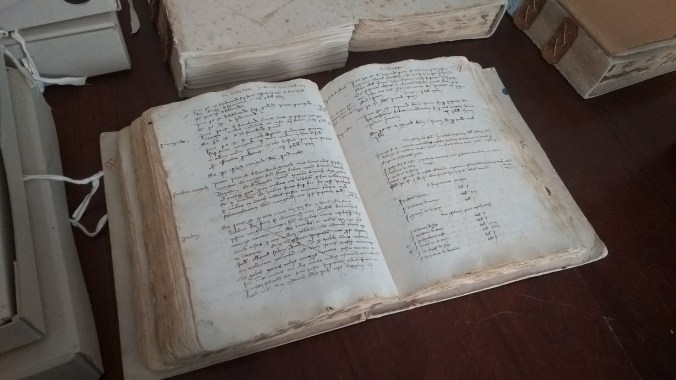
The medieval magistrates of Aberdeen, like their modern counterparts, were concerned with the accessibility and cleanliness of its roads, with building regulations and with potentially hazardous sites. Unlike the modern city council, however, the medieval government only had a small amount of staff working for it permanently or on an annual basis, such as clerks, sergeants and a bellman. For other tasks adhoc committees or officials were appointed. But there may also have been others doing duties which remain largely invisible in the sources as they have survived, because these duties were not directly relevant to the court, unlike those mentioned above. The only aspects worthy of noting were their appointment and any financial arrangements.

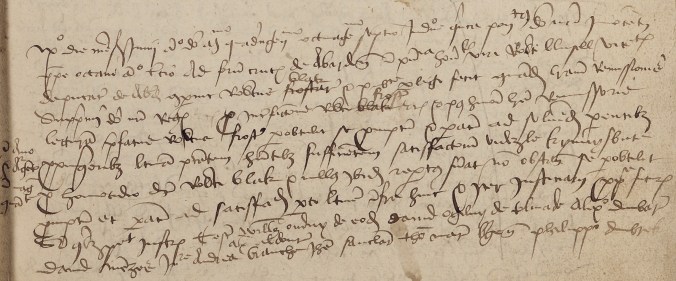
In 1479, for example, the alderman, council and community hired Alexander Coutts to mend the causeways and gutters of the town and to keep all the streets clean so that ‘al men may haf honest and clene passage throuch al the toune’. He would be paid by the people of Aberdeen as follows: all owners of houses with a fireplace (‘fyre house’) would pay him a penny. All other ‘outburgesses’, ‘inburgesses’ (that is to say burgesses living outwith and within the bounds of the town respectively) and ‘indwellers’ (non-burgesses) who had a chamber or a house would also pay a penny, half of them at Martinmass (11 November), the other half at Whitsunday.1

GB0230CA000100001-00006-00599-

GB0230CA000100001-00006-00600-2

ACR, 6, pp. 599-600.

An adhoc committee of 9 or 10 ‘of the best of the town’ was to be appointed by the alderman and baillies in 1449 to go round the streets with the ‘gangand assize’2 to investigate any ‘purprisioun’ or purpresture, that is to say the ‘illegal enclosure or encroachment upon the land or property of another’, often on public or common land.3 Wherever there was any such encroachment, they were to make note of it and charge whoever was responsible to rectify the problem within forty days.4 This exercise resembles a perambulation. The fact that any failure to comply takes place under ‘pain of purprisioune of the king’ also suggests that public property is the focus of the action, which was also the case in perambulations. Different from other known perambulations is the absence of the rest of the population when doing the ambulating and the route followed. This seems to have been a check of encroachments along the streets of Aberdeen’s inner city, rather than along the inner or outer march stones, which were further out.
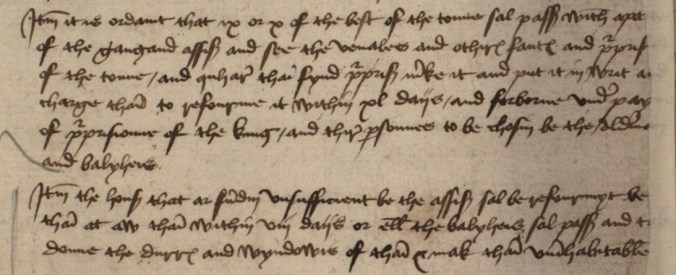
GB0230CA000100001-00005-00001-00034-

ACR, 5-1, p. 34.

The assize was also to check whether houses were safe. If any were found to be ‘unsufficient’, the owners would be allowed only eight days to repair them. Otherwise the baillies would come and take down the doors and windows and make the place uninhabitable.5 In the case of houses in disrepair, the town magistrates thus took a rather abrupt approach. This may have done wonders in getting those buildings repaired quickly by owners who could afford to get workmen out to do the job. But it would be a disastrous policy for landlords (and/or anyone living in their houses) who could not act so swiftly for whatever reason. There is no further evidence whether such people could receive a deferral if requested.

These three entries show that the town magistrates cared about the cleanliness and safety of Aberdeen’s streets and buildings and organised the maintenance and oversight of it, though based on these three entries it is difficult to say how regular this was. The town government was also concerned about any encroachments on public property and so they organised checks of this. This is a fact already well known from the history of the perambulations, or ‘riding of the marches’, though most of the information we have about this is post-medieval.6 As such, these entries form a useful addition to our knowledge of local government in the later Middle Ages.


  1. ACR, 6, p. 599-600 (13 Sep 1479). 
  2. It is not entirely clear what the gangand assize is. It would make sense if the nine or ten men chosen would make up this assize, but the way it is phrased these men are to go with the assize. 
  3. ‘Purprestur(e n.’, Dictionary of the Scots Language (2004) Scottish Language Dictionaries Ltd. Accessed 2 Mar 2018 <http://www.dsl.ac.uk/entry/dost/purpresture
  4. ACR, 5-1, p. 34 (c. 15 Feb 1449). 
  5. Ibid. 
  6. See for example: The Freedom Lands and Marches of Aberdeen, 1319-1929 (Aberdeen 1929). This includes a map of the inner and outer marches perambulation routes. A recent sample check of the registers from the 1630s-60s has shown that the list of ‘References in Council Registers to Perambulations of the Marches’ (Appendix V, p. 35) is not in any way complete. 

Transcription volumes 1-7 completed!

by Edda Frankot

An important project milestone was reached last month when the last words of volumes 1-7 were transcribed on the afternoon of 18 January. The transcription of the first seven volumes, up to the year 1501, is now complete. Over the past eighteen months or so, the project’s two research assistants, Claire Hawes and William Hepburn, with a small amount of assistance of yours truly, have transcribed 4027 pages – no mean feat!

This does not mean, of course, that the project as a whole is now finished. The checking of the transcription and annotations is still in full flow. Once that is completed a final phase of getting the corpus ready to go online will commence. In the meantime, thanks to generous additional support from Aberdeen City Council to enhance the project, Claire and William have begun the transcription of volume 8. This volume will at least partly be transcribed traditionally, but there are also ongoing investigations into the possibility of having this book machine-transcribed for us by a project called READ. Watch this space for updates on that! Overall our final corpus will in part contain a level of annotation enhanced beyond our original specification.

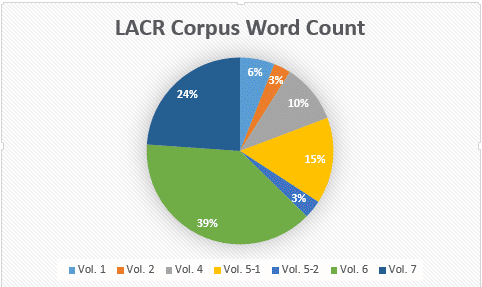
Now that the transcription of volumes 1-7 is complete, it has been possible to do a word count. This count confirms our suspicions that volume 6 includes a relatively large amount of material, but also brings up some other fascinating facts. The total count as it stands now (this number will most likely change slightly during the final stages of the checking process) is 1,391,217 words. To put this in perspective: Shakespeare’s complete works total 884,421 words. A significant chunk of our nearly 1.4 million corpus (so far) is taken up by volume 6: 539,254 words (39%). By contrast, volume 7, which has 137 pages more than volume 6, contains ‘only’ 332,392 words (24%). On average, then, there are about 547 words on every page of volume 6, but only 296 on those of volume 7. The average across all volumes is about 300 words per page. The scribe of a large part of volume 6 used more of the pages (he only left one of the margins blank, rather than both), he placed his text lines closer together and appears to have written in a smaller hand. The volume with the lowest amount of words per page is volume 2, at only 189. This results from many blank spaces left between court entries, and blank pages.

Above: An illustration of different page word densities and lay-outs: ACR, 6, p. 752 (left) and ACR, 7, p. 508 (right).

LACR Corpus Word Count

It has also been possible to differentiate between words in Latin and in Scots (and those from entries in ‘multiple languages’, that is to say entries with a lot of switches between Latin and Scots, which typically occurs in lists of names). Overall 58% of the corpus is in Latin, 41.1% is in Scots and 0.9% in multiple languages. Two entries are in Dutch. In volumes 1 and 2 (1398-1414) only slightly more than 1% of the words are in Scots. In volume 4 (1433-1447) this rises to nearly 9%. By volume 6 (1468-1486) the division between the two languages is almost exactly 50-50, whereas in volume 7 (1487-1501) more than 68% is in Scots. Much more detailed research into this phenomenon is of course undertaken by our former text enrichment research fellow, Anna Havinga. Anna not only distinguishes between words and entries in Scots and Latin, but she also analyses the development of the language shift by year. But even the very coarse overview given here already throws up some fascinating first indications which future research will hopefully be able to elaborate upon.

The best helmsmen stand ashore?*

(* Literal translation of the Dutch expression ‘De beste stuurlui staan aan wal’, which is used to indicate that it is easy to criticise someone doing a job when one is watching from the sidelines.)

by Edda Frankot

ACR, 5, p. 542 (1465)

5-1 p542

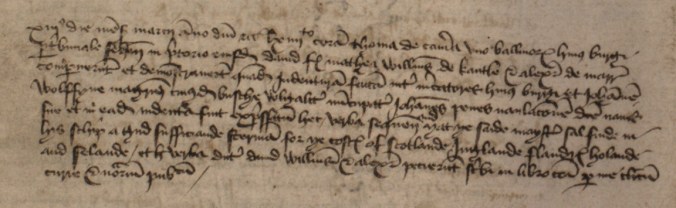
On the thirteenth of March 1465 three merchants appeared before one of the baillies sitting in the tolbooth. They showed an indenture made between merchants of Aberdeen and Johannes Wolffyne, the master of a bus (a type of cargo or fishing vessel) called the Johannes. This indenture, a charter written in duplicate on the same sheet which was usually separated by cutting along a jagged line, concerned a sea journey. The three men who had appeared in court asked that a specific section of the contract be recorded in the burgh’s ‘common book’ by the court clerk and notary public. This request and the entry as a whole are interesting on a number of levels.

First of all it is interesting linguistically: the entry itself is in Latin, but the quoted words from the contract are in Scots. I would have expected the shipping contract, between Aberdeen merchants and what appears to be a foreign skipper on the basis of his unusual last name, also to have been in Latin. Some examples of similar documents which are recorded in the oldest Sasine Register (see the earlier post about this book) are in Latin. Of course, it is possible that the words were translated specifically for this recording, for the benefit of the merchants perhaps, but that does not make it any less interesting.

Secondly, the entry is informative from a maritime historical and legal perspective: the words specify that the skipper should employ a ‘gud sufficiande sterman’, that is to say a helmsman or pilot, to navigate the coasts of Scotland, England, Flanders, Holland and Zeeland. Apparently the skipper was known not to have these skills himself, which suggests that he was either inexperienced on the whole or on this particular route, or that he had a certain reputation for bad steermanship. The fifteenth century is a time when duties aboard ships became increasingly more specialised, with the skipper evolving into a captain, commanding officers like helmsmen below him rather than navigating the ship himself. But the fact that these words were included specifically, and repeated in the register, does indicate a situation that was not entirely normal. The two shipping contracts that are recorded in the oldest Sasine Register do not include a similar stipulation. They do, however, require sufficient sailors, cables, anchors, fire and water, among other things, to be taken on board.1

Finally, the entry is interesting within the context of the development of written records. Despite the existence of a contract in duplicate, the three men thought it necessary to show the document before the court and to have some of its words recorded separately in the burgh’s register. This was most likely done as an extra precaution, should both copies be lost and any problems occur on the journey. Again, this suggests that the merchants were not entirely confident of the shipmaster. In the later fifteenth century, this entry would most likely have ended up in the so-called Sasine Register, which appears to have been a type of protocol book, but a similar book was most likely not yet in existence in the 1460s. Notaries public at this time were often also active as burgh clerks, as evidenced by this entry. As a result, the registers often include a mix of actual court cases and matters of voluntary justice, that is to say matters for which we would today use a notary, like this one.

Unfortunately, we do not know whether any problems occurred during the journey to the Low Countries. Johannes Wolffyne does appear elsewhere in the registers, but this is just two days after this entry, when he and his sailors were charged with ‘perturbatio’ (disturbance) against William Menzies and his ‘accomplices’. It appears that the two groups of men had gotten into a fight, as Menzies and his associates were similarly charged. On the 18th of March, all the men were back in court and this time they were all listed (see images below). They were made, by the alderman and council, to ask each other for forgiveness and to take each other by the hand and forgive each other on pain of a fine.2 If Wolffyne did come back to Aberdeen after this, his following visits will have been less eventful as he leaves no further trace in the records here.

Transcription ARO-05-0542-04:

xiijo die mensis Marcij anno Domini et cetera lxiiijto coram Thoma de Camera uno ballivorum huius burgi protribunale sedente in pretorio eiusdem Dauid filius Mathei Willelmus de Kantle et Alexander de Marr’ comparuerunt et demonstraverunt quandam indenturam factam inter mercatores huius burgi et Johannem Wolffyne magistrum cuiusdam busche vulgaliter nuncupate Johannes penes naulacionem dicte navis sue et in eadem indentura fuit expressatum hec verba sequentia and that the saide maystir sal finde in his schip a gud sufficiande sterman for the costis of Scotlande Inglande Flandris Holande and Selande / et hec verba dicti Dauid Wilelmus et Alexander pecierunt scribi in libro communi per me clericum curie et notarium publicum


  1. ACAA, Sasine Register, vol. 1, p. 144 (15 Oct 1489), p. 170 (10 Feb 1489). 
  2. ACR, 5, p. 535 (15 March 1465), p. 536 (18 Mar 1465). 

An encounter with the Dubrovnik council registers

by Edda Frankot

The Aberdeen Council Registers are unique survivals within a Scottish context: Aberdeen is the only burgh for which a nearly complete set of such books for the fifteenth century is extant. But within a European context Aberdeen is far from unique: many town archives in Europe have collections of medieval records, some of them much larger and stretching back into the fourteenth or even the thirteenth century. They provide important potential comparative material for the Aberdeen registers. In the context of my PhD research and focussing specifically on cases of maritime law, I had already looked at very similar material from the towns of Kampen (Netherlands), Lübeck (Germany), Danzig/Gdańsk (Poland) and Reval/Tallinn (Estonia). Very recently, I had the privilege to be introduced to another set of urban registers: the Reformationes and the Acta Consiliorum of Dubrovnik in Croatia.

IMG_20170922_121515845

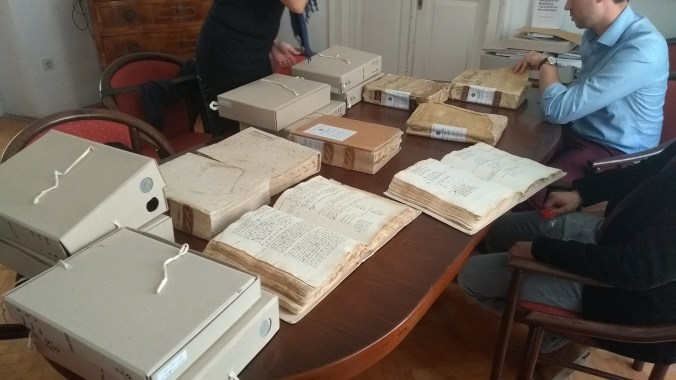
Some of the Reformationes and Acta Consiliorum from Dubrovnik.

I was in Dubrovnik from 20 to 22 September to attend the ‘Mapping Urban Changes’ conference in the context of a proof-of-concept project which I am co-leading with Dr Adelyn Wilson from the School of Law called ‘Spaces of Power in Interregnum Aberdeen’. This sister project of LACR is funded by RIISS under a research development grant. It seeks to visualise the use of the physical space within the burghs of Old and New Aberdeen for the exercise of political, religious, mercantile and administrative power. In addition to presenting this project, I was at the conference to learn about relevant other projects and useful techniques and methodologies. In this respect the conference was very fruitful.

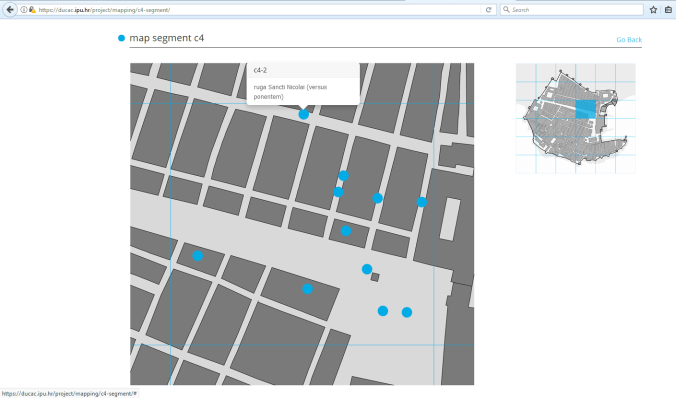
Visiting Dubrovnik also provided the opportunity to learn more about the Du:cac project, which has just been completed. This project, led by Dr Ana Plosnić Ŝkarić of Zagreb University, aimed to transcribe all relevant entries or deliberations from the period 1400-1450 concerning the spaces and buildings within the walls of Dubrovnik and link these to a searchable map. The Du:cac website includes a custom-made map with clickable points, indicating actual buildings, spaces near them (in those cases where a house is said to be near a church, for example), streets and neighbourhoods. These link to relevant transcriptions. The transcriptions will also be published as an e-book.

Dubrovnik map screenshot

A screenshot from the Du:cac website, showing a map segment with clickable points.

The government of Dubrovnik was made up somewhat differently to that of Aberdeen. The city had three councils: the Major Council, the Minor and the Senate. Up until 1415 the deliberations of all three councils were kept in the same book, called Reformationes (these were begun in the late thirteenth century). From 1415, they were divided up into three registers. From the years between 1400 and 1450 there survive three volumes of Reformationes, nine volumes of Acta Consilii Maioris, twelve volumes of Acta Minoris Consilii and eleven volumes of Acta Consilii Rogatorum, comprising a total of 15,944 pages (the Aberdeen Council Registers from 1398-1511 comprise 5239 pages). The volumes are almost completely in Latin, with occasional words in Croat and some entries in Italian, which was used as a lingua franca in the Adriatic region, as Ana Plosnić explained to me. Latin was used in these registers until the end of the Dubrovnik republic in the late eighteenth century.

IMG_20170921_124114721

The Sponza Palace

Just before I had to catch a plane back to Aberdeen via Paris and had to leave the beautiful city (and weather) behind, there was an opportunity to visit the archives which are in the Sponza Palace, one of the few buildings which survived the 1667 earthquake in Dubrovnik unscathed. There, Ana Plosnić kindly showed me some of the fourteenth- and fifteenth-century registers. The page layout of these look very similar to those of the Aberdeen books: with marginal headings and clearly recognizable entries. The Acta Consiliorum also include deliberations on elections, which provide interesting comparative material for the entries recently uncovered in Newburgh’s registers by LACR’s William Hepburn (see the post on his visiting scholarship at St Andrews University Library Special Collections). In Dubrovnik votes could be cast not only in favour of candidates, but also against them, and relatives were excluded from voting for a specific person (indicated as ex. or extra).

IMG_20170922_121503583

All in all, this encounter with the Dubrovnik material once again stresses the importance of considering the Aberdeen registers in a European context.

Manslaughter in 1480s Aberdeen: notes from another fifteenth-century register

by Edda Frankot

The Aberdeen Council Registers are not the only extant registers from fifteenth-century Aberdeen. Another large volume known as the Sasine Register no. 1 has survived since the late fifteenth century, covering the period from June 1484 to January 1502 and totalling just over a 1000 pages.

Its title, Sasine Register, referring to legal procedures whereby a person received formal possession of lands or property, had many years ago put me off using (or even looking at) the book for my PhD on the practice of maritime law. A recent introduction to the manuscript in the context of another project highlighted what a mistake this was: the register is much more a miscellaneous legal register. The title is a later addition. The fact that few other scholars have used the manuscript (and its companions from the early sixteenth century) suggests that I am not the only one who was put off by its title. Though perhaps the manuscript’s unappealing handwriting and the fact that it is almost wholly in Latin do not help either.

Be that as it may, it turned out that the book contains many entries concerning property, but also rather a lot of other very interesting material. A more thorough analysis is still required, but it may be that in June 1484 the town clerks decided to record some of the town’s court business in a separate register. For example, the ‘sasine register’ includes certain matters which were dealt with by only one or two officials and these no longer appear in the council registers. What is most noticeable when leafing through the ‘sasine register’ is its language. Whereas increasingly more Scots was used in the council registers in the second half of the fifteenth century, very few entries in Scots can be found in this book. It is possible that we will see a sharp drop in the use of Latin in the council registers around June 1484 because some of the business recorded in Latin was transferred to this other register. So far we have completed transcription of volumes 5 and 7 (and there appears to be a marked difference in the use of Latin between the two, as concluded by the LACR project’s own Anna Havinga) but have not yet reached 1484 in volume 6. It may also be that there was an increase in business in both Latin and Scots in the mid 1480s. Though we have yet to research this in detail, it is likely that Latin was used more for cases in which formulaic language could be used, that is to say anything that followed a standard format that had been used for years. Examples of this are sasines, the recovery of burghal tenements, inheritance cases (inquisitions post mortem), admissions of burgesses, nominations of procurators etc. This is not to say that all such cases would have been moved to the ‘sasine register’, as some needed to be conducted at specific courts. The recovery of burghal tenements, for example, had to be conducted at four head courts and would be recorded in the council registers. But certain business that could be administered quickly by a smaller number of officials may well have ended up in the other book.

In addition to such cases, there are copies of shipping contracts between skippers and merchants and many other notarial acts, but also fragments of poems and a recipe for a medicine for ‘stanes’ (gall or kidney stones). There are also, quite unexpectedly, entries from the sheriff court. These sheriff court entries will be among the oldest extant in Scotland. Of course, Aberdeenshire can already boast the oldest extant sheriff court book in Scotland (1503-1511)1, but even William Croft Dickinson, possibly the most knowledgeable on Aberdeen and its courts and the editor of the Fife Sheriff Court Book appears to have been unaware of the existence of fifteenth-century sheriff court cases from Aberdeen.

SR p. 37

The interrogation of Andrew Murray senior

The oldest sheriff court entry in the ‘sasine register’ concerns the interrogation of Andrew Murray senior by John Cheyne before Alexander Irvyne, sheriff depute of Aberdeen, as part of the examination into the spoiling of grass or turf in the parish of Ellon.2 Later entries indicate that more serious crimes were also investigated and tried before the Aberdeen sheriff court, as was to be expected. On the 10th of January 1486 Alexander Irvyne was in court to prosecute the killer of Andrew Kelor, but no one compeared (appeared).3 Proceedings on 9 June 1487 were more successful when the killer was known, though the entry confuses killer and killed as both were called Robert. In this case Robert Blindsele was sitting as deputy sheriff.4 Robert Black appeared in court with a letter of remission (forgiveness of wrongdoing) from the king concerning his killing of Robert Frostar and declared himself prepared to pay Frostar’s parents or nearest heirs compensation for his death, which no one objected to.5

SR p. 79

The case of the two Roberts

Though it appears that some of the sheriff court proceedings were held in the tolbooth, like the vast majority of the burgh courts, others appear to have taken place outside, at the mercat cross (‘Ad forum crucis’ in the second line of the image above). It is unclear whether this was a regular occurrence, but at least two of the courts recorded in the sasine register were held there. It should be noted, though, that both were in June. According to Croft Dickinson the sheriff courts in the head burghs of the shire were normally held in the tolbooth. But before the sixteenth century not all courts were held in the head burghs. Elsewhere in the shire people would gather at well-known landmarks, such as churches, or standing stones.6 Croft Dickinson did note a few examples of burgh courts being held at mercat crosses, but these were quite exceptional.7

All in all, the oldest ‘sasine register’ has proven to be another important treasure held by the Aberdeen archives and in recognition of this the manuscript was recently digitally photographed by the National Records of Scotland. But for now, its investigation lies in the hands of those willing to read through its pages one by one…


  1. ‘Illustrative examples’ of this were published in Records of the Sheriff Court of Aberdeenshire, Volume I. Records prior to 1600, ed. David Littlejohn (Aberdeen 1908). 
  2. ACAA, SR, 1, p. 37, 12 Apr 1485. 
  3. ACAA, SR, 1, p. 46. 
  4. On 30 June yet another deputy presided: John Collison. Both Collison and Blindsele would have been Aberdeen burgesses, whereas Irvyne was also laird of Drum. ACAA, SA, 1, p. 81. 
  5. ACAA, SR, 1, p. 79. 
  6. Fife Sheriff Court Book, ed. William Croft Dickinson (Edinburgh 1928), xviii-xix. 
  7. He notes an example from Haddington in 1391 and from Banff in 1549 and 1551. Early Records of Aberdeen, 1317, 1398-1407, ed. William Croft Dickinson (Edinburgh 1957), cxxiv, n. 7. 

Heroes, hangmen, minstrels and more: the admission of burgesses in medieval Aberdeen

by Edda Frankot

In the fifteenth century, new burgesses and guild brothers were admitted to the town every year. Lists of these admissions are regularly included in the Aberdeen Council Registers. A particularly good source is the Guild Court Book (ACR, volume 5-2), but lists are also included in the other volumes. The majority of the entries on these lists are for men that were admitted as both burgesses and guild brothers, but others only became burgesses. Most of the men were sons of burgesses. Another group that gained automatic entry, on payment of a fee, were those who married the daughter of a burgess. The entries of these two groups are normally very formulaic and provide little additional information beyond names and a payment.

admission heading 1452

The heading of the list of new burgesses and guild brothers from the time of provost John of Fife (1452-53)

But the entries concerning non-standard admissions can provide a lot of interesting detail on a great variety of subjects. A significant number of people were admitted ‘at instanciam’, at the insistence, of specific individuals or groups of people. Often these are local nobles, higher clergy or royal officials. In 1446-47, for example, John Matheson was admitted at the insistence of John of Mar and the Lords Gordon and Forbes. In the same year John Bullock was made a burgess and guild brother at the request of the bishop of Ross and various burgesses. In 1452 the council decided to only allow admissions of burgesses’ sons and sons-in-law for the coming year. This was either to limit the number of burgesses and guild members, or to restrict the influence of outsiders on the town. But in the admission list that follows we nonetheless find three men that were admitted at the insistence of outsiders: one after a request by the comptroller of the king’s rolls, one by Lord Crichton, the chancellor, and one by the countess of Huntly. So it appears that it was hard for the magistrates to resist such requests.1

5-2 p717 Matheson

The admission of John Matheson

Especially fascinating are the entries that give a specific reason for the admission, or a condition. Occasionally, men were admitted as a reward for services rendered to the town, or at the request of an existing burgess who had done a good deed. In the list of 1444-45 Thomas Rutherfurd was admitted because of his role in ending the discord between Thomas and John Voket. According to the 1456-57 list Alexander Logy was admitted at the request of Patrick Piot because the latter had prevented infirm or infected outsiders from entering the town at the Green. Thomas Johnson was made a burgess and guild brother in 1498-99 because of his labours around the capturing of the killer or killers of Agnes Burges in the night. The threat of an English invasion caused the council to admit Andrew Chapman living in Loirston, in 1454-55, on the condition that he would keep a fire lit all night at the Loirston cairn and during the day would keep a watch for English enemies with two others. Men with useful professions were occasionally admitted for free: in 1451-52 a barber, a Frenchman, in 1454-55 a ‘medicus’, in 1456-57 a ‘mimus’, an actor or mime, and in 1487-88 a ‘carnifex’ were entered. The latter may have been a butcher, but because his admission specifically says ‘racione sue artis’: because of his skill or craft, perhaps we can assume he was an executioner. Apart from the doctor, these men were only admitted as burgesses, not as guild brothers.2

7 p913 Johnson

The admission of Thomas Johnson

The fees that were paid by most of the men to be admitted could also be used for specific purposes indicated in the records. The fee paid by William Maitland, a carpenter admitted as a burgess in 1455-56 was given to Patrick Wrych ‘pro elimosina’: as alms. The year before, part of the fee paid by Alexander Chalmers would go towards the repair of the ‘key’, which is not specified further. Obviously it was clear to everyone at the time which key was meant. In 1455 the council decided that Donald of Fife, who was at that time a captive in England, could put forward a suggestion for a new burgess and guild brother ‘for his relief and ransoming’. Presumably the fee paid by this person would be used towards the payment of the ransom.3

5-2 p785 Chalmers

The admission of Alexander Chalmers

Overall, the lists of admission provide a wealth of details for anyone with the patience to seek out the gems that are hidden within them.


  1. ACR, 5-2, p. 717, p. 716; p. 769; p. 773. 
  2. ACR, 5-2, p. 695; p. 798; ACR, 7, p. 913; ACR, 5-2, 785; ACR, 5-2, pp. 658, 695, 798; ACR, 7, 40. 
  3. ACR, 5-2, p. 784; p. 785; p. 782. 

Distinguished visitor and research seminars

This week (3-7 April 2017), the Research Institute of Irish and Scottish Studies (RIISS) was pleased to host Professor Jan Dumolyn (University of Ghent) as a visitor. Professor Dumolyn’s research is concerned with medieval Flanders, and he is the leading historian of medieval Bruges. His time in Aberdeen included meetings with various colleagues on campus, and visits to the University Library’s Special Collections Centre, the Aberdeen City & Aberdeenshire Archives, and the Maritime Museum.

Two seminars were held during the week. On 4 April Dr Claire Hawes of the LACR project presented a paper on ‘Politics and the Public Domain in Fifteenth-Century Scotland’, which led to a discussion of approaches to the study of political culture. Dr Hawes offered a fascinating new perspective on the political history of late medieval and early modern Scotland, suggesting a way forward that moves beyond the well-worn framework of crown-magnate relations. On 6 April Professor Jan Dumolyn spoke on ‘Commercial Connections between Flanders, Scotland and the Hanseatic world: An Interdisciplinary Approach’. Both these seminars prompted comment on a number of points of comparison between Scotland and other European territories in the later middle ages. The latter paper offered a view on the potential for collaboration between historians and archaeologists in the study of trade in bulk commodities, and in particular on how ballast stones can be a means to investigate commercial networks across the North Sea and Baltic Sea. The scope for tracing Scottish migrants in the rich records of Bruges was also touched upon, for example noting the Scottish shore porters of late medieval Bruges, and recalling the fact that the dialect word in that city for fish imported from Scotland was ‘aberdaan’.

Project Symposium I: Cultures of Law in Urban Northern Europe

By Jackson Armstrong

On Friday 24th and Saturday 25th February 2017 our project hosted its first symposium, on the subject of ‘Cultures of Law in Urban Northern Europe’. This was funded by the Research Institute of Irish and Scottish Studies (RIISS) and was held in the Craig Suite at the Sir Duncan C. Rice Library, University of Aberdeen.

symposium-2017-021

After a welcome from Michael P. Brown on behalf of RIISS, and an introduction offered by Jackson Armstrong, the sessions, chaired by Anna Havinga, Adam Wyner, Andrew Mackillop and William Hepburn included the following presentations:

Graeme Small (Durham) and William Hepburn (Aberdeen) – Typology of the written record: materiality and process in the Aberdeen Council Registers

Christian Liddy (Durham) – The publication of law

David Ditchburn (TCD) – Time: Extracts from the Aberdeen Council Registers

Edda Frankot (Aberdeen) – Legal business outside the courts: private and public houses as spaces of law

John Ford (Aberdeen) – The Voyage of the James of Veere: Maritime Law in Aberdeen in the Early Sixteenth Century

Claire Hawes (Aberdeen) – Debt, Morality and the Law in fifteenth-century Aberdeen

Justyna Wubs-Mrozewicz (Amsterdam) – Conflicts about property and inheritances in sixteenth century Danzig

Jelle Haemers (& Chanelle Delameillieure) (Leuven) – Jurisdiction and Marriage in the Fifteenth-Century ‘Registers of the Aldermen’ of Ghent and Leuven

Michael H. Brown (St Andrews) – Burghs and Regalities: Conflicts of Jurisdiction

Jörg Rogge (Mainz) – Pax Urbana – the use of law for the achievement of political goals

Andrew Simpson (Aberdeen) – Texts of the Medieval Scottish Common Law in the Aberdeen Council Registers

Jackson Armstrong (Aberdeen) – ‘Malice’ and motivation for hostility and non-lethal wounding

Joanna Kopaczyk (Edinburgh) – Language as code: language choices and functions in a multilingual legal culture

Anna Havinga (Aberdeen) – Language shift in the Aberdeen Council Registers

Adelyn Wilson (Aberdeen) – Legal education in Aberdeen in the sixteenth and seventeenth centuries

Proceedings on Friday 24th also included a visit to Old Aberdeen House (Aberdeen City and Aberdeenshire Archives) with Phil Astley, and to St Machar Cathedral.

The objective of this first gathering was to present ‘gobbet’ style extracts from primary sources, and to raise questions for development illustrated by those extracts. We look forward to reconvening in 2018 to share draft papers developed from these initial questions and discussions, in collaboration for an edited collection of essays on the subject.

Violence against women in medieval Aberdeen

by Edda Frankot

ACR, 5, p. 296, 25 February 1457

vol-5-296

Item Thomas Raa in amerciamento pro iniusta perturbacione vxoris Johannis Dis’ et emendabit parti lese.

Item dicta vxor in amerciamento pro iniusta perturbacione ipsius Johannis [sic; recte: Thome?] et cetera.

Item Thomas Raa in amerciament1 for unjust disturbance of the wife of John Dis’ and will pay amends to the injured party.

Item the said wife in amerciament for unjust disturbance of the same John et cetera.

ACR, 5, p. 304, 15 Jul 1457

vol-5-304

Eodem die Johannes Glenny adiudicatur in amerciamento pro iniusta perturbacione vxoris Johannis Spront et emendabit parti lese ad visum proborum.

Item Johannes Spront adiudicabatur in amerciamento pro iniusta perturbacione dicti Johannis Glenny et emendabit et cetera.

The same day John Glenny is judged in amerciament for unjust disturbance of the wife of John Spront and will pay amends to the injured party in accordance with the vision of honest [men].

Item John Spront is judged in amerciament for unjust disturbance of the said John Glenny and will pay amends et cetera.

The Council Registers include many reference to perturbatio/perturbio and, in its Scots form, strub(u)lance. This appears to have been used for a broad range of disturbances which only occasionally are narrowed down further to ‘perturbatio burgi’ (disturbance of the burgh), or ‘strublance by word’, but which stops short of including violence which resulted in the drawing of blood. Regularly, two people are convicted, one after the other, for perturbatio against the other. Generally the entries are very short, like the examples above, and include no further details on the context of the disturbance: the time, the place and the reason for the dispute. Nor do we get any sense of the seriousness of the conflict. A nice exception to this is the case of ‘strubulance and skathtinge [harming]’ from 1491 which consisted of ‘castyne of wattir and filtht in his house’.2

Usually the convicted and the victims are men, but not always. In the first example above the wife of John Dis’ is both victim and disturber. I think we can assume that the second entry is supposed to say that she was convicted of perturbatio against Thomas, not against her own husband. There is no indication from the sources which of the two may have initiated the dispute. In the second example, the wife of John Spront is the victim of John Glenny, but John Glenny himself was also convicted for perturbatio against Spront, suggesting he defended his wife against unwanted attention. A point to note is the fact that neither of the women is named. Though some women do appear under their own name in the Aberdeen records, they very regularly just appear as the wife of their husbands. In this case it is unclear whether John Dis or his wife was considered responsible for paying the amends to Thomas Raa, as the entry does not extend that far.

It is likely that many of the cases of perturbatio and strublance took place within the context of public houses, which would mainly have been frequented by men, though as said there is very little specific evidence with regards to this in the Aberdeen sources. My main point of reference are the sources from the Dutch town of Kampen from around the same period, which include a lot more detail in cases of violence. In Kampen, too, the groups of perpetrator and victims were mainly made up of men, and the majority of the violence took place in public houses. A drinking jug was a popular choice for a weapon. Unfortunately, similar details are usually lacking in Aberdeen, but these four short entries perhaps leave more to the imagination…


  1. Amerciament: The condition of being subject to a pecuniary penalty at the discretion of the court or judge. http://www.dsl.ac.uk/entry/dost/amerciament 
  2. ACR, 7, p. 273 (14 Oct 1491). 

A Genoese merchant in medieval Aberdeen – a case from the lost ‘volume three’

by Edda Frankot

The Aberdeen Council Registers form an almost complete set of records: the only extensive period which is not covered by the registers runs from the middle of the year 1414 to the end of 1433. Even although there is only one volume missing in the sequence of volumes that is currently extant, namely volume three, former Aberdeen City Archivist, Judith Cripps, in a 1981 report on the matter argued that there may well have been three books that covered the period from 1414-33.1 By the early nineteenth century only the middle part, dating to 1426-29, had survived. At that time, William Kennedy, author of the Annals of Aberdeen, reported that he had seen this part some years before, but that it had ‘lately been mislaid’.2 A recent discovery by LACR’s own project director, Jackson Armstrong, suggests that fifty years earlier this part had also been the only remaining evidence from the period 1426-29. This discovery was the presence of a manuscript with extracts of the burgh records, including ones from 1426-29, in the Aberdeen University Library. For more on this discovery, see this week’s press release.

The extracts were made by James Man, who intended to write a history of Aberdeen. Most of his notes are short summaries of the contents of the burgh records, with occasional short quotes from the original in Latin. Seeing that volume two of the registers is almost entirely in Latin, whereas only 5-10% of volume four is in Scots, the vast majority of volume three would be expected to have been in Latin too. But it appears that Man also came across at least one entry in Scots. This is the only entry from 1426-29 that he transcribed in full, and its language is clearly different from that of the rest of Man’s notes: it is in Middle Scots and reads much like other entries in Scots from the fifteenth century elsewhere in the registers.

This specific entry is also interesting in that it features one of the only known instances of a southern European merchant active in Aberdeen. Pelegrino Grellus was a merchant from Genoa who, with his brother Lazarino, appears regularly in the royal Exchequer Rolls in the late 1420s and early 1430s, at about the same time as the two brothers appear in the Aberdeen records.3 The entry, dated 1426, concerns a dispute between ‘Pylgrime mirchand of Gene (=Genoa)’ and Jelm (or John?) van Wrey, whose place of origin remains to be identified, and his shipmen. Man may have had some trouble reading the place names in the original, as the first few letters of the word in his copy are difficult to identify. It looks something like ‘Mineth’ and is likely to be a place in the Low Countries. The alderman (provost), bailies and community of Aberdeen determined that Van Wrey, who was shipmaster of a ‘bus’, and his shipmen should calculate their fees (‘and se qwhat is acht thaim of thair fees’), which Pelegrino should then pay to the sailors. In addition, it was determined that the shipmaster should sail to Lazarino in Edinburgh. It appears that another decision had to be made there as to who should pay the shipmen’s fees for that part of the journey: the shipmaster or Lazarino, but it is not entirely clear from the notes whose decision this was to make.4

It may be that Pelegrino was in Aberdeen in relation with the transactions detailed in the Exchequer Roll, that is to say collecting salmon as part of his payment by the king for supplying the court, though there is no mention of a payment to the brothers in the Exchequer Roll for 1426-7.5 A year later, Pelegrino did receive thirty lasts and two barrels of salmon, in addition to another eleven lasts and eleven small barrels. For 1428-9 the two brothers are named together.6. It may also be that Pelegrino and Lazarino were already active in Scottish trade before they started supplying the king.

It is rare to come across southern European merchants active in Scottish trade. Taken as a whole, there were few foreign merchants who resided in Scotland in the later middle ages. There were no communities of merchants residing in any of the Scottish burghs in this period as there were in other towns throughout Europe (such as, for example, the Scots in Bruges and later in Veere), not even in Edinburgh.7 In addition, the majority of merchants who did come to Scotland were either English, Dutch, Flemish or Hanseatic (especially from Stralsund and Danzig). The most notable Aberdeen resident with a presumed southern European connection was William of Spaigne/Spanye, who appears in volumes four and five and may well have appeared in volume three, as his first appearance is on page six of volume four. William of Spaigne was a councillor in the late 1430s and early 1440s and appears finally in 1450. In that same year a Jonet Spaigne is listed in an account. She was perhaps a relation, either a daughter or a sister. Judging by the fact that William was a councillor, he must have been fairly well established in Aberdeen by the late 1430s. Despite his suggestive surname, we do not know whether he came from Spain himself, or descended from a Spaniard. We do know that he owned some property on the Gallowgate in the late 1440s.8

There is also no evidence as to where the Genoese Pelegrino resided, but his brother owned a house in Kirkcudbright in the mid-fifteenth century and served as custumar of that town in 1455 and 1460, so many years after the entry from 1426.9 In 1426 Lazarino appears to have been in Edinburgh, though it is not clear whether he was a permanent resident. Unfortunately, any other potential appearances in volume three are lost forever, like most other Scottish burgh records from that period. But thanks to the efforts of James Man in the 1700s we have at least gained a glimpse into Aberdeen in the 1420s and its links with the outside world.


  1. Report to City of Aberdeen District Council on Missing Register of Council 1414-1434, Judith A. Cripps, City of Aberdeen Archivist, 29 June 1981. 
  2. Letter from the Scottish Record Office (John Imrie) to John Wilson, Town Clerk of Aberdeen, 2 February 1981. 
  3. ER IV, 443, 444, 445, 472, 507, 531, 542, 621. 
  4. AUL, MS 532, p. 13. 
  5. With regards to supplying the court, see ER IV, cxlv 
  6. ER IV, 443; 472, 507. 
  7. David Ditchburn, Scotland and Europe: the Medieval Kingdom and its Contacts with Christendom, c. 1215-1545, volume 1: Religion, Culture and Commerce (East Linton 2000), 204; Edda Frankot, ‘Aberdeen and the east coast of Scotland. Autonomy on the periphery’, in: Wim Blockmans, Mikhail Krom and Justyna Wubs-Mrozewicz, eds, Routledge Handbook of Maritime Trade around Europe, 1300-1600. Commercial Networks and Urban Autonomy (Woodbridge: Routledge, forthcoming 2017), 409-25, at 415. 
  8. ACR 4, pp. 6, 103, 139; ACR 5(1), pp. 25, 26, 116; ACR 5(2), pp. 647, 659, 662, 663, 667, 674, 682, 691, 692. 
  9. Ditchburn, Scotland and Europe, 204.