Accounts kept by Provost Andrew Alanson show details of how the burgh’s funds were managed, including expenditures on cultural activities, roadworks and hospitality.

Dr Jackson Armstrong consulted the original papers in the Beinecke Rare Book and Manuscript Library, Yale, after chasing a reference to the accounts made by Roderick Lyall in a publication from 1989. Lyall had first identified the papers in the early 1980s. With assistance of archivist Diane Ducharme of the Beinecke, Jackson located the accounts within the Gordon of Gordonstoun Papers, part of the Osborn Collection, gifted to the Library in the 1960s.

The new publication includes a document transcription of the text (almost entirely in Middle Scots), and explores the creation and preservation of the accounts, as well as what they reveal about the process of accounting and auditing in medieval Scotland. The fact that they survive at all seems to be linked to a dispute which arose over who, among the town’s elite, was selected to audit the accounts.
We are fortunate to know a great deal about Andrew Alanson – a provost and man of law – given he has been the subject of another recent study by Prof. Andrew Simpson.
The income received by the provost came primarily from rents of lands (including the ‘freedom lands’), local mills, and salmon fishings on the Dee and Don.
Expenditures ranged widely, but included the provost’s costs to attend parliament; payment to the men that made the scaffolding for the Candlemas play (on 2 February) (16 pence); payment to an unnamed author for the writing of a play (1 merk), which could have been the Candlemas play or perhaps the Corpus Christi play held in June (& for the characters in the annual Candlemas play see ARO-5-0661-04); costs of the town minstrels’ gowns (40 shillings); the upkeep of roads and causeways and bridges (including the Bow Brig over the Denburn); and the maintenance of the tolbooth (including repairs to the town clock, or ‘knok’ in Scots), of the quayside, and of St Nicholas Kirk.
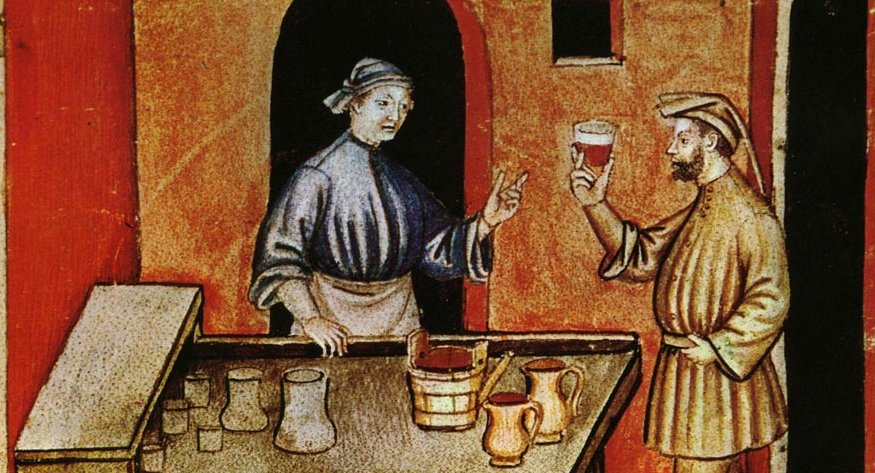
One of most significant expenses was for hospitality. This included the costs of wine purchased for a meeting of the burgh council in a local tavern on one occasion, but more often gifts of wine to visiting noblemen.
The magnates who were ‘wined and dined’ by the provost included the earl of Huntly (George Gordon, the second earl), the bishop of Aberdeen (Thomas Spens), Lord Erskine (Thomas, second Lord Erskine), Lord Forbes (William, third Lord Forbes), the ‘Lord of Erroll’ (William Hay, third earl of Erroll), and the ‘Lord of Crawford’ (David Lindsay, fifth earl of Crawford). Red wine and sweet Malmsey wine were the favoured refreshments.
The accounts are published in the December 2023 issue of The Scottish Historical Review.
 aberdeen registers
